Her Story
About Randi
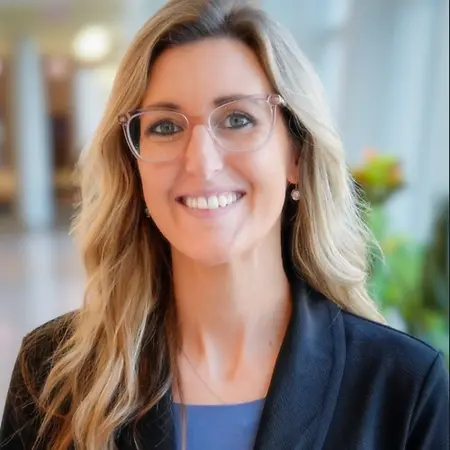
Randi Beecher, B.S., RT(R), is a Diagnostic Imaging Supervisor with over 15 years of experience in healthcare and a strong commitment to advancing patient-centered imaging services. She currently serves in a leadership role at UPMC in Central Pennsylvania, where she oversees both hospital-based imaging operations and a large outpatient imaging network spanning 13 sites. Her work focuses on ensuring high-quality diagnostic services, optimizing workflow processes, and maintaining excellence across inpatient and outpatient care environments.
Her career began after graduating from a radiology technology program, when she moved to California to start her clinical journey before returning to Pennsylvania to continue her work close to her training roots. Early in her career, she quickly recognized her natural leadership abilities and was fortunate to be mentored by strong leaders within her organization. In her 20s, she pursued leadership development opportunities and became a Lead Technologist, a position she held for seven years, building a strong foundation in both clinical expertise and team development.
Randi was later promoted to Imaging Supervisor, a role she has held for over two years, where she now leads with a hands-on, people-focused approach. A typical day involves overseeing operations, guiding workflow across multiple teams, rounding with staff, and ensuring both employee and patient needs are met at every level. She is deeply committed to cultivating a positive healthcare culture, mentoring team members, and fostering professional growth. Known for her optimism and problem-solving mindset, she embraces challenges and conflict as opportunities to find solutions that benefit both staff and patients. She earned her Bachelor of Health Science degree from Grand Canyon University and continues to be driven by a passion for leadership, collaboration, and continuous improvement in healthcare delivery.
Her Interview
Ten minutes with Randi
01What do you attribute your success to?
I have had amazing mentors. I've had mentors that I've worked alongside for years who have recognized my leadership skills and my talents, and they even recognized them whenever I didn't recognize them myself. They made sure to get me where I needed to go to grow those skills. I look back, and it's still to this day, if I didn't have those mentors, I wouldn't even be the mentor and the leader I am, because if you're not growing people and helping people be better versions of themselves, that's not a leader to me. A leader is recognizing how to grow your team and how to grow others around you.
02What’s the best career advice you’ve ever received?
The advice that I received is to make sure to never lose sight of why, of why and your purpose. You know, it's easy to get lost in the day-to-day, the routine, mundane tasks that you do, but I really have learned, and that's so incredibly important to me. I feel like I'm constantly reminding my team of their purpose, because when they lose sight, I want to bring them back to that, because we all have a purpose and we're doing service for others. That would probably be the most influential leadership advice that I've received.
03What advice would you give to young women entering your industry?
My advice to women is that women are incredibly gifted at multitasking and remembering and organization. My message to women in healthcare is when we bring everything that defines us and our qualities and characters as a woman together, we not only help the sick and serve patients, but we can come together and really impact the future generation of our healthcare industry by bringing compassion into our work. I think that that's so important, and I love that about women in healthcare, because they always have such great balance of the emotional side, the compassionate side, but then they also bring that professional business side. That is what my message is to women.
04What are the biggest challenges or opportunities in your field right now?
We're seeing a huge challenge after COVID, after the pandemic. We have seen a significant decrease in healthcare workers. You hear it on the news, it is very true. Everybody wants to make decent salaries, so when it comes to healthcare, if people can make more money doing digital work or IT work, it seems as if a lot of people are going that route, and we're not seeing the increase in healthcare workers coming through our student programs. One thing that I feel is a challenge is retention, and how do we continue to bring in and retain these healthcare providers that are going to take care of our future generations. I feel that healthcare has had a bad rap, and it's a stressful environment, a toxic environment. This is where we need to do the work as leaders, because we need to change that culture. Because if we don't change that culture and make healthcare a place where people can have a purpose to help others, I do fear that that will be an issue down the road. We see the issues with low staffing and how that affects patients' lives. The challenge is there, and I'm very, very much interested in healthcare retention strategies and leadership and how to promote good culture and environment for our healthcare workers.
05What values are most important to you in your work and personal life?
I would say integrity, dignity, and respect. I feel that if you go into every situation with values, upholding honesty and transparency, you build trust with people, and you can lead people in very difficult situations. Those values are extremely important to me. I talk to my teams about it. They know who I am as a person, and know that those are the values that I'm very passionate about and uphold, just because I don't believe that you can truly make an impact if you aren't leading by example. Those values are how I lead by example.
Join Influential Women and start making an impact. Register now.