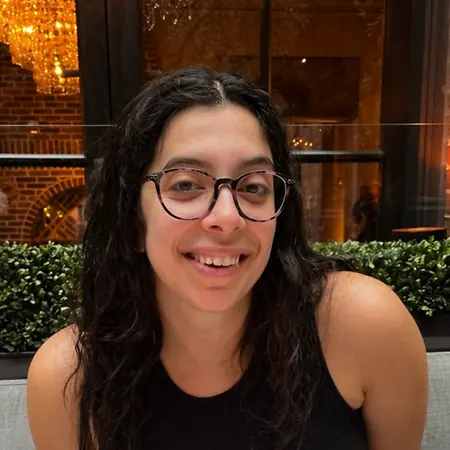
I overlooked my interpersonal skills, assuming they didn't set me apart, but building authentic relationships is the key to success.
Raquel Cohen · In Her Own Words
Her Story
About Raquel
Raquel Cohen is a holistic health and wellness professional with three years of experience since graduating from Washington University in St. Louis in 2023, where she earned a Bachelor of Arts in Sociology. She sees her work as rooted in an integrative approach to mental, emotional, physical, sexual, and spiritual well-being. Raquel is committed to expanding access to inclusive and affirming health education. Her early foundation in the field was shaped by four years of volunteer work on a relationship and sexual violence helpline during college, an experience that deeply informed her dedication to advocacy and community care.
Following her graduation, Raquel began her professional career at DC SAFE as a case manager for survivors of domestic violence. She later worked in the behavioral health space, supporting families with children on the autism spectrum by coordinating tailored therapy plans and tracking developmental progress. These roles strengthened her skills in case management, interdisciplinary collaboration, and trauma-informed care across diverse populations. Raquel recently completed a Sexual Wellness Education and Enlightenment Training Certificate through the Institute for Sex Education and Enlightenment, further deepening her expertise in sexual health education. She currently works part-time as a host for singles mixers with Shaka Club, where she focuses on cultivating safe environments that encourage vulnerability and authentic connection. Raquel also volunteers biweekly with Community of Hope, processing and sorting donations for babies as well as parents. A published writer in gender studies, Raquel has explored topics including Black queer activism through music and media. She recently completed a memoir that reflects her ongoing journey of self-discovery and her broader commitment to understanding the importance of individualized definitions of well-being.
Her Interview
Ten minutes with Raquel
01What do you attribute your success to?
I attribute my success to staying curious. I think my struggle with the limitations of case management could have really knocked me down, disappointed me, led me to question myself, who I was and my skills. But instead, I embraced the fact that maybe there was something else that could pull me and a new area wherein I could excel. My success was also only possible due to the support systems I have - my fiancé, my family, and my friends who only encourage me to follow my passions. I'm really grateful to them and myself for seeing in me huge potential that I didn't always know was there.
02What’s the best career advice you’ve ever received?
One of the best pieces of advice I've received is to be open, to not only discovering what's out there but discovering what's within myself. When I was transitioning out of case management, I felt lost for a while. I had really trusted close family and peers who told me to open up, use this moment as a learning opportunity. Once I opened up within myself to what I already knew and what I maybe hadn't totally processed, I found new ways to grow from opportunities I did not realize existed. I think that was honestly key for me because it can be easy to pigeonhole by seeing myself only as a case manager, but change happens all the time! I think sometimes it's scary, but when we embrace new ideas, it can lead to really, really wonderful things.
03What advice would you give to young women entering your industry?
I would say, first of all, thank you, and second of all, we need you. I see this dearth of roles in the field, and it honestly drives me. On the one hand, it can be surprising and maybe a bit of a letdown; on the other hand, it drives me to the truth that we need more comprehensive sex education. We need more skills-based dialogue, training, and presentations. We need more formats for people to talk to others, transform, and confront biases. I would tell people trying to enter this field, women especially, full steam ahead. If this is your calling, you're meant to do this - the world is meant to hear what you have to say.
04What are the biggest challenges or opportunities in your field right now?
One of the challenges is funding and that can relate to politics. I think there is a fear of what sex education covers. Right now, there's been renewed interest in abstinence-only sex education because of a disputed claim that if we tell kids different things that they may not know about their bodies, that puts them in danger. The reality is, with technology and the internet, kids have access to phones at wildly younger ages which exposes them to potentially that same information without an appropriate context in which to ingest or question it. How the internet presents sex and what children might learn will be categorically different than if it's from a skilled teacher. Kids will inevitable see videos or pictures and hear myths or truths from friends about intimacy, that will never change. But, how children can interact and process that knowledge is critical to a well-rounded understanding of relationships to themselves as well as others. Research also negates the fear that exposing people to certain material leads them to do it more. Actually, when it's done comprehensively, holistic education can provide the exact types of care that allow people to make the right choices and potentially avoid harm, rather than perpetuate it.
05What values are most important to you in your work and personal life?
Community is a big one, especially with people who have different day-to-day lives and histories to me. Curiosity as well, to hear other perspectives and to benefit from knowing more about the world. People are so different, brilliant, and complex! That leads me to diversity, which is huge for me. I would also say compassion. I think it can sometimes be, unfortunately, a not so compassionate world. The more grace we give ourselves and others can only build better bonds between groups of people who can then come together, which brings me back full-circle to the value of community.
Join Influential Women and start making an impact. Register now.