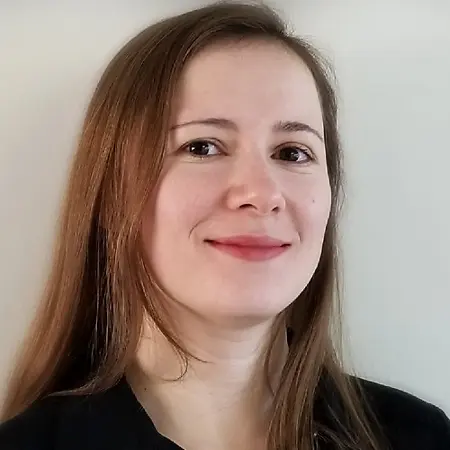
Her Story
About Raquel
Raquel Dias is an accomplished Assistant Professor in the Microbiology and Cell Science Department at the University of Florida, where she has led her own laboratory since January 2022. Her research integrates artificial intelligence, machine learning, and computational biology to tackle complex problems in human health, genomics, and precision medicine. As part of the University of Florida’s AI initiative, a collaboration with NVIDIA that provided $70 million to develop a supercomputer and hire top faculty, she is pioneering new methods to analyze genomic and clinical data to uncover the underlying drivers of multifactorial diseases.
Raquel’s scientific journey began in Brazil, where she earned a bachelor’s degree in biological sciences and a master’s degree in computer science from the Pontifical Catholic University in southern Brazil, gaining early experience in high-performance computing and machine learning. She pursued a PhD in Microbiology and Cell Science at the University of Florida, developing machine learning tools to study protein-ligand interactions and exploring the human gut microbiome’s role in Type 1 Diabetes. Following her doctorate, she held a postdoctoral position at Northern Arizona University focusing on genetic variants and cancer in Native American communities and later worked as a senior staff scientist at Scripps Research Institute, where she applied AI to clinical genomics and coronary artery disease risk prediction.
In addition to her research accomplishments, Raquel is a recognized mentor and award-winning scientist, having received Brazil’s Young Scientist Prize and an NIH K-type career development award. She balances her professional achievements with a rich personal life, enjoying time with her husband and young son, indulging her passion for 3-D printing, science fiction, and video games. Guided by principles of openness, collaboration, and rigorous scientific inquiry, she continues to advance AI-driven solutions in life sciences and clinical research, training the next generation of computational biologists and bioinformaticians.
Her Interview
Ten minutes with Raquel
01What do you attribute your success to?
I attribute my success to the amazing support I've received from my parents and my bigger brother, who always inspired me through our competition with video games and encouraged me toward programming and coding. My high school science teacher, Patricia Silva, was a role model who told me I had a lot of potential and that I would go very far in my career one day. That really stuck with me. Dr. Eric Triplett was another major mentor who believed in me as a girl from Brazil and opened the doors for me to do science here in the U.S. He accepted me into the PhD program and later advocated to bring me back to University of Florida. The collaborative spirit I experienced at my first international conference after winning the Young Scientist Prize was also transformative. Seeing how the scientific community helps each other rather than competing, how they brainstorm ideas together and lift each other up, really inspired me to persevere. My passion for technology, video games, and sci-fi culture since I was young, combined with my curiosity about the Human Genome Project and life sciences, gave me the drive to keep going no matter what obstacles I faced.
02What’s the best career advice you’ve ever received?
The best career advice I ever received came from my high school science teacher, Patricia Silva, who was a role model for me. She told me that I had a lot of potential and that I would go very far, very high in my career one day. Those words really stuck with me and became a turning point in my life. She believed in me when I was just starting out, and that belief gave me the confidence to pursue my dreams in science and technology. Her encouragement helped me push through obstacles and stay focused on my goals, even when I was the only woman in a room full of men or facing prejudice in male-dominated fields.
03What advice would you give to young women entering your industry?
I would say the same thing my high school mentor told me: don't doubt your capacity, don't let a few obstacles put you down. You can do it. You just need to fight for it long enough, and you'll find your path. Finding good mentors is so important. Having role models who believe in you can make all the difference. I know there will be obstacles in the way, and there could be some prejudice as well, especially for women in computer science. Sometimes I was the only woman in a class with 50 people, and I would hear jokes sometimes. Don't let those things put you down. You are much more than that. In fields dominated by men, it feels like men don't need to prove themselves, but women need to prove everything. That's something I felt for sure. But things are improving, and hopefully it'll get to a point where things are more even. The key is persistence and finding that collaborative spirit. Don't give up.
04What are the biggest challenges or opportunities in your field right now?
The biggest challenge in my field right now is that it's still very male-dominated, especially in computer science. When I was doing my master's in computer science, I was the only woman many times in a place dominated by men. Even at Scripps, I would sometimes be the only woman in a meeting with 20 people in business meetings where I had to present and be evaluated. I was questioned sometimes more than men would be. There's a pattern in fields dominated by men where it feels like men don't need to prove themselves, but women need to prove everything. If a man says something questionable, people will accept it, but if a woman says something reasonable that could be questioned, they will question it no matter what. That's something I definitely felt. However, I have noticed some good improvement over the past decade or so, and hopefully it'll get to a point where things are more even. The opportunities lie in the growing recognition of the need for diversity and the collaborative spirit that's emerging in scientific communities.
05What values are most important to you in your work and personal life?
In research, we have to be open, we have to be honest, we have to be transparent. We have to be collaborative and help each other. There's no such thing as competing with each other. More brains working together will go much farther and produce much more cutting-edge research. This collaborative spirit, this transparency, this honesty, this teamwork of moving things forward together instead of trying to push each other down, trying to lift each other up, is amazing in the department where I work. That's one of the things that made me want to come back to University of Florida after my PhD and my research path as a postdoc and senior staff scientist. I had this amazing experience here with those values. I take those same values into my personal life with my husband and my son. Being loyal, being transparent, being helpful, lifting each other up, always supporting each other. Family is very important to me. Those things, that openness, transparency, honesty, and collaboration, are very important for me in both my work and personal life.
Join Influential Women and start making an impact. Register now.