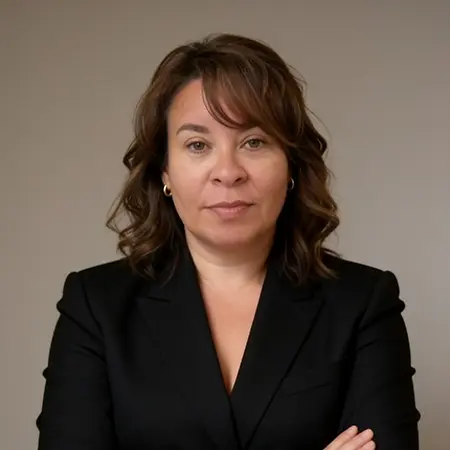
Her Story
About Raquel
Raquel Mercado, MBA, is the Director of Electric Operations at New Smyrna Beach Utilities, where she leads the substation and relay department, energy control center, and transmission and distribution operations. With more than three decades of experience in the energy industry, she oversees teams responsible for maintaining safe, reliable electric service while driving operational excellence, system modernization, and continuous improvement. Her leadership is defined by a strong commitment to safety, innovation, and developing high-performing teams.
Mercado began her career in 1991 as an instrumentation and relay technician through a union apprenticeship at the Ravenswood power plant in the Consolidated Edison system in Queens, New York. While advancing through increasingly senior technical and leadership roles, she earned an associate degree in Electrical Engineering Technology, a bachelor's degree in Electrical Engineering, and an Executive MBA from Quinnipiac University. Prior to joining New Smyrna Beach Utilities, she held executive leadership positions with AVANGRID, including Vice President of Environmental, Health & Safety, where she led large-scale transformation initiatives, expanded project management capabilities, and helped reduce company-wide recordable injuries by 43 percent.
Known for her strategic mindset and collaborative leadership style, Mercado has built a career on understanding utility operations from the ground up and empowering others to succeed. She credits her success to the mentors who invested in her development, her willingness to embrace new challenges, and her ability to solve complex operational problems through innovation and data-driven decision-making. Guided by integrity, respect, and trust, she remains passionate about advancing the utility industry through sustainable practices, operational excellence, and the development of the next generation of energy leaders.
Her Interview
Ten minutes with Raquel
01What do you attribute your success to?
I attribute my career success to starting in the union and learning the business from the ground up. That foundation gave me a well‑rounded perspective and a deep respect for the people doing the work — especially the field crews whose point of view often gets overlooked.
Over the years, I’ve built on that experience with strong mentors, continuous learning, and a natural aptitude for problem‑solving. I’m known for being innovative, open‑minded, and adaptable, which has helped me navigate complex challenges and drive meaningful change.
Maintaining a strong professional network has also been key. LinkedIn, in particular, has been a powerful tool for staying connected, sharing ideas, and opening doors throughout my career.
02What’s the best career advice you’ve ever received?
The best career advice I ever received came early on, when a manager called me and said, “You need to do more to self‑promote. Who is Raquel? Raquel who? You’re in a big company, and nobody knows who you are.”
That moment stuck with me. It taught me the importance of being intentional about visibility — knowing when to step forward, share your work, and make sure people across the organization hear your name. It’s how you earn sponsors, build influence, and create opportunities that align with your strengths.
03What advice would you give to young women entering your industry?
The advice I give young women entering this industry is simple: don’t give away your power. We’re natural helpers, and sometimes that leads us to over‑help — taking on too much, stepping in too quickly, or carrying responsibilities that aren’t ours. There’s a balance between being supportive and diminishing your own influence.
Be intentional about how you show up. Protect your time, your voice, and your boundaries. And remember that optics matter — your visibility, your confidence, and your self‑promotion are part of how you build credibility and open doors. Own your space in the room.
04What are the biggest challenges or opportunities in your field right now?
One of the biggest challenges in our industry right now is the sheer pace and scale of load growth. We’re seeing demand curves that look nothing like the last decade — AI data centers, electrification, and reshoring are driving a hockey‑stick rise in load across the country. Some regions are projecting 60% growth over the next 20 years, which is unprecedented in modern utility history.
At the same time, we’re trying to connect new generation fast enough to keep up. Renewables make up the vast majority of new capacity coming online, but more than two terawatts of projects are stuck in interconnection queues — almost twice the currently installed U.S. capacity. That bottleneck is slowing progress and putting pressure on reliability.
Reliability itself is becoming harder to maintain. Extreme weather events are hitting more often and with higher severity, and customers expect uninterrupted service even as the grid is stretched to its limits. Utilities are being asked to deliver firm capacity in places where infrastructure simply wasn’t built for today’s loads.
And layered on top of all of this is affordability. Retail prices continue to rise, and every major investment — whether it’s transmission, storage, or resiliency — has to be balanced against ratepayer impact.
From my perspective, the challenge isn’t just technical — it’s organizational. We need new ways of thinking, new partnerships, and a more integrated approach across transmission, distribution, generation, and regulatory strategy. Incremental fixes won’t get us where we need to go. The industry is at an inflection point, and the companies that succeed will be the ones willing to rethink how the grid is planned, built, and operated.
05What values are most important to you in your work and personal life?
The values that matter most to me, both in my work and in my personal life, are integrity, respect, and trust. Treat people the way you want to be treated — that’s the baseline. Integrity keeps you grounded, respect keeps relationships healthy, and trust is what allows teams to actually move.
As a leader, if you don’t have those three components, everything becomes a hard sell. People won’t follow you if they don’t trust you. They won’t collaborate if they don’t feel respected. And they won’t believe in your direction if your integrity wavers. Those values guide how I show up, how I make decisions, and how I build teams.
Join Influential Women and start making an impact. Register now.