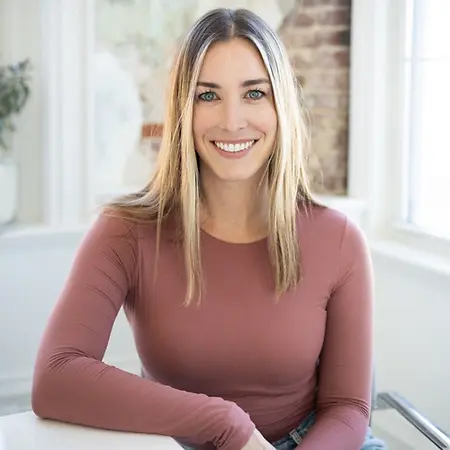
Her Story
About Rebecca
Throughout my career, imposter syndrome has been both a challenge and a compass guiding me toward growth. I started as a speech pathologist working in a school with two specialized programs - one for students with social-emotional disorders and another for students with complex communication needs using AAC devices and ABA approaches. When advocates and parents asked me hard questions about my clinical decisions, I had a choice: I could feed into that voice saying 'I'm just a bad speech pathologist,' or I could use it as motivation to learn more and be better. I chose the latter, eventually becoming the AAC supporter for my entire district. But this created an equity issue that bothered me deeply - why should a child who happened to live near my school get excellent AAC services while a child down the street didn't? That question led me to start Inclusive Educational Consulting two years ago. My business model is built on training rather than direct service, using a coaching approach where I work alongside educators in their natural environment. I purposely charge less for coaching than presentations because that's where real change happens - when I can model strategies in the moment with actual students, then debrief with adults about why it worked and have them try it themselves. What I've realized is that the core thing holding students back is often adults' limiting beliefs. We all have that imposter syndrome voice, and when something hard comes up, we wonder if it means we're bad at our jobs. I work with educators on celebrating their strengths and reframing learning as exactly that - learning, not failure. Being brave doesn't mean the fear goes away; it means acknowledging it and doing it anyway. I tell my stepdaughters this all the time: brave people are scared, but they do it anyways. Recently, that voice in my head said 'you're not a writer, no one's gonna buy this,' so I wrote a book. Then I wrote another, and another. Now I have a complete K-12 social language curriculum that embeds language and social-emotional learning into the academics teachers are already teaching, so it's not extra time in the day. The core message is belonging - that regardless of whether we're friends or not, we all deserve to feel safe in our environment: safe to be creative, safe to ask questions, and safe to learn. This applies to students and adults alike. In schools, I see how being friends with someone makes collaboration easier, while not being friends becomes an obstacle. My curriculum teaches people to acknowledge differences, disagree respectfully, and recognize that we can respect each other as humans even when we don't mix. My hope is that students learn this early and carry it through their careers, becoming emotionally resilient adults who can try hard things and respect each other.
Her Interview
Ten minutes with Rebecca
01What do you attribute your success to?
I attribute my success to using imposter syndrome as a checkpoint rather than a barrier. Whenever I have that feeling of imposter syndrome, I use it as a signal of where I need to go next. Throughout my career, that voice in my head has shaped my trajectory - when advocates asked me hard questions about AAC and I felt like maybe I was a bad speech pathologist, instead of giving in to that feeling, I used it to push myself to learn more and become better. I tell my stepdaughters that brave people are scared, but they do it anyways, and that's something I carry in my own work. Being brave doesn't mean the scaredness goes away - it's acknowledging that feeling and doing it anyway, trying something scary and seeing the result. When that voice recently told me 'you're not a writer, no one's gonna buy this,' I recognized it as an area I needed to move forward and grow in, so I wrote a book, then another, then another. That's really what's driven me through my career - acknowledging that voice, noting it, and then pushing forward anyway. It's about trying, and recognizing that trying something scary is what makes the difference between women who make it and women who don't.
02What advice would you give to young women entering your industry?
My advice is to take a blank piece of paper and write down your dream job. This sounds easy, but it's so hard for people because even writing down their dreams on paper brings up that imposter syndrome voice. I tell people to write down everything - the salary you want, the hours you want, not worrying about if it's possible or not. When that voice in your head pops up saying 'well, that can't happen, I can't get that amount and work these hours,' just push it aside. As adults grow up, their creativity and their ability to dream really dims because that voice in our head gets louder. So I coach people to write it all down as if they have it right now - 'I wake up at 9am every day, I have this salary' - really describe what that job looks like for you. It might surprise you, and it usually surprises people. Once they have it all written down, they also have their action plan. This is the end goal, so now how do I make this happen? It sounds so simple, but it brings up all those feelings of 'well, can I have it?' But when they do that work, they realize there are some actionable things they might be able to do, and it's not as scary, not as big of a leap.
03What are the biggest challenges or opportunities in your field right now?
I think there are two main layers of challenges in education right now. The first is the mindset barrier - there's a certain mindset in education of 'we always did it this way, this is the way we do things.' There's often a lot of burnout because people feel like they can't leave their school without getting their retirement, so sometimes I'm working with people who really do need a new job or they're really burnt out and not acknowledging it. Because of that, it's really hard to make change for people who are already past the point. That mindset is definitely my hardest barrier. The second major challenge is the policy barrier, which exists at federal, state, and district levels. Some of my passions and beliefs are very progressive, which aligns with real policy issues happening right now. There are a lot of educational cuts happening, and a lot of changes creating a ton of fear in education right now. I'm acknowledging that reality while trying to be creative and flexible to still meet kids' needs, even while funding is being cut. We have to find ways to navigate these policy barriers while still providing quality services to students.
Join Influential Women and start making an impact. Register now.