Her Story
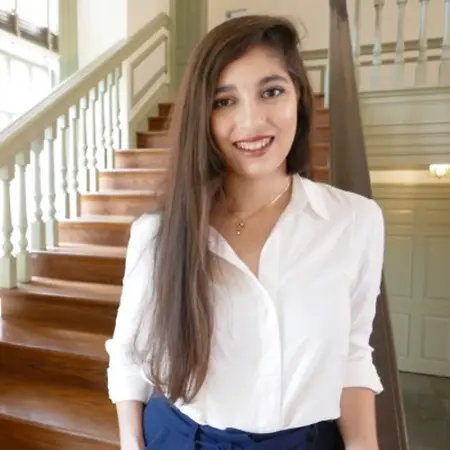
About Rebeccah
I've been in the cultural heritage field for about 5 years, and I've been in my current role for about 3 years, though I had a title change along the way. I had only worked in one other digitization role prior to this, because I was in grad school and working as a government contractor. I'm largely a department of one, so every day is different. My days can really vary, but generally speaking, it all kind of revolves around handling museum artifacts and digitizing them to the best of my ability, which can vary depending on their condition. I also do project management with other people in other departments within the museum and within my own department. I got this job by being very extroverted and taking risks. I met a fellow employee on the bus on my commute one day, and just through small talk, we started a conversation, and I made a connection. When I applied, I asked her to refer me. I really get by a lot on personality. I sometimes refer to myself as a personality hire, and it is my opinion that personality hires should be paid double, because we do our actual job in addition to entertaining people and keeping morale up. In the cultural heritage field, you work with a lot of introverted personality types, which is perfectly fine, but being that more extroverted person kind of gives you an edge when you don't have the credentials that are so highly coveted. Not to say that I'm not qualified, but when I don't have a PhD, even though I do have experience, it's a lot harder to get in the room. I often do have to find myself proving myself through articulating my thoughts.
Her Interview
Ten minutes with Rebeccah
01What do you attribute your success to?
I attribute my success largely to being very extroverted and just taking risks. I got the job that I currently have because I was able to elbow my way in. I met a fellow employee on the bus on my commute one day, and just through small talk, we started a conversation, and I made a connection. When I applied, I asked her to refer me. I really get by a lot on personality. I sometimes refer to myself as a personality hire, and it is my opinion that personality hires should be paid double, because we do our actual job in addition to entertaining people and keeping morale up. In the cultural heritage field, you work with a lot of introverted personality types, which is perfectly fine, but being that more extroverted person kind of gives you an edge when you don't have the credentials that are so highly coveted. Not to say that I'm not qualified, but when I don't have a PhD, even though I do have experience, it's a lot harder to get in the room. I often do have to find myself proving myself through articulating my thoughts.
02What’s the best career advice you’ve ever received?
I think there are two pieces of advice that I still carry with me that I got from my academic advisor back when I was in college for my undergrad. On one hand, he told me that success is not a ladder, it's a jungle gym. He explained that it's not always going to be a linear ascension, and sometimes you have to move sideways and shuffle around in what might feel like a lateral move until you can then go forward and up. At the time, I was 22 and thought to myself, yeah, whatever. And then a few years later, found myself thinking, goddammit, he was right. Success isn't always a ladder, it's a jungle gym. The other really helpful thing that he told me was follow footnotes. I was a history major, he was a history professor, and so he was talking about literal research. He said, if you find a good source, go ahead and look back and look at what sources those use, follow those. It can lead you to lots of different places, which is very practical advice in terms of research, but I think it can also be applied to life in that way. If you find a good resource in your life, not necessarily exploit it, but then dig around, see where that resource can take you, whether that's a mentor or educational materials, volunteering experience, anything like that. Follow the footnotes. It's gotten me pretty far, both in my professional writing and just in life.
03What advice would you give to young women entering your industry?
I would say that, realistically, they have to know what they're up against, and realistically, you are probably being considered by a room of older white men with PhDs or just more experience, or more degrees, or what have you. That's the reality. You have to know your audience. I think that the best thing that women can do is to bring something, is to find out how to market what they can bring to that table that those men don't have. So, for me, that was technical experience, and being able to throw around enough technical jargon that I knew it was going over the heads of academics who have never worked in my field before, and to the point that they kind of just trusted me. It's sort of the reverse. It's like, if you're a woman in Home Depot, and if you just pretend to look confused, someone very quickly will come and help you, and they'll basically do everything for you. It's kind of the reverse, where you really sell that you know what you're talking about to people who have no idea what you're talking about. So learning how to use a piece of technology that other people are not familiar with is really, really helpful, and having the confidence of saying, I know what you want, I can deliver. I think that so many men fake it, and I think that women should fake it more.
04What are the biggest challenges or opportunities in your field right now?
It's a challenge in a way that this industry isn't always the most prioritized, because museums, art galleries, libraries, archives, things like that, we're not always being funded as well as we would like to be. When you don't have the funding you need, you don't always have the staff or the resources that you need. So, that can be really challenging when you already work there and you're under-resourced, and then it can be a lot harder when you want to break into that field, but there's just not the budget to have a bigger staff for there to be job openings. That's a really big challenge, for sure. But I do think that one of the good opportunities about it is that, frankly, no one goes into museums because they want to make money. It's kind of a double-edged sword. No one here works here because this is their get-rich-quick scheme. People are here because they genuinely love what they do, they're here because they're experts in their respective field, so maybe that's 20th century British painting, maybe that's women's history, maybe that's Holocaust education, but people are there because they're passionate. In that way, you get to meet a lot of really fascinating people who are really smart and very talented. Don't get me wrong, grad school messed me up in a lot of ways, but I will never not love learning. So, in a way, you're still a lifelong student, and there's always so much to learn, and that's always comforting in a strange way.
05What values are most important to you in your work and personal life?
Balance is extremely important to me. I learned in graduate school, and I learned during when I was working remotely during the pandemic, and when I was a government contractor, that people don't really care about you that much. Maybe that sounds kind of pessimistic, but I think to some degree, it's also very literal. We live in a very individualistic society, and it's kind of just a fact. Everyone has their own life, and people don't really care about you that much. In the workplace, if you can't do your job, that's kind of the most important thing, and people really only have limited patience and resources. I think I learned very quickly that a job is a job. It's not like workplace comedies, like The Office, where it's actually a family. No, a job is a job. So, in that respect, I think that professional boundaries are extremely important for a lot of reasons. For me, I've learned that I have to leave work at work. I don't like working remotely, I don't like my home and my workplace becoming conflated. It just never let me turn off, and so I need to have boundaries. At work, I have to have boundaries. As I'm building my own department, as I'm building protocol, I am very strict about being given an appropriate allotted amount of time to accomplish a task, or people submitting formal requests instead of trying to orchestrate everything through water cooler talk, and by people respecting when I say I need a certain resource in order to complete a task. If I don't have that resource, then it just doesn't happen, and I'm not gonna lose any sleep over that. Work is work, and I need balance in a lot of my ways. I need to be able to come home and not think about work, and the same way that when I'm at work, I need to be able to know that I will have what I need to complete my tasks.
Join Influential Women and start making an impact. Register now.