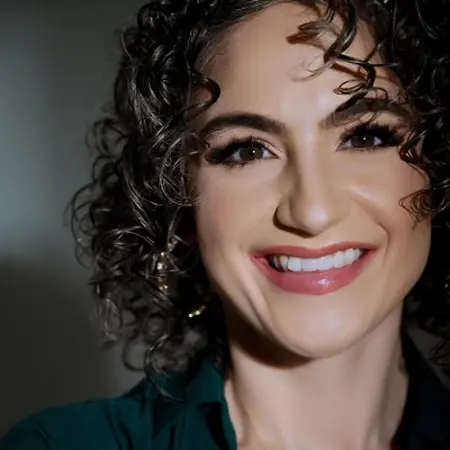
Her Story
About Rebekah
I have been working within the nonprofit sector for almost 25 years now, and my journey began with early exposure to the arts through an incredible organization called Voices United when I was in elementary school. That experience really showed me how service, the arts, and community all come together to create a better world, and it taught me that it's really an ecosystem where all parts need to be strong and healthy and working together in order for any kind of community to thrive. I studied music business and started working within the arts, then went back to school to complete my degree in my mid-30s. Throughout my career, I've had dual trajectories - from a personal creative standpoint, I moved from being on stage to playwriting, directing, and producing, gradually stepping further behind the scenes. Similarly, in my professional career, I moved from programmatic work to further behind the scenes into operations. I've worked as a playwright with productions at theaters around Florida including the Hippodrome Theater in Gainesville and City Theater Miami, and I've also worked as a journalist and arts critic, primarily as a freelancer for publications like the Miami Herald and Miami New Times. Currently, I serve as Chief Operating Officer at Big Brothers Big Sisters Miami here in South Florida, where my role focuses on making sure that operations and the back end of things are in place so that programmatically we're really able to deeply deliver on the mission. What keeps me motivated is knowing that the mission-driven work I do will make a difference in people's lives and in my community.
Her Interview
Ten minutes with Rebekah
01What’s the best career advice you’ve ever received?
One of the most important lessons I've learned along the way is that it's not always about you. The decisions that are made aren't as personal sometimes as they have to feel, and if you take the personal out of it and remember that everyone is really just trying to do their best on a day-to-day basis, then generally you're in a good place. It's easy for us to take things personally in our lives, but finding the ability to take a little bit of distance from that has certainly helped me. It's a muscle that you have to grow - you have to be able to take a step back and really see where things are going, and understand that even when things don't work out the way you want them to, it doesn't mean someone is out to purposely get you. No one really has that much time or energy to do something like that, and if they do, they just need to do something else with their lives. It's not about you. This is something I'm always exercising and working on, and while I've gotten better at it so the initial reaction isn't always personal, it's definitely something we're all just trying to work through as we make it through the day.
02What advice would you give to young women entering your industry?
Even though we're a nonprofit - and that's a tax designation - we still need to do good business. We may not be selling a thing, but there is still a level of business integrity and efficacy that we need to focus on. Mission is always number one, but I think those of us in nonprofit tend to have a sometimes looser approach to certain business practices. We are better equipped when we adopt some of the practices that work in the corporate world, particularly when it comes to more standardized operations. We need to definitely keep the mission first, but also look at how we're making sure that we're stewarding public funds and donated monies in a way that is really responsible, not just towards mission delivery, but also for sustainability, so that we're really creating something that is able to last.
03What are the biggest challenges or opportunities in your field right now?
Funding is always the number one challenge - it's always the top conversation we have with colleagues. Even within funding, it's how funding is dispersed, with funds often not being available for operational and behind-the-scenes needs. If a nonprofit owns a facility, things like a new roof are critical but generally not something a donor wants to support. We need to have conversations with funders about making sure funding is available for administrative needs and not just strictly programmatic ones, because if the administrative needs aren't taken care of, then programmatically we're not able to execute. Another major challenge is being able to get volunteers to support the mission. The demand on people's time is very different these days than it was even 10 years ago. People are passionate about engaging within the community and wanting to make it a better place, but sometimes it comes down to timing. Within the nonprofit realm, we need to look at how we meet people where they're at - what are the barriers of participation that exist, and how can we remove the ones that still allow us to execute on the mission. We need to stay as innovative as possible even if the mission is the same, delivering it in a way that stays current and in tune with both the needs of the people we're serving and those who want to participate. We need to stay engaged and in dialogue with all the different stakeholders to make sure we're not just delivering the mission, but delivering it in a way that is sustainable, checking in to see if what we've been doing is still what the need is, or if something has shifted.
04What values are most important to you in your work and personal life?
The values most important to me include compassion, empathy, and integrity, but I would also add relationships and community. It's about how we really build that mentality that no one is an island - how we're really able to engage and work together and be stronger together. That's something I look towards in the work that I do, the work that I support, and the people I spend time around. It's a through-line with a lot of them - how do we build together to make something better? It doesn't always have to be huge grand plans of changing the world, but sometimes it's just little acts of things that sort of make things easier for people.
Join Influential Women and start making an impact. Register now.