Influential Woman · AI communications and consulting
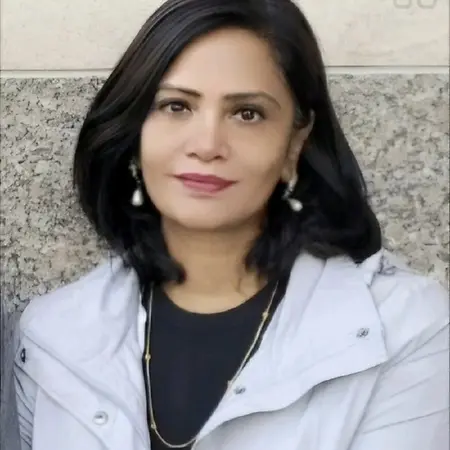
Renuka Naj
Founding Principal, Krosskeys Communications LLC
West New York, NJ
Her Story
About Renuka
Living and working in the New York/New Jersey area, I'm surrounded every day by the kind of cultural mix that reminds me the world is one big, interconnected community. That matters to me professionally, too. American businesses are influencing conversations and markets across the globe in real time, often without fully realizing it. I want to help businesses understand what that means, and how to communicate in ways that actually resonate across cultures.
I help develop strategies and campaigns across some of the areas that matter most, like health, food security, the environment, and education. And I support the whole way, from baseline to finish line. That means helping leaders set their goals, find the right partners and messages, shape impact stories, track what's working, and measure whether the work is actually delivering what it promised. To move funders and investors, I advise leaders to offer both solid evidence and a story that resonates emotionally. I am proud of my contributions to the U.S. President's global health and food security initiatives that have saved millions of lives globally.
As a media expert, I think one of the most important things I can do is to make sure the next generation actually knows how to navigate the AI driven digital age. That means teaching young people how to identify misinformation and disinformation, understand media ethics, stay safe online, and think critically, not just accept what they see on face value. It also means building a real appreciation for the rigor behind good research and science and technology. These are essential skills for the world we're living in right now.
Her Interview
Ten minutes with Renuka
01What do you attribute your success to?
I would say I have a healthy curiosity about people, where they come from, what they carry, and how they see the world. Perhaps that's why I chose journalism early in my life. I'm also adaptable, flexible, and listen to different viewpoints, having lived in multiple knowledge systems, countries, and cultures. The relationships I have built across continents over the years remain alive today because they were built in a genuine way with mutual respect, a shared interest in each other's work and life. That ability for lasting human connection is one trait I attribute my success to.
02What’s the best career advice you’ve ever received?
Last week I had the privilege of meeting Seth Godin at an event for nonprofit leaders. His forthcoming book, The Knot, introduces the concept of entanglement: the hidden conflict that arises when we want two incompatible things simultaneously: progress and safety, growth and familiarity, forward motion and the comfort of old habits. That tension, he argues, is what keeps talented, well-intentioned people stuck. What struck me most was recognizing that the moments I have advanced furthest in my career were precisely the moments I chose to untangle rather than accommodate that tension: to release what was no longer serving me and move toward what I could not yet fully see.
03What advice would you give to young women entering your industry?
My advice to young people is simple: keep pace with technology, but never lose sight of why it matters. Use it to do good. Use it to help people and to preserve history and values this nation was built on, because those things are worth protecting. I believe people are happier when they move together. When you feel you are cared for, loved, appreciated, everything changes. And that starts with sharing: your time, skills, knowledge, your energy, your humanity. So learn something new. Step into public service. Volunteer in your community. Be the kind of person who shows up for the people around them. Know your inner strengths and leverage that to shine Everyone has their own unique story. Not to compare your life with others on social media, but blaze your own trail.
04What are the biggest challenges or opportunities in your field right now?
As communicators the challenge is now dealing with new technology like AI, which is disrupting everything. How do we differentiate ourselves in an industry that is fast changing. Communications, marketing, advertising, branding, journalism, the craft that we spent years building is being reshaped faster than most institutions know how to handle it. The most challenging part is building trust and credibility in the middle of AI disruption. But one of the most exciting shifts I'm watching is how Ai is lowering the barriers to entrepreneurship. Communicators who once needed large teams, big budgets, and huge backing can now build and run their own companies and create new apps. The playing field is changing, and for people with real expertise, and good judgment, that's a remarkable moment to be in. But speed is not the same as strength. In a world where content can be generated in seconds, the temptation is to move fast. But accuracy, credibility, reputation, and trust are not things we can automate. They are earned carefully, and through the kind of human judgment that no algorithm can replicate.
05What values are most important to you in your work and personal life?
I think trust is a very important part, whether it's your personal or your professional life. Being reliable is important. Show up. Do what you said you would. Be the person people can count on. Once you've earned that trust, safeguard it. Keep your relationships nourished with family, with your community, country, and the world. They are the heartbeat of everything.
Join Influential Women and start making an impact. Register now.