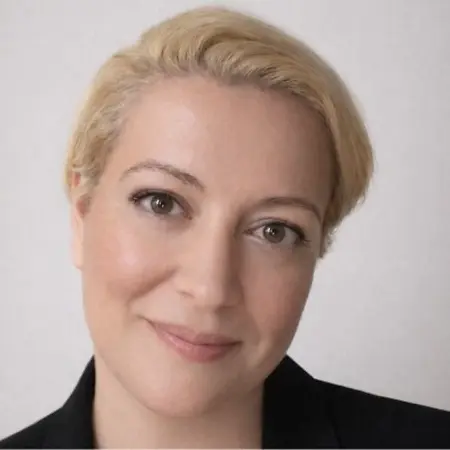
Her Story
About Rheannon
I serve as Vice President of Customer Experience and Change Management at the Board of Pensions, where I've been for nearly 10 years. We're a nonprofit affiliated with the Presbyterian Church, offering benefit packages including health insurance, retirement benefits, and death benefits for those who serve the PCUSA - churches, colleges, conferences, and camps. Our tagline is 'serving more, serving better, serving the church,' and we really focus on serving those who serve, because people in nonprofit work tend not to serve themselves. My role encompasses all training initiatives, data integrity, quality control, and continuous improvement, essentially defining how we operate and creating strategy around our operations while ensuring staff readiness through change management. Before joining the Board of Pensions, I spent 10 years with the state of Vermont in several different capacities. I started working on Vermont's pre-ACA healthcare access initiative, evaluating employer-sponsored insurance against state-based programs and helping subsidize access to healthcare for all Vermonters. I saw a wide range of employer-sponsored insurance across the tri-state area and determined subsidies to help people access coverage. I then transitioned to the tax department in the commissioner's office during the healthcare exchange rollout, seeing the financial side of state-based programs. Later, I moved to HR supporting state employees with benefits from both an administration and technical perspective, configuring systems for benefit enrollment. I often say I'm bilingual - I can speak both business and technical language and translate between the two. At 38, I was diagnosed with triple positive breast cancer just after being promoted to VP. I managed a very intense treatment plan while continuing my work responsibilities - my doctors thought I was crazy because I was the only one in a chemo chair on work meetings. I'm now a survivor and cancer-free, and that experience taught me so much about my own strength, commitment, and the humanity part of leadership. It shaped how I approach leading and management, helping me understand what people might be balancing outside of work. My journey to education was non-traditional - I went straight from high school into working full-time out of need, as I didn't have family support to go directly to college. Years later, I balanced working full-time while doing night school and weekend classes to earn my degree, which I'm really proud of accomplishing.
Her Interview
Ten minutes with Rheannon
01What do you attribute your success to?
I'm really passionate about leadership - how to be a great leader and how to influence others into being leaders. And I don't necessarily mean only if you manage people; you can not be a manager in an organization but still be a leader, still be influential, supportive, and have all of those attributes. What I would love to be known for is inspiring, mentoring, and influencing people in a way that helps them create what their dreams and goals are, bringing their own natural talents into the mix and using that to feel empowered in the work that they're doing. I don't think I'll probably ever master it, but that's something I aspire to be, and I go in every day with that in mind. That's something I continue to work towards and on. I've really transitioned from seeking a mentor to being the mentor, and I pride myself on the work I do in supporting others, building others, and developing others. Success from a business perspective is more than just the work you're completing - you have to be engaged, especially in nonprofit, at a different level and committed differently. You feel that when you feel seen, when you feel heard, when you have space, when you have people investing in you and seeing potential you might not see in yourself. I try very hard to create that ecosystem within my own team and organization.
02What’s the best career advice you’ve ever received?
I don't know if I could say what I've received in terms of advice - I think I've learned things along the way - but the advice I would give would be not to wait until you feel perfectly confident to start taking yourself seriously. Women are incredibly capable, and we often minimize our own contributions. It's hard to put ourselves out there. I've said this in my head a lot: 'well, anyone could do this,' but the truth of the matter is, don't shortchange yourself. That's not true that everyone can do that. People who bring clarity, steadiness, who solve problems, people who develop other people - those are not things to shortchange or snub at. Those are really important skill sets to have and bring. Take yourself serious. You have a lot to offer the world, and don't be afraid or shy to put that out there.
03What advice would you give to young women entering your industry?
Don't try to overcompensate for who you are. As women, you get caught up in the stereotype - am I too hard, am I too soft, what should I be or shouldn't I be? - as opposed to just being. We are amazing individuals, very powerful individuals, and it's okay that we may have stronger emotional ties to things. I think that's what brings in more humanity, which is so important and often overlooked in the workplace. You being you is a very special thing, and don't be afraid of that. Don't try to make yourself something you're not. Be confident in what you have to offer, and take yourself seriously. Don't shortchange yourself or minimize your own contributions. People who bring clarity, steadiness, who solve problems, who develop other people - those are really important skill sets, not things to dismiss.
04What are the biggest challenges or opportunities in your field right now?
There is so much opportunity in change management. We're in a day and age where the landscape is changing so drastically with technology, but yet we as an organization need to ensure, especially with the work that we do, that we don't lose the human aspect of what we do. It's balancing how these two worlds collide and support one another. I think there's a huge amount of opportunity as we look to the next 5 to 10 years, not just in our organization but outside of it. We're all trying to figure out how to connect but also leverage the advancements we've gotten from technology, and how those two meld together and support one another. What does leadership look like when we start talking about incorporating more AI in all of our solutions? What does it look like when we have more technology that can take some of the mundane tasks or administrative functions out of our day? How do we support our staff to grow and understand those aspects, but yet not lose the human aspect of the service that we provide? It's balancing those two worlds - the macro and micro aspects are really still opportunities to get into and understand and grow.
05What values are most important to you in your work and personal life?
Being open, honest, compassionate, and empathetic - these are all traits that I think are really, really important to bring, whether that's to your personal life or your career. It really helps you build better relationships, and a lot of what being successful is, whether in the workplace or outside, is all about the strength of the relationships that you create. Whether that's the relationship I have with my children, my husband, the people that report directly to me, or even people that don't report directly to me, it's all foundational and important to growth and moving along. If you have something that is difficult, you can always go through something more difficult if you've built a strong relationship around that. There's a different collaboration in solving a problem or working through a complicated situation if you have that foundation. Coming with your authentic self, being open, being compassionate, being empathetic - I think these are all foundational to being able to build strong relationships.
Join Influential Women and start making an impact. Register now.