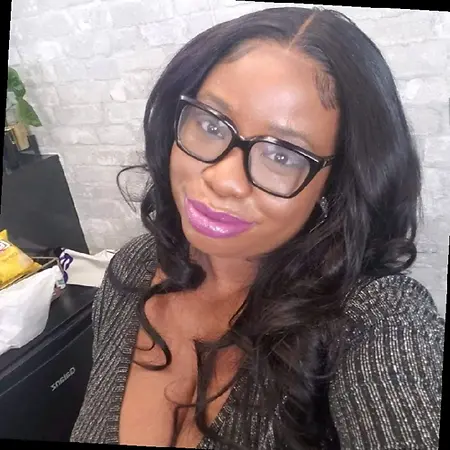
I was terrified of being wrong, so I played it safe. Then I learned that being helpful beats being perfect, and confidence grew when I stopped being a database and became a peer.
Rhonda Fox · In Her Own Words
Her Story
About Rhonda
Rhonda is a higher education executive and administrative leader based in Baltimore, Maryland, with extensive experience supporting senior leadership and driving operational excellence in academic and nonprofit environments. Currently serving as an Executive Associate and Chief of Staff at The George Washington University, she provides high-level administrative oversight for the RMC Dean’s Office. In this role, she manages complex scheduling, budgets, procurement, faculty hiring processes, and strategic projects while serving as a key liaison between internal university units and external partners, including affiliated health systems and stakeholders.
With more than a decade of experience in administration, operations, recruiting, and organizational strategy, Rhonda has built a career focused on improving systems and enabling institutional effectiveness. Her professional background includes roles in executive support, talent acquisition, and consulting across higher education and nonprofit organizations. She has worked in fast-paced environments where she coordinated large-scale events, managed cross-functional communications, streamlined workflows, and supported leadership decision-making through detailed reporting and process improvement initiatives. Her work consistently emphasizes structure, efficiency, and clear communication across teams.
Rhonda holds academic training in business administration, accounting, and finance, along with additional studies in human resources management. She is also certified in administrative and HR-related disciplines and maintains active involvement in professional organizations supporting administrative professionals. Known for her calm leadership style and attention to detail, she combines strategic thinking with hands-on execution, often serving as the operational “anchor” for complex teams navigating growth and change in higher education environments.
Her Interview
Ten minutes with Rhonda
01What do you attribute your success to?
What really inspired me was just me being a student myself, and I was not happy in the services that I was getting at the school that I was attending. I was like, I could do this better than them. That's what really put the bug in my ear to actually do it. I was like, I could do this better. Like, it doesn't make any sense. It's not organized. I call myself, when people ask me, like, a funny quip about, like, have you ever had someone ask you, describe what you do, but don't actually say the actual title? I've seen that on social media before, and I always answer and say it like this, and it always gets a laugh. I tell people I am the Olivia Pope at my job. And they're like, you're a fixer! And that's what inspired me. I was having so many issues with different departments when I was a student. I was like, I could do this better. I'm an executive associate with George Washington University, and I work with the School of Medicine and Health Sciences. What led me to my career path that I'm currently on was that I really was interested in working with students when I was actually just seeking out roles that had to do with operations and administration. At the time, I was working for state government, and my department was going through a lot of transition, so I figured the best time for me to start if I'm really interested in doing this is to start now. It was kind of scary because I had never really worked at a university - I've only ever attended a university as a student. A friend of mine at the time had told me about the school that some friends of hers had attended, and she reached out to them to see if they knew of any openings. I went in with no higher ed experience, interviewed for the job, and I ended up with the job. That is how I have ended up now been working in higher ed for 10 years, still doing a lot of administration operations, but I'm doing what I love, which is working in higher education and shaping the minds of future leaders. If I really just wanted to highlight something that I feel like I'm really getting great at, it's kind of like faculty development. I work a lot with the faculty at my current institution, and I've been doing it for almost 3 years now. I did it before in other roles, but I really with this role that I'm currently occupying, I really get to sink my teeth into it, working with other administrators to figure out programs for our faculty to be able to establish a career development in their path. I found that I really enjoy it, and I never realized how much I kind of was doing the work, but not necessarily doing it full time per se. Now that it's actually really a part of my role and what I do, I found that I really enjoy it. I work with 3 senior deans in my office, and part of my job is keeping them organized. They all have busy schedules because they all do different things, but part of my job is the organizational management for them. I do a lot of scheduling, calendar meetings, whether they're virtual meetings or in person. I provide a lot of executive-level support to them in different ways, whether it's related to faculty development with the faculty that they have to oversee. We work a lot with our current medical school students because I'm part of the medical school. I keep them organized. The campus that I work at is a brand new campus as part of the School of Medicine - it's actually their regional medical campus for our medical school. When I started working here, I was the only person in the office. It was just me. I was the one that had to figure out all of the policies and the SOPs for the office that we currently do now, and I didn't really have any oversight or help in actually figuring everything out. I had to learn it as I went, and it was all very daunting, I will say, because it was all brand new, so we basically created everything from scratch. I knew eventually we were going to be hiring staff, and I was like, I need to make sure that everything related to their role, they actually know how to do the training. I was learning all these programs while they were learning it, so we were learning it together as we were able to hire people. I guess I would say that's my most notable achievement, because I stuck with it. I'm a veteran of the United States Army, and I'm actually currently enrolled in the dual bachelor's, master's program right now that I'll be finished with next year. So that's been a lot, working full-time and completing, finishing up my education goals. There's been times where I've taken a break just for different reasons, where I was having stressors in life, because I think sometimes life happens for everyone.
02What’s the best career advice you’ve ever received?
I think the best advice I ever received was to find my niche. Someone told me to find what I love about my work, and I will be able to find the path of what I should be doing, or they called it my purpose. I've never really understood what they meant, really, until when I actually wanted to start working in higher education. I never understood what they meant by that because I had always thought of work as, it's just a job. It's just, you know, you go there, you do your shift, and you go home. I never really considered it purpose-driven. It wasn't until the person who told me that, and also when I really started wanting to do self-work on myself and do reflection and go to therapy - I remember I was doing one therapy session that I had, the therapist was like, you know, do you actually love what you do? And I was like, no, I don't. And she was like, well, that's part of your issue. You hate your job. She was like, and that is one reason why you're unhappy. I think after I had that conversation, and the person was like, well, find your purpose, and I was like, what is my purpose? I think once I really just identified that, I have been able to find my purpose, my fulfilling destiny, in just what I do, working in higher ed, working with students, helping shape the future for different career paths, whether someone wants to be a doctor, or a nurse, or whatever the case may be. For me, I've been able to now know what my purpose is - I'm helping shape the minds of education in our country and also just in my community at my school. That is my purpose, being able to help my students find their purpose. That was the advice, and I ain't gonna tell you a lie, it took me a few years to figure out what that was. But once I was able to, once I identified it, I really have been very fulfilled in my job.
03What advice would you give to young women entering your industry?
Entering higher education can be exciting, but it also comes with real challenges—academically, socially, and professionally. Here’s grounded, practical advice that actually makes a difference:
1. Take your voice seriously early on
Don’t wait until you feel “ready” to speak up in class, meetings, or group projects. Confidence often follows action—not the other way around. Ask questions, share ideas, and advocate for yourself.
2. Build relationships, not just a résumé
Professors, advisors, and peers can open doors—but only if they know you. Go to office hours, follow up after meetings, and stay in touch. Opportunities in higher education often come through people, not postings.
3. Learn how systems work
Universities have layers—academic policies, funding, research opportunities, administrative structures. The more you understand how things actually operate, the better you can navigate (and benefit from) them.
4. Don’t overcommit to proving yourself
A common trap is saying yes to everything to show you’re capable. That leads to burnout fast. Be strategic: choose roles and activities that align with your goals, not just ones that look impressive.
5. Seek mentors—but don’t rely on just one
Have a mix: someone senior for guidance, someone mid-career for practical advice, and peers for support. No single person will have all the answers.
6. Get comfortable with discomfort
You will be in rooms where you feel underqualified or outnumbered. That doesn’t mean you don’t belong. Growth in higher education often comes from being stretched.
7. Understand your worth—especially in negotiations
Whether it’s pay for a campus job, a research role, or your first job offer after graduation, don’t default to accepting the first offer. Do your research and ask questions.
8. Protect your time and energy
Rest isn’t optional—it’s part of performing well. Burnout doesn’t make you more successful; it just makes things harder.
9. Document your achievements
Keep track of projects, leadership roles, presentations, and outcomes. When it’s time to apply for jobs, scholarships, or grad school, you won’t be scrambling to remember what you’ve done.
10. Define success for yourself
Higher education can push a narrow definition of achievement (grades, titles, prestige). Decide what actually matters to you—career impact, financial stability, work-life balance, or something else—and let that guide your choices.
04What are the biggest challenges or opportunities in your field right now?
One reason I did not attend the AAMC conference this year is the current climate in higher education. As reflected in ongoing national conversations, many institutions are facing increased pressures, including shifts in funding tied to the current administration. As a result, universities—including my own—have experienced reductions in resources and have had to adapt quickly.
Across campus, this has been an ongoing discussion. I serve on several committees where we regularly talk about how to continue delivering high-quality education while operating with fewer resources. It has required thoughtful planning, flexibility, and a willingness to rethink how we do our work. Overall, it has been a challenging period for many in higher education.
05What values are most important to you in your work and personal life?
I have a close-knit circle of friends—my “sisterhood” sister circle—and I really value the time I get to spend with them. I especially enjoy a good girls’ trip. My best friend and I have been close since we were 15, and we try to take two trips together each year. It doesn’t always work out with our schedules since we both work and live in different states, but we make it a priority to stay connected and see each other whenever we can.
Spending time with family is just as important to me. My parents and siblings don’t live nearby, so I make a conscious effort to visit them as often as possible.
I’m also passionate about giving back—I serve as a mentor with the U.S. Dream Academy and find great fulfillment in working with and supporting young people.
For self-care, I enjoy simple yet meaningful routines like getting a monthly massage, keeping my nails done, and taking time to get my hair done. I also love activities that help me unwind and explore, like bowling, visiting museums, and discovering new places.
Living in Maryland, I really appreciate being close to Washington, DC—it makes for easy and fun weekend outings to museums and art exhibits. I’m also an animal lover, so I enjoy visiting the zoo. In addition, I love exploring wineries. While I don’t always make the trip to Virginia, I enjoy planning occasional visits to its wineries.
One of my long-term goals is to visit Napa Valley—I’d love the opportunity to explore the region and fully experience everything it has to offer.
Join Influential Women and start making an impact. Register now.