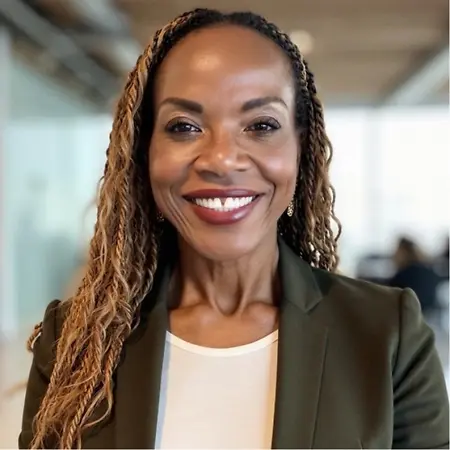
Her Story
About Rose
Rose James is a Legal Executive, Board Member, and strategic leader serving as Global Senior Director, Intellectual Property at Expedia Group, where she leads global IP strategy, protects innovation, and partners with executive leadership across technology, data, and security functions. With more than 25 years of experience in intellectual property law and global technology transactions, she is recognized for advising Fortune 500 companies and innovative organizations on complex legal, commercial, and strategic matters. Her expertise spans intellectual property, licensing, mergers and acquisitions, and corporate governance, with a strong focus on aligning IP strategy with business growth in the travel technology sector.
Her journey in intellectual property law has been anything but linear. After graduating from law school in 1997, she began her career in project finance and mergers and acquisitions while maintaining a strong interest in intellectual property and regulatory work. Because she initially lacked the science background required for the patent bar, she pivoted into trademarks and soft intellectual property before returning to school to earn a degree in physics from The George Washington University, ultimately enabling her to become a patent attorney. She also spent approximately five years at the U.S. Department of Homeland Security in legislative law, an experience that deeply shaped her understanding of how policy, law, and technology evolve together. Today, she draws on that foundation to interpret and anticipate change in emerging areas such as artificial intelligence and generative AI, helping guide how intellectual property law adapts to new forms of innovation and creation.
At Expedia Group, Rose plays a critical role in managing and expanding a strategic intellectual property portfolio in a fast-moving global technology environment. Her work includes patent strategy, IP risk management, mergers and acquisitions due diligence, and advising on emerging AI partnerships with companies such as OpenAI, Anthropic, and Perplexity. She brings a strong business-focused perspective to intellectual property, balancing cost, protection, and competitive advantage while responding quickly to evolving business needs. Beyond her professional responsibilities, she is deeply committed to mentorship and representation, particularly as a woman of color in a traditionally male-dominated field. She actively contributes to her community and professional networks and is known for her strengths in vision, execution, and problem-solving—driving meaningful impact while helping open doors for future leaders in law and technology.
Her Interview
Ten minutes with Rose
01What do you attribute your success to?
I would say my upbringing. I always go back to my grandmother, my maternal grandmother, who was the most amazing role model I have had in my lifetime. She was the matriarch in her family who kept everyone together. She had 10 children and ran a business. She's from the Caribbean, from St. Lucia, and she had lots of land and property. She was the big decision maker, and she did all of this with kindness. She always looked out for other people. She managed so much and showed me how you can be someone with big vision who executes in a way that can be overlooked, but foundationally, she was holding everything together. She did it so well with compassion and love, but also savviness. She was so smart. She made sure she had money set aside, that she looked out for her kids, that she had funds and property to take care of things if things went bad. And she did all of this without formal education, without a large formal education. That really anchored me in what's possible for a woman. That example just stayed with me throughout my lifetime.
02What’s the best career advice you’ve ever received?
The best career advice I've ever received is to eliminate and take away people's excuses. Get in front of the excuses. For example, when I was at the Department of Homeland Security, I was asking for a certain title, and they told me I needed to have five specific things to get it. So whenever I'm desiring something, I figure out what's required, and when I go ask for it, I've already taken away the excuses. Then someone has to find another reason to say no. So the best advice is when I go into a situation, I'm 1000% prepared. I've taken away all of the excuses. You don't have to be creative as to why you're going to say no. Get in front of the excuses. Come in prepared. Be so well-prepared that you have eliminated all of the excuses. It surprises people. They're not expecting you to have already anticipated that.
03What advice would you give to young women entering your industry?
I think it would go back to knowing that there is value in your perspective, that you bring value. We have a unique perspective and value that we bring to all of these situations. And what it is, it's because of that life journey, the upbringing, the experience. All of these things that we somehow think are deficits are actually what's creating us, what's making you into the human that navigates the world uniquely. So I want women to embrace that journey that brought them to wherever they are, standing in it, and realize the power in it. It takes time to be almost unmovable when you are grounded. It doesn't matter what you're doing, you're always going to succeed. The profession is challenging. It is demanding. So much is required of us, so much is expected of us, that you have to foundationally be secure. You have to prepare yourself. You have to know yourself. You have to have your education, solidly know what the law is, what intellectual property law is foundationally. Once you have that, then you can do all of these other things. But that grounding, to me, and knowing that it's a power and not a deficit, became the game changer for me. When I realized that all of these things that people were telling me were things I should be ashamed of, or that were not valuable, were in fact the things that make me who I am. They were all part of the superpower. I'm struggling to capture this in a way that is actionable for young people, but it's really for them to understand that there are no throwaways in their experience. Everything that you experience is part of your learning. It happens for a reason. But you have to know that so that you can act upon it. So if you're an IP lawyer, or you're a computer scientist, or you are CEO, or you are a mom who's juggling all of these things, or you're an entrepreneur, all of it, foundationally, once we have that, we're unmovable, unstoppable, limitless. All potential is limitless if we can really fully embrace that.
04What are the biggest challenges or opportunities in your field right now?
Right now, AI is the biggest thing. It's AI all the time, every day, every moment. We're at a pivotal point with generative AI, and the question is how does intellectual property law address creation, enforcement, and all of those things related to intellectual property in this new landscape? My early start as a legislative lawyer really helps me understand the trajectory of how the law adapts to technology. There are questions about the rights of creators when their works are being used to train AI. What about the market impact on the creator if AI can replicate their work and they don't get the economic benefit that intellectual property bestows upon the creator? If that work can be replicated without any sort of compensation, that's a fundamental challenge. The U.S. Copyright Office and Patent Office have taken policy positions. The U.S. government has an AI national framework. The EU and the UK are grappling with this too. All over, this is a question we're dealing with. In the judiciary, they're looking at the rights of the rights holder, the artist, the creators' rights. This is the biggest change we've seen in our lifetime. At Expedia, I get the unique opportunity to work so closely with the tech organization, with our chief technology officer and his leadership team, including our chief AI and data officer. We have enterprise relationships with OpenAI, Anthropic, Perplexity. Having the opportunity to align the intellectual property work with what these leaders are doing is really transformational for me.
05What values are most important to you in your work and personal life?
Kindness. It's one of the most important values to me. Kindness is a superpower. It's very difficult to be kind, especially in a corporate environment, and to maintain being a compassionate leader. Some people see it as a weakness. For many, many years, my kindness was seen as something that holds you back. Actually, kindness is, to me, a superpower. You operate from that because it shows how it informs your life in every single way. Operating from a place of kindness means that you are of good expectations. It's not in a naive way. You go in places with your eyes wide open, but you expect the best. We have to expect the best always, because when you do, often the best happens. I value and I am in awe of leaders who are compassionate in the way that they lead. They lead understanding the importance of people and the impact on humans and others, making business decisions from that perspective. To me, it's the kind of thing I would always want to emulate, and it's difficult to do. It's easy to fall prey to stress and profit and all of these other things. That's seductive. That's an easy thing to do. It's much more difficult to balance how you navigate yourself in the world with integrity and dignity and prevailing kindness.
Join Influential Women and start making an impact. Register now.