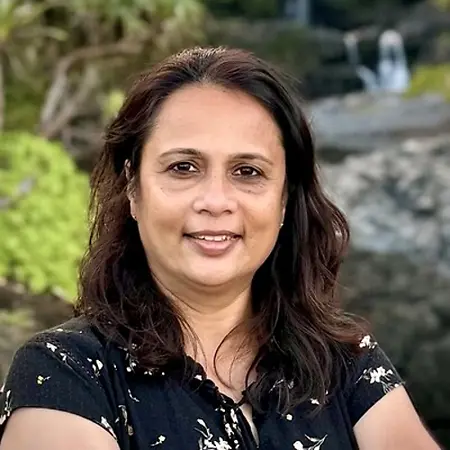
Her Story
About Rupal
My journey into recruitment began over 15 years ago when I was a young mother with two small children. Having grown up with a working mom who wasn't always available, I wanted to be present for my kids during their foundational years. As my children grew and settled into their routines, my priorities shifted and I began to focus on my own ambitions. I upscaled myself through online courses and certifications via LinkedIn Learning and Wharton University. I'm deeply passionate about closing gender gaps in tech hiring. Through my work with Women's History Month initiatives and analyzing our hiring data, I discovered that over 75% of our applicants were men, largely because women tend to self-select out of opportunities when they don't meet 100% of job requirements, while men apply even at 50-60% fit. I've been advocating strongly for changing our job descriptions to be less aggressive and more inclusive, adding language that encourages women to apply even if they don't have every single skill listed. I work closely with my recruitment team, immigration, onboarding, referrals, and leadership, and I'm most proud of maintaining a zero dropout rate from my hiring pipeline with no offer declines. I believe in paying people what they're worth and bridging the gap between candidate expectations and company offers. Recently, I've been attending webinars on AI tools like Copilot, Cloud, Gemini, and Claude to learn how to automate routine work and focus more on strategic initiatives.
Her Interview
Ten minutes with Rupal
01What do you attribute your success to?
I attribute my success to continuous learning, much of which has been shaped by my colleagues, peers, leadership team, and the broader professional community around me. I still see a long runway ahead in my journey, but where I am today is significantly influenced by the guidance and support I’ve received from the leadership team in my organization. Their consistent investment in my growth and development has played a pivotal role in shaping my career progression.
02What’s the best career advice you’ve ever received?
Learning never stops!
03What advice would you give to young women entering your industry?
I would strongly encourage individuals to experiment and step beyond strict rule-based thinking. Progress rarely comes without taking calculated risks and having the courage to make that leap of faith. It is through experimentation and exposure to new challenges that people truly discover their potential and often exceed their own expectations.
I also believe in encouraging a broader vision—especially early in careers—where individuals are willing to take informed risks and explore opportunities beyond their perceived comfort zone.
From a diversity and inclusion standpoint, I’ve observed a consistent pattern: women often self-select out of opportunities if they do not meet 100% of the listed requirements, whereas men tend to apply even when they meet only 50–60% of the criteria. This behavior gap significantly impacts representation.
To address this, I believe job descriptions should be viewed as flexible frameworks rather than rigid checklists. Encouraging confidence, curiosity, and willingness to learn is critical to building more inclusive and high-performing teams
04What are the biggest challenges or opportunities in your field right now?
One of the biggest challenges we’re seeing today is the increasing use of AI by candidates to tailor resumes specifically to pass ATS filters, even when their actual experience may not align with the role. As a result, teams often invest significant time in screening and technical interviews, only to realize later in the process that the profile was optimized more for keyword matching than genuine capability.
At the same time, it’s a double-edged sword because organizations are also leveraging AI to identify and source the most relevant talent. So, in many ways, candidates are simply adapting to the evolving landscape.I believe there is tremendous opportunity ahead to use AI more intelligently—not just to improve sourcing efficiency, but also to validate skills more effectively, reduce process inefficiencies, close existing loopholes, and ultimately create a more accurate and meaningful hiring experience for both employers and candidates.
05What values are most important to you in your work and personal life?
I tend to hold myself to a very high standard of accuracy and integrity. If a report or recommendation doesn’t fully make sense to me, I would rather pause, re-evaluate, and validate the information before proceeding. The same principle applies to hiring decisions as well. My judgment may not always be perfect, and it is naturally influenced by the information available at the time, but if I believe a decision is thoughtful, ethical, and aligned with the larger objective, then that, to me, is where true value addition lies.
Join Influential Women and start making an impact. Register now.