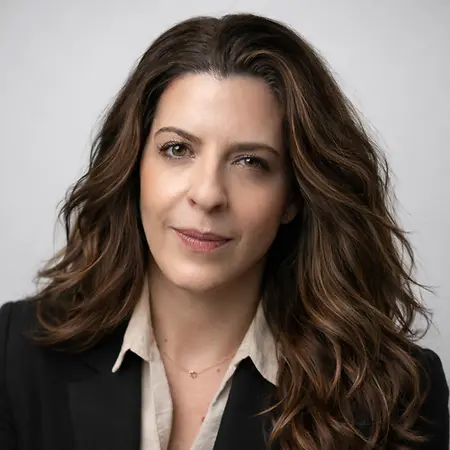
Her Story
About Ruthie
Ruthie Bashan is a senior Jewish communal leader, social worker, and strategist with more than two decades of experience in the nonprofit and social impact sector. Based in the New York metropolitan area, she has built a career guiding organizations, teams, and communities through periods of change, crisis, and growth. Her work focuses on strengthening Jewish communal life through organizational strategy, community resilience, and Israel–diaspora engagement. In addition to her leadership and consulting work, Ruthie serves as an adjunct professor at Montclair State University, where she teaches undergraduate and graduate courses on trauma-informed practice, community engagement, and social work.
Throughout her career, Ruthie has held leadership and program development roles across a range of communal and nonprofit organizations, including consulting with American Friends of NATAL on resilience initiatives and crisis response efforts for Israeli and Jewish communities. She previously served as Director of Special Services at Kaplen JCC on the Palisades, where she led departmental operations, expanded inclusive programming, and developed trauma-informed team culture during a period of organizational transition. Earlier in her career, she worked as a social worker with Jewish Family Service & Children’s Center of Clifton-Passaic, providing clinical support, developing community programs, and mentoring clinicians serving families and trauma survivors.
Ruthie’s professional philosophy centers on the power of meaningful human connection and the importance of creating systems that support individuals whose struggles often go unseen. Drawing from her background in counseling, art therapy, and social work—earned through studies at New York University and Montclair State University—she approaches leadership with a trauma-informed and values-driven perspective. Whether through program strategy, teaching, or community engagement, Ruthie works to help organizations operate with clarity, compassion, and purpose while strengthening the sense of belonging that sustains resilient communities.
Her Interview
Ten minutes with Ruthie
01What do you attribute your success to?
I think life has shaped my success. Both my mom and my grandmother were very, very involved with the community - they volunteered and each one of them were the first in their own field. I'm deaf and have a cochlear implant from surgery when I was young, and my mom was deaf as well. I have two children. I never identified myself through my disability, but a lot of times when the world was looking at me, that was the first thing they saw. So part of reaching out and doing more and paying attention to the person in front of me came from my own experience of not always feeling that I was being seen. That experience of wanting to be seen for who I truly am, beyond my disability, has driven me to see others fully and help those whose pain is invisible.
02What’s the best career advice you’ve ever received?
Be authentic, be curious, and ask questions. I found that in every workplace I was in, coming in and being genuinely curious about the people I was working with - my colleagues, my clients - and being curious about the systems you're functioning within, and asking questions, has been invaluable. No question is too dumb. This is a way to create human connection and a way to learn what you don't know. I always ask, and I find this being one of the most important questions: is there a question I should ask that I didn't ask? Because we don't know what we don't know. In every place I was, asking questions and being curious and engaging with the people, the systems, the environment - truly, authentically, not just to put some checks on the list, but really, really being curious and wanting to know - this was how I learned so much, made so many connections, reached so many opportunities, and it's also really enriched my life.
03What advice would you give to young women entering your industry?
Claim your space. Claim your seat at the table. Don't let other people tell you who you are. Don't determine yourself or define yourself by other people's terms. It's pretty simple, but we too often say sorry too much and we try to make ourselves small. So don't - claim your space. You sit at the table like anyone else. Know your value and don't let other people tell you your worth.
04What are the biggest challenges or opportunities in your field right now?
Every challenge also brings an opportunity, so it's never one or the other - it's always both, in my opinion. Right now, on a professional, global level, I think the biggest challenge and opportunity is that we are living in a world that's moving toward more and more trauma, more and more needs, and less and less resources. This is on a global level. On a personal level, social media, AI, and phones - we have more and more objects that create space between people, that actually create more distance between humans. So the challenge is to close that space, close that gap, create those connections, and find a way to bring resources to more people as fast as possible.
05What values are most important to you in your work and personal life?
Human connection is most important to me. Being truly present and really seeing the person in front of you. Compassion - both self-compassion and compassion for others - is essential to everything I do.
Join Influential Women and start making an impact. Register now.