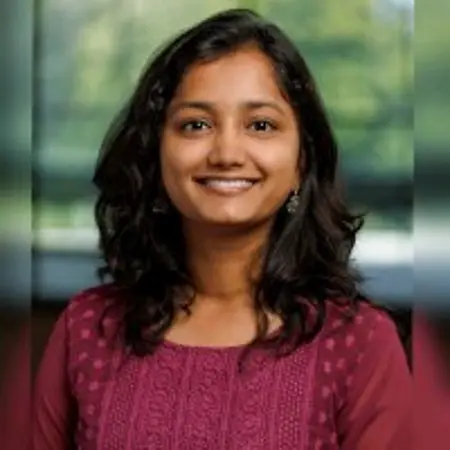
I underestimated my curiosity, thinking it meant I didn't know enough. I later realized curiosity drives meaningful science and became my greatest strength.
Rutuja Borawke, PhD · In Her Own Words
Her Story
About Rutuja
Rutuja B. (she/her) is a Ph.D. student in the Department of Pharmacology and Toxicology at the Medical College of Wisconsin (MCW), where she has been pursuing doctoral training since 2023. She is also enrolled in the Basic & Translational Science program through the Clinical and Translational Science Institute (CTSI) and holds a Master's and Bachelor's of Science in Biotechnology from University of Pune, India. Her academic foundation spans neuroscience, molecular biology, and translational biomedical sciences, with a consistent focus on understanding disease mechanisms through both experimental and interdisciplinary approaches. Over the course of her training, she has developed strong expertise in laboratory-based research methods and translational frameworks aimed at connecting mechanistic discoveries to clinically relevant outcomes. Her current research as a graduate research assistant is centered on the role of estrogen in memory regulation and its implications in Alzheimer’s disease pathophysiology. She investigates the neuroprotective properties of estrogen and how hormonal fluctuations, particularly the decline in estrogen during the post-menopausal period, may contribute to increased vulnerability to Alzheimer’s-like neurodegeneration in women, using human induced pluripotent stem cells (hiPSC) culture model. A central goal of her work is to identify critical windows for therapeutic intervention, including the potential timing and efficacy of hormone replacement therapies for individuals at elevated risk. Through this work, she aims to contribute to a more nuanced understanding of sex-specific mechanisms in neurodegenerative disease and to support the development of targeted, preventive treatment strategies. In addition to her academic and research commitments, Rutuja is deeply engaged in community outreach, advocacy, and mentorship. She serves as a community representative for the Alzheimer’s Association Wisconsin Chapter and actively participates in initiatives at MCW such as the Suicide Prevention Council, the Health Literacy Committee, and the Anti-Racism Committee at the Saturday Clinic for the Uninsured in Milwaukee, Wisconsin. Her outreach work involves engaging with schools, community events, and public health initiatives to increase awareness of Alzheimer’s disease, mental health, and suicide prevention, particularly in underserved and disproportionately affected populations. Alongside these efforts, she is committed to mentorship and academic guidance, supporting undergraduate students interested in pursuing graduate studies and Ph.D. programs in the United States, with an emphasis on fostering accessibility, scientific curiosity, and long-term career development in biomedical research.
When she is not in the lab or community, you can find her near the lakes, taking a stroll in the nature, catching sunsets or visiting the markets that have vintage and whimsical arts. She recently became a plant mom and is learning various artwork such as embroidery, oil and watercolor painting, mosaic work, etc. She also loves to dance! A cool thing about her is that she has completed Astronaut Training Program at NASA, Kennedy Space Center, Florida!
Her Interview
Ten minutes with Rutuja
01What do you attribute your success to?
I attribute much of my success to my parents, whose constant encouragement, sacrifices, and belief in my abilities gave me the confidence to pursue ambitious goals. Their resilience, values, and unwavering support continue to shape the way I approach both my personal life and professional journey. At the heart of everything I do is curiosity. I don't have a single role model — there are so many remarkable individuals I look up to — but what truly propels me forward is an insatiable wonder about the world. My success is rooted in a combination of curiosity and resilience, two forces that have guided me through both clarity and uncertainty. I have always approached challenges as opportunities to learn rather than obstacles to fear. Surrounding myself with mentors and collaborators who challenge and inspire me has been equally transformative. I also believe consistency often outweighs bursts of brilliance, and showing up every day has made a lasting difference. Above all, staying authentic to my values has allowed me to build a path that feels both meaningful and sustainable.
02What’s the best career advice you’ve ever received?
The best career advice I've ever received, and have since lived by, is to put yourself out into the world without reservation. Shoot for the moon. Even if you miss, you'll land among the stars. The very worst outcome of trying is a rejection, and every rejection is simply a stepping stone closer to the right door opening. I've learned to welcome those moments rather than fear them. I seize the opportunities that come my way, and when they don't come, I try to create them. Holding yourself back out of fear is the only true setback.
03What advice would you give to young women entering your industry?
Own your voice early, even if it feels like it is still evolving. Seek out spaces where your ideas are not only heard but genuinely considered. Do not underestimate the power of building strong, supportive networks with other women as they are invaluable. Be willing to take risks that align with your values, even if the path ahead is not fully visible. And finally, remember that your presence itself is meaningful, and you do not need to shrink to fit into spaces you are meant to expand. Stay dedicated to your work, stay anchored to your "why," and let that drive carry you further than you ever imagined.
04What are the biggest challenges or opportunities in your field right now?
One of the biggest challenges in neuroscience today is bridging the gap between rapidly advancing technologies and meaningful clinical translation. We are generating vast amounts of data, but interpreting it in a way that leads to tangible therapeutic outcomes remains complex, especially transitioning from rodent models to humans. At the same time, this moment presents an extraordinary opportunity to integrate interdisciplinary approaches, from genetics to computational modeling, to better understand brain function and disease. There is also growing momentum toward personalized medicine, which could transform how we approach neurological and psychiatric disorders. Ultimately, the field is at a point where collaboration and innovation can redefine what is possible in both research and patient care.
05What values are most important to you in your work and personal life?
Honesty and kindness - these are the two values I return to every single day, both in my work and in how I move through the world. Each morning, I make a quiet commitment to be kind to myself and to the people around me. It sounds simple, but I believe it is profoundly powerful. That spirit of kindness is also what draws me to community engagement. There is nothing quite like the moment you see your presence make someone smile, or feel seen, or feel less alone. I don't give to the community because I have to, I give because it fills me in ways that nothing else can. Kindness, for me, is not just a value. It is a way of living. Also, balance is something I actively strive for, recognizing that a fulfilling life is built not only on professional achievements but also on meaningful personal experiences.
Join Influential Women and start making an impact. Register now.