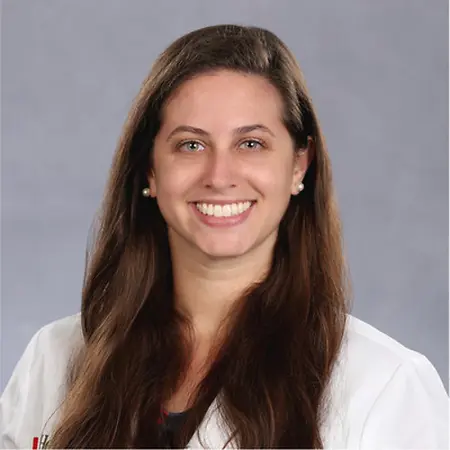
Her Story
About Samantha
I've been in healthcare since 2015, working as a genetic counselor for about 11 years now. I first learned about genetic counseling when I was in high school - I was a swimmer and had a personal interaction with the healthcare system that put my swimming career in jeopardy. My swim coach, who had become a mentor to me, shared that she had a similar experience and told me about these healthcare professionals called genetic counselors. That was really the first time I learned about the profession, and from there I made it my mission to see if it could be a good fit for me. It always just clicked - you're in healthcare helping people, you get to take the time to talk to people, it's not just science working in abstract to affect change but not really getting to see the people who are impacted by that. It was the perfect mix of loving people and that feeling of helping somebody, but also this very fast-paced world of constantly having to learn new things. In my current role as a prenatal genetic counselor, I see patients and do the clinical side of things, and I'm also responsible for teaching different subsets of medical school through guest lectures and regular annual lectures. I've worked in three different job settings throughout my career. My husband's job moved us to London right after we got married, and I didn't even have a job lined up. I eventually found my place at a fertility clinic working with sperm bank, egg bank, and people going through IVF. A British doctor there who had done all his training in the States took me under his wing and introduced me to some of the most important people in the field - it was a great learning experience not only for my knowledge but for my growth as a genetic counselor. Now I'm housed within the Department of Human Genetics, and I also do consulting work within the field of genetic counseling. I have to deliver a lot of bad news, and it's very hard, but somebody has to do this and I'd rather it be me than anybody else. It could be a doctor who has 5 minutes, or it could be me who has a full hour. I always say to my patients, when the hour's up, this doesn't have to be the end of the conversation - I'm still here for you. In the medical field, we don't experience that a lot. The world of prenatal genetics and women's health and reproductive rights is a very challenging place right now, and I just want to help my patients have as positive an experience as possible when they are going through one of the hardest moments of their lives.
Her Interview
Ten minutes with Samantha
01What do you attribute your success to?
I think my biggest strength in doing what I do is just being able to be empathetic, but also having a level of self-awareness. Our world is constantly changing, and people you interact with have come from different life experiences, and I think being able to acknowledge that every situation is unique is really important for what I do. I've also learned over the years the value of having your coworkers and sharing those experiences so that you don't have to keep it all for yourself. When I lost that kind of sense of camaraderie at my middle job where I was the only genetic counselor in the whole company, it was challenging. I grew a lot at that part of my career, but having other people who understood what I do and how hard that can be has been invaluable.
02What advice would you give to young women entering your industry?
The profession has come a long way since I was back applying to school - it seems much more competitive now, there's much more awareness about the profession and a lot more people wanting to get into it. But I think my biggest advice is just being able to be empathetic, but also having a level of self-awareness. You know, our world is constantly changing, and people you interact with have come from different life experiences, and I think being able to acknowledge that every situation is unique is really important for what I do.
03What are the biggest challenges or opportunities in your field right now?
The world of prenatal genetics and women's health and reproductive rights is a very challenging place right now. I have to deliver a lot of bad news, and it's very hard, but somebody has to do this and I'd rather it be me than anybody else. It could be a doctor who has 5 minutes, or it could be me who has a full hour. I always say to my patients, when the hour's up, this doesn't have to be the end of the conversation - I'm still here for you. I think in the medical field, we don't experience that a lot. I just want to help my patients have as positive an experience as possible in the world as it is today, when they are going through one of the hardest moments of their lives.
04What values are most important to you in your work and personal life?
I think that somebody has to do this work, but I'd rather it be me than anybody else. I have to deliver a lot of bad news, and it's very hard, but it could be a doctor who has 5 minutes, or it could be me who has a full hour. I always say to my patients, when the hour's up, this doesn't have to be the end of the conversation - I'm still here for you. I think in the medical field, we don't experience that a lot. The world of prenatal genetics and women's health and reproductive rights is a very challenging place right now, and I just want to help my patients have as positive an experience as possible in the world as it is today, when they are going through one of the hardest moments of their lives. It's something that touches everyone, whether or not you talk about it or share with everyone - prenatal, or cancer, or whatever, we all have genes. I think it's an important job.
Join Influential Women and start making an impact. Register now.