Influential Woman · Strategic Communications / Consulting Services
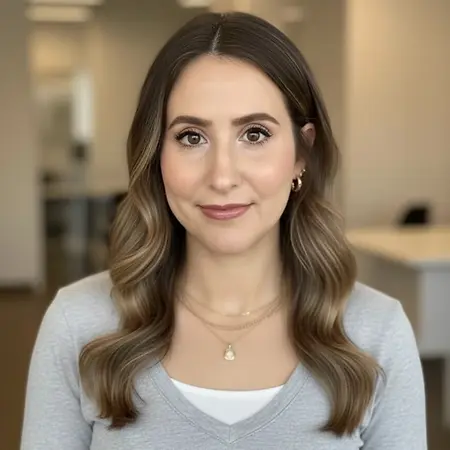
Samantha Adams Becker
Founder and CEO, SAB Creative & Consulting
Deerfield, IL 60015
Her Story
About Samantha
Samantha Adams Becker is a strategic communications leader and CEO of SAB Creative & Consulting, a storytelling agency focused on education and learning-centered organizations. Based in Deerfield, Illinois, she partners with universities and mission-driven nonprofits to shape human-centered narratives that communicate impact, strengthen engagement, and support institutional change. Her work blends storytelling, branding, and strategic communications to help organizations articulate their value and connect more effectively with learners, faculty, and broader communities.
Her career spans editorial publishing, education, and education technology, with early experience at the New Media Consortium helping shape influential higher education research and reports. She later founded SAB Creative & Consulting in 2017 and has since worked with institutions including Arizona State University, Morgan State University, Washington University in St. Louis, The University of Texas at San Antonio, and community-based networks such as Internet2 and CoSN.
She is also a co-founder of the 100 Year Project, a collaborative initiative exploring the long-term future of learning and technology across global education systems. Samantha holds an English degree from The University of Texas at Austin and a graduate certificate in nonprofit management from Harvard University. Her professional approach emphasizes empathy, transparency, and stakeholder inclusion, with a strong focus on change management and scalable communications strategy. Recognized for her leadership in education storytelling and digital communications, she is widely regarded for helping institutions translate complex initiatives into accessible, compelling narratives that drive understanding and engagement.
Her Interview
Ten minutes with Samantha
01What do you attribute your success to?
One day at a time.
I've learned that success isn't about having it all together—it's about continuing to move forward, even when things are messy. Sometimes that means I'm crying because it's been a hard day. Other times it means I'm turning up the music and having a spontaneous dance party by myself in my office. You learn to ride the waves.
Professionally, I attribute a lot of my success to relationships. I've spent years investing in people, building trust, and genuinely caring about the communities and clients I serve. I try to be transparent, communicate openly, and approach difficult conversations with both honesty and kindness. Those relationships have become the foundation of my business.
I also haven't been afraid to pivot. Businesses evolve, opportunities change, and sometimes the best path forward isn't the one you originally planned. Being adaptable — and not taking every setback too seriously — has helped me navigate a lot of uncertainty.
I have a wonderful family and incredible girlfriends who keep me grounded. My business is one of the great loves of my life, but it isn't my entire identity. Having a full life outside of work gives me perspective and reminds me that there is always more to the story.
Over the years, I've built a deep trust in myself. Success, for me, comes down to strong relationships, resilience, adaptability, and the belief that even a difficult day is just one day. Tomorrow almost always looks different.
02What’s the best career advice you’ve ever received?
The best career advice I've ever received is also the best personal advice I've ever received, and that's just to be you. Everyone else has been taken - be your most authentic self, lean in to what makes you different. I think I never started out in my career thinking I'm gonna run a niche storytelling agency for education. No way. But what happened was, I fell in love with the field. And I'm also a creative person, so rather than trying to fit myself into something cookie-cutter, I decided, hey, there's a really big need, even if it's niche, and I can jump in and help.
Also, I think that humor is a really important survival skill, and often underrated. Finding the humor in something, being silly where you can - I think all of my clients and my team would say we joke around a lot. Our profession is not life or death. Working for a smaller agency and having my own agency, we can take a little bit more risks and be a little bit more out there. And that's okay. I think oftentimes when we take those creative risks, that's where we see the most reward or impact.
03What advice would you give to young women entering your industry?
You don't need to feel imposter syndrome. I know it's hard to avoid, I still feel it often, but you've got this. You actually have the knowledge and the skills and everything you need. So don't be afraid to speak up, to take up space, and to share your perspectives. Yeah, you are way more powerful than you even know. And sometimes it's hard to even see your own influence, right? It's sort of this invisible cloak that you have. But when you start sharing, and you start leading by example, you're gonna inspire other people to do that. You got this.
04What are the biggest challenges or opportunities in your field right now?
I think that education as a field has largely been underfunded in many ways, and teachers specifically are underpaid. When we're trying to say that education is important and everyone needs an education, which I believe, we need to be compensating the people that spend all day creating curriculum and teaching learners. I think pay teachers and educators more - I think we'd also attract even more people to the field if we do that. We have amazing teachers, and I think we'd get even more, and even different types of people.
Another challenge is the pace of technological change. We've been talking about immersive learning, virtual reality, and adaptive technology for a while, but artificial intelligence has certainly changed the game. While I embrace ethical AI and build bots to help build storytelling capacity with organizations, the uptake of AI, understanding of it, and even how AI platforms are built is going to be a challenge and also an opportunity. How are we gonna integrate AI into teaching and learning in a way that actually helps, but then also how are we going to prepare people for jobs in the future where AI is intersecting with every industry and profession? That has implications for every field. In education, it becomes a matter of every school and college having its own understanding or strategy and collaborating on the programming that needs to be created, not just for degree-seeking students, but for the entire community.
05What values are most important to you in your work and personal life?
The values that matter most to me are impact, empathy, and trust.
I think one of the reasons I ended up in this work is that I get to partner with organizations that are genuinely trying to improve people's lives. I'm drawn to mission-driven work, especially projects and initiatives that expand access and create opportunities for people who may have been overlooked.
One example is ASU's Earned Admission program. If a student is denied admission, they can starting take real ASU courses online for $25 and, if they meet the requirements, earn their way into the university. More than 10,000 people have been admitted through that pathway — many of whom may have never believed higher education was an option for them. Being able to help tell stories like that is incredibly meaningful to me.
I also value transparency. Whether it's with clients, colleagues, friends, or family, I believe trust is built through honest conversations. Not everything goes according to plan, and I've found that the strongest relationships are the ones where people can say, "This isn't working the way we hoped — let's talk about it and figure out a better path forward."
And underpinning all of it is empathy. The best storytelling, leadership, and strategy all start with understanding people's experiences and needs. Before you can tell a story of impact, you have to understand the people at the center of it.
For me, the sweet spot is empathy paired with strategy — using both heart and action to help create meaningful change.
Join Influential Women and start making an impact. Register now.