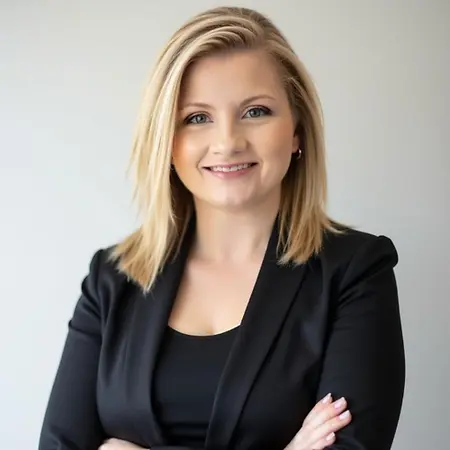
I taught myself to translate complex work into clear business impact, helping leadership see the bigger picture and it completely changed my opportunities.
Samantha Zeckmeister · In Her Own Words
Her Story
About Samantha
Samantha Zeckmeister, MBA, PMP, is a PMO and enterprise portfolio leader with more than 15 years of experience across banking, financial services, project management, and client-facing leadership roles. Her career journey—from retail sales and banking operations to residential real estate and enterprise portfolio management—has given her a unique ability to connect strategy with execution while understanding the perspectives of both frontline employees and executive leadership. Today, she specializes in building governance frameworks, aligning organizational priorities, and leading complex, cross-functional transformation initiatives within the financial services industry. In her role at Kohler Credit Union, Samantha oversees the enterprise project portfolio and leads the continued development of the organization’s project management office. Since joining the organization, she has played a key role in several large-scale enterprise initiatives, including multiple core conversions and a financial institution merger—transformational projects that impacted every area of the business. Known for bringing clarity to complexity, Samantha focuses on strengthening prioritization processes, building scalable governance structures, and fostering collaboration across teams to ensure strategic initiatives are executed effectively and sustainably. Samantha holds an MBA in Management from Concordia University-Wisconsin and a Bachelor’s Degree in Advertising & Public Relations and Print Journalism from the University of Wisconsin-Milwaukee. She recently earned her PMP certification, further reinforcing her expertise in enterprise project leadership and strategic execution. Passionate about creating momentum through trust, structure, and communication, Samantha is committed to helping organizations improve how they prioritize work, manage change, and deliver meaningful business impact.
Her Interview
Ten minutes with Samantha
01What do you attribute your success to?
I grew up in a household that strongly valued ambition, education, and hard work. My dad built a career in banking and ultimately became a CEO, while my mom worked in real estate and leadership roles, so my brother and I were always encouraged to pursue growth and push ourselves to achieve more. While my career path may look unconventional at first glance, I truly believe that diverse experience has become one of my greatest strengths. Having worked in customer-facing roles, within corporate environments, and alongside teams across different functions has given me the ability to connect with a wide range of people and approach challenges from multiple perspectives. My husband, who is an engineer, is very different from me in personality and approach, but his work ethic has had a tremendous influence on me over the past 15 years. Watching his loyalty, persistence, and dedication has absolutely made me a harder worker and reinforced the value of consistency and follow-through. I’ve also been fortunate to work with an exceptional leader over the last several years. My current manager has played a significant role in helping me grow professionally by giving me the confidence to trust my perspective, speak up, and advocate for my ideas. Having that kind of support has allowed me to step more fully into my own leadership style.
When I reflect on what has shaped me most, it really comes down to the strong, supportive people I’ve been surrounded by throughout my life and career.
02What’s the best career advice you’ve ever received?
One concept my current manager and I talk about often is the question, “What does good look like?” It’s a simple idea, but it shapes how we approach our work, our teams, and even our day-to-day interactions. It challenges us to think intentionally about what we’re trying to accomplish, the standards we want to hold ourselves to, and ultimately, the kind of impact we want to have.
For me, that mindset often comes back to one core question: How have I helped today? In business, it’s easy to get consumed by deadlines, problems, and constant demands, but shifting the focus toward helping others changes the dynamic entirely. It becomes less about reacting to challenges and more about asking: How can I make something clearer? How can I make someone’s job easier? How can I remove friction or take something off another person’s plate? What I appreciate about this approach is that it’s not about doing everything yourself or carrying all the responsibility. It’s about creating a culture of support, collaboration, and mutual respect.
This year, our team intentionally adopted the mindset of simply trying to be helpful in every interaction, and it has had a noticeable impact. When people consistently show up with the intention of helping, it builds trust. Conversations become more productive, relationships become stronger, and collaboration happens more naturally. It creates an environment where people are more willing to support one another because they know that support goes both ways. What makes this philosophy so powerful is that it doesn’t require grand gestures. Often, the smallest actions can have the biggest effect. Simply approaching situations with the mindset of “How can I help?” encourages a more positive, solutions-oriented perspective, and over time, that can significantly influence both workplace culture and professional relationships.
03What advice would you give to young women entering your industry?
I believe one of the most important qualities for a successful project manager is developing a strong understanding of the industry you support. In project management, there’s often a mindset that our role is simply to manage timelines, coordinate teams, and keep initiatives moving forward. While those responsibilities are certainly important, I’ve found that what has truly made me successful at KCU has been my willingness to actively listen, learn, and understand the business beyond the scope of my job description.
Over the last five years, I’ve made a conscious effort to pay attention in meetings not just for deadlines and deliverables, but to genuinely learn about banking operations, strategy, technology, accounting, and the challenges different teams face every day. Taking the time to understand what departments like Deposit Operations, Accounting, or IT are navigating allows you to build stronger relationships and establish credibility in a much more meaningful way.
When you understand the work people are doing, you become more than just the person documenting notes or managing schedules. You become a trusted partner in the conversation, someone colleagues can collaborate with, brainstorm alongside, and rely on as an advocate in the room. That level of trust changes the dynamic entirely.
I strongly believe project management plays a critical role in strategy, organizational change, and decision-making, but to contribute at that level, you have to be willing to move beyond the mindset of “that’s not my job.” It may not technically be my responsibility to understand something like data mapping during a core conversion, but if I’m part of the conversation, I see value in learning it. Every bit of knowledge you gain becomes another tool that helps you communicate more effectively with stakeholders across the organization.
That broader understanding allows you to engage with people on their level, whether you’re speaking with technical teams, operational leaders, or executives. Instead of conversations being limited to timelines and status updates, you’re able to contribute context, ask better questions, and connect ideas across the organization. In turn, that strengthens relationships, builds credibility, and increases your value as a professional.
I’ve found that when you consistently stay curious, open-minded, and willing to learn beyond your immediate responsibilities, opportunities begin to open in ways you don’t always expect. Your name comes up in conversations and rooms you may not even be part of yet, simply because people know you bring both perspective and partnership to the table.
04What are the biggest challenges or opportunities in your field right now?
One of the ongoing challenges within the financial services industry, particularly on the operational and technology side of banking, is that it continues to be a predominantly male-dominated space. While branch environments are often led by women, the deeper you move into operations, strategy, technology, and executive leadership, the more noticeable that imbalance becomes.
I’ve been fortunate to work alongside many incredible male leaders and colleagues throughout my career, so this certainly isn’t a blanket criticism of the industry. However, there is still a unique balancing act that many women navigate, finding the space to be confident, knowledgeable, and assertive without being unfairly labeled as “bossy” or overly aggressive.
Growing up, my dad used to joke about what he called the “gray hair tax,” and there’s a lot of truth to that in banking. Financial services has traditionally been associated with seniority and tenure, so even when you have the knowledge, experience, and results to back yourself up, there can still be assumptions tied to age or perception. It creates an interesting dynamic, particularly for younger women aspiring to leadership roles.
That said, I do believe the industry is evolving. Within the credit union space especially, we are beginning to see more women stepping into executive and C-suite leadership positions. There is still progress to be made, but the momentum is there, and that visibility matters. As someone with aspirations of eventually reaching the executive level, it’s encouraging to see those barriers gradually being challenged and redefined.
At the same time, the industry is experiencing enormous transformation through technology and innovation. AI and fintech disruption are reshaping financial services at an incredible pace. Even as a regional credit union, we are no longer competing solely with the bank down the street, we’re competing with digital-first companies like SoFi and Chime, which has forced organizations to think more creatively and strategically about innovation.
While that level of disruption can feel intimidating, I also see it as a tremendous opportunity. Technology is advancing so quickly that many future careers likely don’t even exist yet. I recently had that conversation with my son while discussing college and career paths, the landscape is changing in real time, and adaptability will be one of the most valuable skills people can develop.
Within IT especially, we’re seeing an influx of younger professionals bringing fresh ideas, new perspectives, and digital fluency into the workplace. Organizations that remain open-minded and willing to learn from that expertise will be in a much stronger position moving forward.
05What values are most important to you in your work and personal life?
One of the values I care about most is honesty, particularly in the form of transparency and clarity. Part of that naturally aligns with my role and personality. I’m highly organized, very detail-oriented, and someone who believes people work best when expectations and communication are clear. While I understand there are situations where not every detail can or should be shared, I do believe that being intentional, direct, and honest with people builds trust and mutual respect.
I also place a high value on curiosity, both in myself and in the people I work with. When challenges arise, I appreciate individuals who are willing to go beyond simply saying, “I don’t know.” There’s a big difference between stopping there and saying, “I don’t know, but let me find out.” That willingness to take the extra step, seek understanding, and help move things forward makes a significant impact.
For me, curiosity is closely tied to problem-solving and continuous improvement. I enjoy asking questions like: Why is this process done this way? Could it work better? Is there a more effective solution? That mindset encourages people to think critically rather than simply accept things at face value.
I value honest conversations, but I also appreciate people who are fully engaged, willing to ask thoughtful questions, and motivated to improve the work around them. When teams combine transparency, curiosity, and accountability, it creates an environment where people feel empowered to contribute ideas, solve problems collaboratively, and continuously grow together.
Join Influential Women and start making an impact. Register now.