Her Story
About Samina
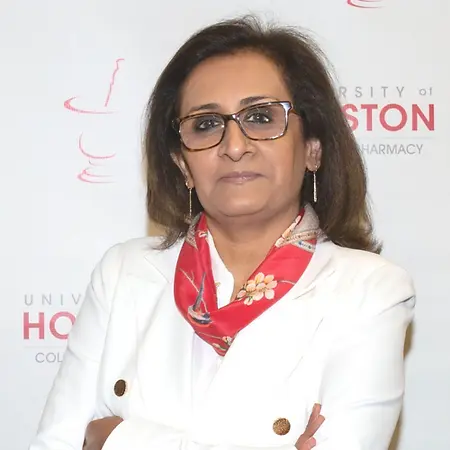
Dr. Samina Salim is a distinguished behavioral neuroscientist, clinical and translational researcher, and population health scientist with expertise in refugee health and pharmacy education. Currently an Associate Professor at the University of Houston College of Pharmacy, she has dedicated her career to advancing research that addresses health disparities among displaced populations and vulnerable communities. Her work combines behavioral neuroscience, population health, and pharmacy education to develop evidence-based interventions that improve outcomes for those most in need. Dr. Salim’s journey into science and academia was shaped by perseverance and transformation. As a teenager and college student, she was initially unfocused and unaware of the potential of higher education. Her decision to pursue a PhD in biochemistry marked a turning point, teaching her the value of failure, accountability, patience, and perseverance. After completing her PhD at Aligarh Muslim University in 1997, she pursued postdoctoral training at the Karolinska Institutet in Stockholm, Sweden, and later joined the University of Texas Health Science Center. She began her career in a research-track faculty position at the University of Houston, navigating cultural adjustments, intense professional expectations, and gender disparities. Her persistence was rewarded in 2012 when she received a National Institutes of Health grant, which led to a tenure-track appointment and ultimately her promotion to Associate Professor. Beyond her research and teaching, Dr. Salim is deeply committed to service, creativity, and global engagement. She founded AligsCare (www.algscare.org), a nonprofit supporting families affected by cancer in India, which has assisted over 300 families. She is also a published poet, with her book "To Gaza with Love" reflecting her passion for storytelling and advocacy. In her spare time, she enjoys traveling, exploring new cultures, and continuing to foster international academic partnerships, including the University of Houston’s expanded collaboration with the Jordan University of Science and Technology, Jordan, and the Aligarh Muslim University India. Her career reflects a blend of scientific rigor, compassion, and a commitment to making a meaningful difference in the world.
Her Interview
Ten minutes with Samina
01What do you attribute your success to?
"I attribute my success to curiosity". When asked directly what has been the key to my success over two decades in education, she answered without hesitation: curiosity. "Throughout my journey, I was always curious about people - how they made it, what they did to get to where they are. Nobody actually sat me down and gave me advice. I just observed and watched people's journeys and learned from them. That curiosity drove me to keep learning, keep growing, and keep pushing forward even when things were difficult."
02What’s the best career advice you’ve ever received?
Nobody ever sat me down and gave me career advice. I learned by watching people and observing them. I was very curious, so I always wanted to know about people - how they made it, what they did to get where they are. I just observed and watched people's journeys and learned from their experiences. My learning came from curiosity and observation rather than direct advice from mentors.
03What advice would you give to young women entering your industry?
Believe in yourself. Don't give up your dreams. Things might get delayed, but persistence pays off at the end. I know from my own experience that self-doubt is one of the biggest challenges facing young women entering higher education. I experienced it myself when I was working twice as hard as my male colleagues and still couldn't secure a tenure-track position. I began to doubt myself, wondering if I would ever make it or if I should just settle. But I kept going, and eventually that persistence paid off when I received the NIH grant that changed everything. So my advice is to push through that self-doubt and keep believing in yourself.
04What are the biggest challenges or opportunities in your field right now?
The biggest challenge I see facing young women in higher education is self-doubt and reluctance. That's what I hear a lot from young women entering the field. I experienced this myself during my career when I had to work twice as hard as my male colleagues and still struggled to secure a tenure-track position. I began to doubt myself, wondering if I would ever make it or if I should just settle with what I had. But I pushed through those moments of doubt with persistence and determination. Currently, I'm also facing challenges with funding for my health disparity research work due to political changes, which has impacted the resources available for the important work we're doing.
05What values are most important to you in your work and personal life?
Integrity is the most important value to me, both professionally and personally. When asked what values matter most to her, she didn't even have to think about it - it took her two seconds to answer. "Integrity guides everything I do, from my research and teaching at the University of Houston to my work with AligsCare, the cancer foundation I founded. It's the foundation of how I conduct myself in all aspects of my life, and it's non-negotiable for me."
Join Influential Women and start making an impact. Register now.