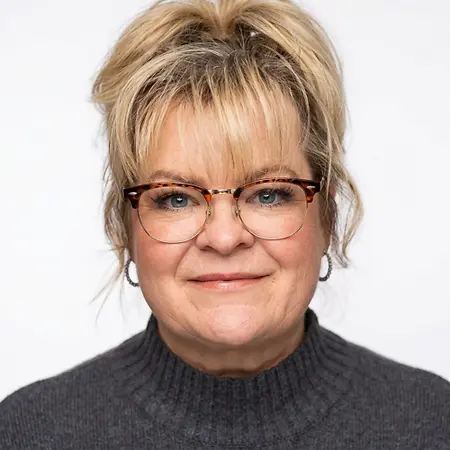
Her Story
About Sara
Sara Evans is an ASL Interpreter Educator based in Knoxville, Tennessee, where she works at Bromberg & Associates and serves as an Adjunct Professor at the University of Tennessee, Knoxville. She brings extensive experience across Deaf education, interpreter training, and language access, supporting both K–12 and higher education settings. Her academic background includes a PhD in Deaf Education, Interpreting Education, and Special Education from the University of Tennessee, Knoxville.
Sara’s career in education and language access spans more than three decades, beginning in 1992 as a classroom educator before expanding into interpreting and higher education roles. She has taught and mentored students in ASL, interpreter education, and Deaf studies programs, including supervising interns and developing coursework in communication access and Deaf education. Throughout her career, she has worked as both an interpreter and educator, including time as a tenure-track professor at Eastern Kentucky University.
Her professional philosophy centers on centering Deaf voices, community engagement, and responsible use of hearing privilege to amplify Deaf experiences rather than overshadow them. Sara emphasizes that effective work in the field requires immersion in Deaf culture, humility, and a commitment to service-driven leadership. Guided by long-standing mentorship and a deep connection to the Deaf community, she continues to focus on preparing future interpreters and educators to lead with respect, awareness, and accountability.
Her Interview
Ten minutes with Sara
01What do you attribute your success to?
I've been blessed to have an incredible support system throughout my journey. The Whitworths in Georgia, at the Georgia School for the Deaf, were my very first instructors to learn sign language, and they saw in me what I didn't see in myself. I actually argued with Jim Whitworth about whether I was going to go into anything deaf-related, insisting that wasn't my path, but he told me, no, this is what you have to do. Throughout my career, I've had people placed in my path who said, you can do this, and supported me in ways that allowed me to grow. I've also been fortunate to have an amazing tribe here in Knoxville and a patient partner who embraces this deaf world with me. I remained single for most of my life because I was very selective about who I brought into this community, and now at this stage when I'm doing so much, I have friends from all ages and walks of life who have embraced the deaf world alongside me. My mother, Ethel Evans, was also a huge influence. She was a three-time breast cancer survivor, tough and strong, but also incredibly generous. She wasn't a subservient wife or mother, she was equal, and I didn't realize until I was an adult how much of her tenacity and strength I had in me. She taught me not to let men intimidate me or tell me I couldn't have a role I wanted.
02What’s the best career advice you’ve ever received?
The best career advice she ever received came from early instructors who encouraged her to pursue work with the Deaf community after recognizing her potential, along with the personal reminder to “know who you are” and trust that identity without questioning it.
03What advice would you give to young women entering your industry?
My first response to anybody coming into this amazing community and culture, whether as an interpreter or educator, is you have to be in the community. You can't just be in a classroom learning theories. You've got to get out there, because these are the people you're working with, and there's a huge cultural aspect to this job. If we don't know that, understand that, and respect that, we're not going to be doing our best in whatever profession we choose in this community. It's truly an honor to be welcomed into this community, so you need to know your place and have the proper perspective of who we are as hearing people in the deaf world. I recognize that I have hearing privilege, and I always want to use that privilege to elevate the deaf experience and open doors. I don't need to be the leader in anything. If I'm in a leadership role, it's to bring in deaf voices and deaf representation. It should never be about me. And remember, you know better, you do better. We're all going to make mistakes, but we can't beat ourselves up for it. Look at your intent versus your impact, and when your intentions were right but your actions were wrong, learn from it and grow.
04What are the biggest challenges or opportunities in your field right now?
The biggest challenges and opportunities in her field include improving authentic Deaf representation and language access, using hearing privilege responsibly to create opportunities for Deaf individuals, and navigating the gap between intent and impact when working within marginalized communities.
05What values are most important to you in your work and personal life?
The values most important to her in both work and personal life include respect, humility, community, kindness, tenacity, and integrity, along with a commitment to using her privilege to elevate and support others.
Join Influential Women and start making an impact. Register now.