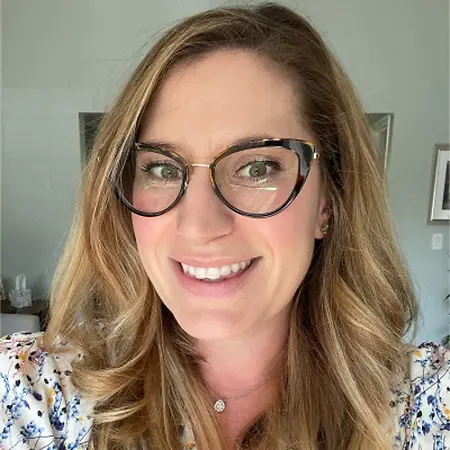
Her Story
About Sara
I started my career as a preschool teacher, which might seem unusual for someone in tech, but the common thread throughout my entire career has been learning and empathy. I didn't have a specific goal in mind - it wasn't like I wanted to become a UX researcher. I just took opportunities that presented themselves and was always willing to try something new, put myself out there, and learn something different. There are actually a lot of similarities between teaching preschool and doing UX research - both involve trying to break things down to basics, understanding the needs of who we're trying to serve, making things clear and concise, and bringing forward simple, inclusive solutions. I started in big tech doing recruiting at Microsoft, then worked at Amazon for about 5 years doing recruiting, programs management, and diversity programs. When I was doing diversity programs, I led a global survey for the marketplace organization - about 20,000 people globally - to really understand what made them feel included at work, what programs they decided to participate in or not, and what made them feel most connected to their jobs. That's when I discovered my passion for data and research, understanding what makes people do what they do and what their drivers are. I had the opportunity to work at Microsoft on the Microsoft Learn platform, which blended together my experience with teaching and learning and my passion for research. I was hired as a customer research program manager and really learned on the job how to become a UX researcher through a week-long intensive class in New York and from my peers - other UX researchers, information architects, and PMs. I did that role for about 3 years, then was hired at Google to work on their cloud learning platform, where I've been for almost 5 years. My area of expertise is adult learning, specifically online learning and cloud learning. A typical day can range from doing customer interviews or usability studies to understand how people are using our designs, partnering with designers to understand what problems we're trying to solve and helping them brainstorm solutions, or partnering with PMs to envision new features to improve our user experience and stay relevant and innovate in the space.
Her Interview
Ten minutes with Sara
01What do you attribute your success to?
I attribute my success to being willing to take opportunities that presented themselves to me and always being open to trying something new, putting myself out there, and learning something different. I didn't have a traditional background or a specific goal in mind - I just built relationships and learned on the job, taking advantage of opportunities and figuring out how to carve my own path. I don't have a master's in human-computer interaction or human factors, I didn't go to a fancy Ivy League school, and I don't have a master's or doctorate, but I managed to build relationships, learn on the job, and take advantage of opportunities. When I used to travel around the world doing hiring at Amazon and would ask powerful product leaders if I should get my MBA, they told me that people go to get their MBA to work at places like Microsoft, Google, and Amazon - but I was already there, and I could probably learn more on the job than in the classroom. That advice really validated my approach of continuous learning and seizing opportunities rather than following a traditional educational path.
02What’s the best career advice you’ve ever received?
The best career advice I ever received was from powerful product leaders I met while traveling the world doing hiring for Amazon. I would ask them if I should go back to school and get my MBA, and they told me that people go to get their MBA to work at places like Microsoft, Google, and Amazon - but I was already there. They said I could probably learn more on the job than I could in the classroom. That advice really stuck with me and validated my approach to career development through hands-on experience rather than traditional credentials.
03What advice would you give to young women entering your industry?
I would tell young women entering this industry that you don't need a traditional background to succeed. I like to talk about my non-traditional background because I think it shows other folks that they can step outside of what they've done and do something different. You don't need a master's in human-computer interaction or human factors, you don't need to go to a fancy Ivy League school, and you don't need a master's or doctorate. What matters is building relationships, learning on the job, taking advantage of opportunities that are presented to you, and figuring out how to carve your own path. Be willing to try something new, put yourself out there, and learn something different. That's been my way of giving back - showing that there are multiple paths to success in this field.
04What are the biggest challenges or opportunities in your field right now?
The biggest challenge and opportunity in my field right now is how advancements in AI and generative AI will impact the role of UX researchers. I think roles for UX researchers will shift - we'll become more like advisors and user advocates, as opposed to necessarily doing as much of the interviewing and synthesizing, because those are tasks that AI can do. There is some concern or worry, like there is in any industry right now, about how AI will impact the roles that we do. But so far in my role, it's been interesting and helpful. For example, when we're talking to users, I can have everything auto-transcribed instead of having a note taker, so I can connect more deeply with the participants and be more in the moment, not really focus on writing every word down. AI can also help with synthesis - after talking to 15 people, having AI take a pass over your draft and make recommendations definitely cuts down on the analysis and synthesis time significantly. I can be more productive, and I'm optimistic and hopeful about the future with AI. I'm not really one of those doomsday, doom and gloom folks. I think it can be a benefit.
05What values are most important to you in your work and personal life?
The most important values to me in my work and personal life are learning and empathy. I would say the common thread throughout my entire career path has been learning and empathy. Whether I was teaching preschool or doing UX research, it's always been about understanding the needs of who we're trying to serve, breaking things down to basics, making things clear and concise, and bringing forward simple, inclusive solutions. In my diversity programs work at Amazon, I focused on understanding what made people feel included at work and connected to their jobs. I'm also passionate about giving back and sharing my experience - any way I can give back and share my experience is always an opportunity for me. I want to show others that they can step outside of what they've done and do something different, that there are multiple paths to success.
Join Influential Women and start making an impact. Register now.