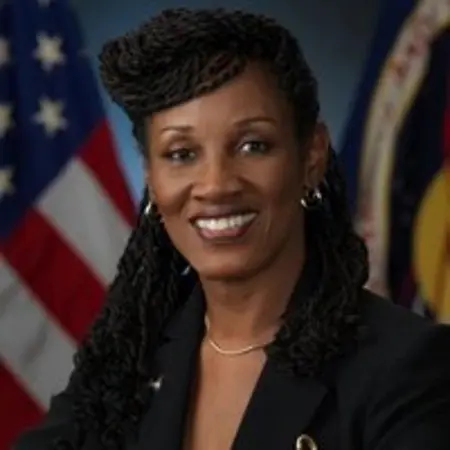
Her Story
About Sarah
Sarah L. Murray is a retired NASA human spaceflight operations expert, U.S. Army veteran, and leadership consultant with decades of experience in space systems, astronaut training, and international STEM outreach. Over her 33-year career in the space industry, she held leadership roles in Mission Control, managing Space Shuttle communications, International Space Station power systems, and astronaut training at the Neutral Buoyancy Laboratory. She also chaired the International Training Control Board, coordinating training and operations across global partners, and led the Columbia Recovery Office following the 2003 shuttle accident, working with federal agencies, contractors, and local authorities to recover debris safely and efficiently.
Before joining NASA, Sarah served five years in the U.S. Army, primarily in Germany, working in medical emergency operations. Following her military service, she pursued a Bachelor of Science in Electrical Engineering from The University of Texas at El Paso while balancing family responsibilities. Her path to NASA was unconventional—her first opportunity arose through a Rockwell Space Operations interview, which led to a long and distinguished career in human spaceflight, where she combined technical expertise, leadership, and operational excellence.
Since retiring in 2021, Sarah has dedicated herself to international STEM outreach with the International Space Schools Educational Trust (ISSET), leading Mission Discovery programs that allow students worldwide to design microgravity experiments sent to the International Space Station. She continues mentoring students, promoting leadership development, and advocating for professionalism, compassion, and excellence in all endeavors. Her career reflects a lifelong commitment to advancing human spaceflight, fostering global collaboration, and inspiring the next generation of scientists and engineers.
Her Interview
Ten minutes with Sarah
01What do you attribute your success to?
I attribute my success first and foremost to my parents - they are number one because I saw how hard they worked and they had very high standards. Beyond that, it's about perseverance - you just don't give up, no matter what. I remember when I was going to school after the military, I had a toddler and I didn't have a car, so he's in the little toddler seat on the back of the bike and I'm riding the bicycle back and forth to school and working. When I was in the military, I had to purposely take the night shifts so I could be in class in the morning - the nurse let me because I needed to work the night shifts so I could be in class in the morning. That ability to pivot is very, very important, and I learned a lot from it. I love that NASA moves the leaders around to different organizations so we learn different leadership skills based on the type of people and the job that has to be done. Every day that they helped us search, they got a day taken off of their sentence, and so perseverance and the willingness to keep moving forward no matter what obstacles you face - that's what got me here.
02What’s the best career advice you’ve ever received?
The best career advice I’ve ever received is to always do every task to the best of your ability.
03What advice would you give to young women entering your industry?
I would tell them, try to be better than everybody there. You know, coming up, we were taught that if you're Black, you have to do twice or ten times better than the white person to be considered equal, right? And so that's really what I was always trying to do - I was always trying to be the best. Fortunately, I had some really good supervisors at NASA and they saw that I was better, not just equal, and so it worked out. But for young women, I would tell them: try to be the best at what you do, don't be afraid to ask questions, and, you know, being professional and tactful at all times. That's what will get you far in this industry.
04What are the biggest challenges or opportunities in your field right now?
Coordinating international training and operations across diverse cultures and organizations remains a significant challenge, while expanding STEM outreach through programs like Mission Discovery presents a major opportunity to inspire and grow the next generation of space and engineering talent.
05What values are most important to you in your work and personal life?
Compassion is very, very important to me, right? And empathy in my work life. Along with that, I would say professionalism - always be professional. And as much as you can, try to do jobs that you enjoy. It might not start out that way because sometimes you gotta get your foot in the door, but if you end up in a job that you love to do, you will excel at it. No matter how much you're getting paid, if you love to do it, you will excel at it because you don't need people to tell you 'oh, can you do this?' You'll already be trying to make it better and better and better because it's something that you enjoy doing and you love doing it. So when you can, that's what you want to strive for - doing a job that you enjoy doing so that you excel at it.
Join Influential Women and start making an impact. Register now.