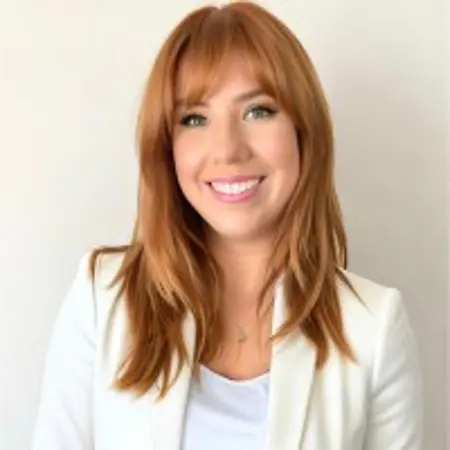
Her Story
About Sarah
Sarah Smith is a seasoned executive administration professional known for her servant leadership style, strategic mindset, and ability to bring order to complex environments. Currently serving as Director of Executive Administration at PlanSource, Sarah was brought in to help rebuild and professionalize the executive administration function. She has built her career around supporting C-suite leaders, managing cross-functional teams, and creating systems that improve efficiency, communication, and organizational effectiveness. Often referring to herself as a “chaos coordinator,” Sarah is recognized for her ability to walk into challenging situations, identify what needs to be fixed, and restore calm while keeping people aligned and focused. Before joining PlanSource, Sarah spent more than a decade at WorkForce Software, where she worked closely with the same CEO for over 12 years across multiple organizations. Her role evolved into a strategic partnership, helping prepare executives, manage priorities, coordinate presentations, and ensure teams were equipped to support business goals. Earlier in her career, Sarah served as a Special Assistant and Mission Support professional at the Central Intelligence Agency, where she supported senior government leaders, handled highly sensitive information, and coordinated complex logistics. Her time there shaped her calm-under-pressure approach and ability to adapt quickly in fast-moving environments. Sarah is currently continuing her education in AI and business strategy through Georgetown University, complementing the extensive experience she has gained through mentorship and hands-on leadership. Outside of work, she is deeply committed to service and community involvement as a board member for Community Outreach Service Corporation and a longtime corporate partner volunteer with Els for Autism Foundation. Among her many honors are the Civilian of the Year Award from the CIA, a service award from the National Reconnaissance Office, and the Lifetime Shinola Award from WorkForce Software. Looking ahead, Sarah hopes to continue growing into a formal Chief of Staff role, where she can further leverage her strengths in executive partnership, team leadership, and strategic operations.
Her Interview
Ten minutes with Sarah
01What do you attribute your success to?
When I think about what's shaped my success, it always comes back to the same place: home.
I was raised by two incredibly hardworking parents who made real sacrifices to give me the best possible foundation: schools, opportunities, experiences they didn't always have themselves. They never made those sacrifices feel like sacrifices. They made them feel like belief. Belief in me, in what I could become, in the idea that hard work opens doors.
That value was never just spoken, it was modeled. Every single day. I watched them show up, put in the work, and keep going even when things were hard. That kind of example doesn't just teach you a lesson; it becomes part of how you move through the world.
And what I'm most grateful for is that it didn't stop when I grew up. Both of my parents are still on speed dial—and I mean that literally. Whether I'm troubleshooting a broken light switch or navigating everything that came with a brain tumor diagnosis, they're still my first call. That kind of consistent, unconditional presence is something I don't take for granted for a single day.
I had great role models growing up. I still do. And I think that's one of the greatest advantages anyone can have, not just being taught what success looks like, but being shown, every day, what it means to show up for the people you love.
02What’s the best career advice you’ve ever received?
The best career advice I've ever received is to "do it scared."
Most people wait until they feel ready. Until they have enough experience, enough confidence, enough certainty that they won't fail. But readiness rarely announces itself. What you're actually waiting for is permission that never comes.
Do it scared means raising your hand even when your stomach drops. Saying yes before your brain catches up. Trusting that the version of you who figures it out is already in there, she just needs the opportunity to show up.
I learned this firsthand at an all-hands meeting. Someone asked who wanted to work for the Director's staff at the CIA. The room went quiet. Not a single hand went up right away and eventually mine did.
I don't know if it was impulse or a split second where I decided the regret of not trying would be worse than the risk of failing publicly. I interviewed the next day and had one of the most meaningful roles of my career by the end of the week.
The job wasn't given to me because I was the most qualified person in the room, no where close. It was given to me because I was the only one willing to raise my hand. Courage doesn't have to be loud or certain. It just has to show up when everyone else stays seated.
03What advice would you give to young women entering your industry?
My advice is simple, but I don't think it gets said enough: ask to be included.
Ask to be in the room. Ask to join the meeting. Ask to take on the project. The worst anyone can say is no, and a no today doesn't close the door forever. But the opportunities you never ask for? Those are the ones that quietly pass you by.
Women, in particular, are often conditioned to wait. To earn their seat rather than claim it. To prove they belong before they raise their hand. But the truth is, inclusion rarely falls into your lap, you have to advocate for it, sometimes loudly, often repeatedly, and almost always before you feel ready.
When you put yourself into conversations and opportunities, something shifts. You stop being a observer and start being a contributor. People begin to see what you bring to the table and more importantly, you begin to see it too. That visibility compounds. It turns into trust, into responsibility, into growth you couldn't have planned for.
So don't wait for the invitation. Ask for it. Walk into spaces that feel slightly out of reach. Make yourself part of discussions that matter. Every room you enter is a chance to add value, build relationships, and expand what's possible for your career.
The worst they can say is no. But you'd be surprised how often the answer is yes, simply because you asked!
04What are the biggest challenges or opportunities in your field right now?
The first is a challenge that long predates AI: the persistent undervaluing of this role. Executive Assistants are often the connective tissue of an organization, managing relationships, anticipating needs, holding institutional knowledge, and keeping leaders and teams functioning at their highest level. Yet the role is frequently dismissed as administrative, transactional, or easily replaceable. The truth is that a great EA isn't just managing a calendar. She or he is managing access, information, trust, and outcomes. That distinction matters, and our field has long deserved more recognition for it.
The second is something every industry is grappling with right now: AI. And specifically, what it means for the future of administrative work. The honest answer is that AI is already replacing lower-level administrative tasks—scheduling, data entry, travel logistics, inbox filtering. That's real, and it's happening fast.
But here's what I think the conversation often misses: AI doesn't replace judgment. It doesn't replace relationships. It doesn't replace the strategic thinking that the best executive support professionals bring to their work every day.
If anything, the rise of AI is an opportunity and I mean that seriously. It's an opportunity to finally shed the parts of the role that were never the point, and step fully into the parts that are. When AI absorbs the transactional work, it frees up the best EAs to operate the way they always should have: as strategic partners to leadership. As people who don't just execute decisions, but help shape them. Who don't just manage access to the executive, but influence how that access is used. Who sit at the intersection of people, information, and priorities and bring real judgment to all three.
The tools are changing. That means the expectations can change too. And for the EAs who are ready to rise into that space, I think the next few years are actually one of the most exciting times to be in this field.
05What values are most important to you in your work and personal life?
At the heart of everything I do is a belief in servant leadership. I love the idea that the most meaningful thing you can do in any role, any room, any relationship, is to make the people around you better. There is no motive other then an honest desire to see others around you win. Leadership isn't about being at the front, it's about clearing the path for others.
That starts with something simple but increasingly rare, treating other people the way I'd want to be treated. Not as a performance but as a genuine practice. It means showing up with my full attention, holding space for others' perspectives, and choosing generosity over transactional thinking, even when its inconvenient.
A few other values that follow naturally are integrity, curiosity, and intentionality. Saying what I mean and meaning what I say whether someone is watching or not. Approaching every situation, especially challenging ones, with the belief that there is something worth understanding here and finally always being deliberate about the energy and effort I bring because how you do anything is how you do everything.
I believe that values aren't aspirational statements. They're the decisions you make when no one's keeping score.
Join Influential Women and start making an impact. Register now.