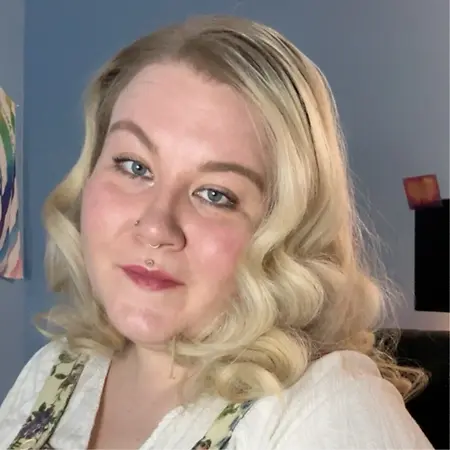
Her Story
About Sarah
Sarah Rose Smithson, M.A., is a Programs and Projects Manager, writer, graphic designer, and community advocate based in the Albuquerque–Santa Fe metropolitan area. She currently works at the Transgender Resource Center of New Mexico, where she supports the Co-Executive Directors in delivering direct support services, including harm reduction and mutual aid programs for transgender, nonbinary, and unhoused community members. Her work focuses on strengthening access to essential resources, coordinating services, and ensuring that community needs are met through responsive, mission-driven operations.
She holds a Master of Arts in International Relations from Queen Mary University of London and a Bachelor's degree in International Studies from the University of New Mexico. Her academic work focused on constructivist applications of international relations theory in Latin America and the Caribbean, sharpening her analytical thinking and deepening her interest in cross-cultural systems and global engagement. She has further invested in her professional development through certifications in Practical Project Management and Nonprofit Leadership Development from the University of New Mexico, and completed the Embracing Equity Anti-Racism Learning Series through Embracing Equity New Mexico.
Sarah Rose's career has spanned healthcare, hospitality, and IT — experiences that ultimately reinforced her commitment to building a long-term career in the nonprofit sector. She is most passionate about project management, program development, and administrative systems work, especially roles that involve improving efficiency, strengthening operations, and supporting teams behind the scenes. At Explora Science Center and Children's Museum, she was recognized with a departmental management award two years in a row for her leadership, communication, and responsiveness. During her tenure, she directed and managed two scholarship programs that awarded $42,500 in scholarships largely to BIPOC students, headed the organization's mentorship program, and successfully grew and refined a career pathways internship program over three years into a more focused and effective workforce development experience — collectively reflecting her deep investment in equity-centered education and workforce development.
Her creative practice spans graphic design, illustration, multimedia art, zine-making, and tarot, and she brings that visual and intuitive sensibility directly into her professional work through website design, social media management, and branded communications. She is a published author through Swimming With Elephants Publications and continues to weave writing, design, and storytelling throughout both her organizational and community work.
Beyond her professional life, Sarah Rose has volunteered with the Southwest Women's Law Center, Equality New Mexico, and Jemez Valley Animal Amigos, advocating for LGBTQ+ rights, gender equity, and animal welfare. She has directed Pride Parade planning committees for two organizations over three years, bringing organizational leadership and community vision to some of New Mexico's most visible celebrations of LGBTQ+ identity. Her time in Sydney, Australia, as an au pair and in community outreach further deepened her understanding of global issues and cultural diversity. She is a certified Youth Mental Health First Aid provider and a certified Adult and Pediatric First Aid/CPR/AED Instructor through the American Red Cross, reflecting her ongoing commitment to community safety and wellbeing.
A new face in the New Mexico fashion scene, Sarah Rose recently made her runway debut walking in the Locker 505 Charity Show for MadVan Design, expanding her creative presence beyond the page and into wearable art and community-centered fashion events.
Her Interview
Ten minutes with Sarah
01What do you attribute your success to?
My path into this field really crystallized during my master's degree, when I found myself weighing my prospects and realizing that working at the international scale felt too removed from the kind of change I actually wanted to make. I kept coming back to the same question: how do you change the world without first changing your community? How do you change your community without first helping an individual? Real systemic change has to start at the grassroots level, and that's where I wanted to be.
Exploring careers across healthcare, hospitality, education, and IT only deepened that conviction — what I kept coming back to was my love of project management, program management, and administrative systems work. There's something deeply satisfying about taking a system and making it work better for the people it's meant to serve. Combining that with mission-driven work in direct service to my community felt like the clearest possible answer. I'm just trying to create the change I want to see, starting locally.
02What’s the best career advice you’ve ever received?
The best career advice I ever received is simply: have fun. If you're not having fun at work, you're probably not in the right job. That's especially true in human services, where the work can be heavy, and burnout is real — a genuine sense of levity makes all the difference between work that drains you and work that sustains you.
For me, that shows up in small, intentional ways. I prioritize building warm, easy relationships with my team, and I make a point of bringing lightness into the workday wherever I can. I even carry a basket of fidget toys to meetings — a little bit of play goes a long way toward keeping people present, comfortable, and connected, as well as prioritizing accessibility for Neurodivergent professionals such as myself.
03What advice would you give to young women entering your industry?
Don't be afraid to take risks and experiment until you find your fit. Good work should feel meaningful and genuinely enjoyable — and your body will tell you when you're in the wrong environment. Trust that signal.
I'd also say: invest in your relationships with your coworkers more than you think you need to. Strong teams don't happen by accident, and your ability to build trust, navigate conflict, and show up for the people around you will matter just as much as any technical skill on your resume. Prioritize those things early, and they'll carry you far.
04What are the biggest challenges or opportunities in your field right now?
We're operating in one of the most challenging moments this field has ever seen. The federal landscape is increasingly hostile — transgender people are actively having their rights stripped, and rhetoric labeling gender-affirming advocacy as "radical" or even domestic terrorism creates a chilling effect on the work we do and the communities we serve. The stakes couldn't be higher.
At the same time, New Mexico is rising to meet that moment. For the first time in history, our women-dominated legislature has made extraordinary strides in protecting New Mexicans, and the state is becoming a true sanctuary in every sense of the word. That's genuinely inspiring — and it's something worth fighting to protect.
On the funding side, the writing is on the wall for nonprofits that have relied heavily on federal dollars. Diversifying funding streams isn't just a best practice anymore — it's a survival strategy. I'm seeing organizations across the sector prioritize that shift, and it's the right move.
Locally, homelessness in the Albuquerque metro is at a crisis point. The solutions exist — they're being proposed by the communities most affected — and what's needed now is the political will from the Mayor's office and city council to actually implement them. Continuing to sidestep structural solutions isn't just ineffective, it's a choice with real human consequences.
05What values are most important to you in your work and personal life?
Mission alignment is everything to me. Whether I'm at work or volunteering my time, I need to believe in what I'm doing and feel it connects to something larger than a paycheck or a task list. That's what drew me to the nonprofit sector, and it's what keeps me rooted there.
Community is at the center of that — human and otherwise. I'm a passionate LGBTQ+ advocate; I've sat on the roundtable for Equality New Mexico and continue to dedicate real time and energy to advocacy work in that space. But my sense of community extends to animals, too. I've done extensive fostering over the years, including a lot of bottle babies during quarantine, and I've volunteered with Jemez Valley Animal Amigos on rural drive-in vaccination and mobile spay-and-neuter clinics. I even currently foster a leopard gecko for a participant who lives in my office building. Animals deserve advocacy just as much as people do, and that work fills me up in a way that's hard to describe.
Creativity is a deeply held value, not just a skill set. I'm a multimedia artist, graphic designer, illustrator, zine maker, and tarot reader, and making things — whether that's a painting, a collage, a zine, a brand identity, or a tarot spread — is fundamental to how I process and engage with the world. I bring that creative sensibility into my professional work wherever I can, because I believe well-designed systems and communications aren't just more effective, they're more humane. Art and advocacy have always felt intertwined to me.
Curiosity rounds it all out. I'm a voracious reader who can clear a 300-page book in a day when I'm really in it, and I'm drawn to the strange and wonderful corners of the world. Natural history museums, pinned insect collections, taxidermy in the classical sense — I find that kind of careful, reverent documentation of the natural world deeply compelling. Wherever I travel, I'm always hunting down the best museums and restaurants in town.
Ultimately, what ties it all together is a belief that good work should be meaningful, grounded in relationships, and oriented toward justice — for people, for communities, and for the living world around us.
Join Influential Women and start making an impact. Register now.