Her Story
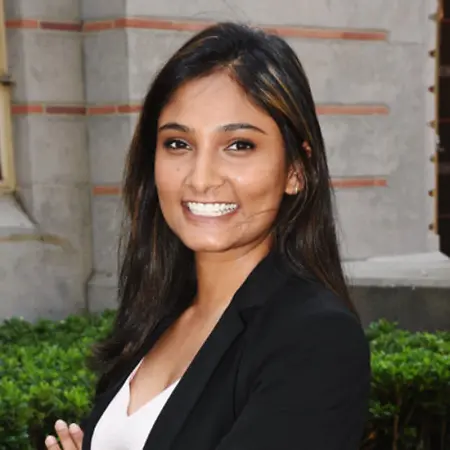
About Shalini
I've been passionate about space for as long as I can remember - my dad says that when I was a baby, nothing would calm me down more than him taking me outside at night to look up at the stars. He always knew there was going to be some special connection there. For the longest time, my goal was to be an astronaut, and that's still a goal, but building rockets is my stepping stone to get there. I've never wanted to be anything else. I've worked on different parts of rocket systems throughout my career, from the second stage engine to the second stage itself, and seeing those systems come together and launch successfully was an absolute goosebumps moment for me. My typical day involves mentally prioritizing what I need to achieve during my drive to work, because once I enter the office, the noise catches up quickly, especially when people come to me as a last resort for help. I keep my daily goals minimal so I can support my team while still accomplishing what I need to. My work includes understanding where things are on the production floor, addressing hardware needs and escalations, exploring trade space discussions, and conducting one-on-ones with my team. I'm currently taking some time off between roles, and my next position will be more technical and more aligned with what I want to do next in my career.
Her Interview
Ten minutes with Shalini
01What do you attribute your success to?
I think my parents had a big hand in helping me understand very early that sometimes no one can be there for you the way that you can be there for yourself. I have the ability to step away from a situation and look at it from a third-person view, because sometimes a situation looks bigger and scarier when you're in it, but when you're in a position where you're giving a friend advice, you're able to think more level-headedly and look at what is a contributing factor and what isn't, what is important and what isn't. My parents helped me realize that I could do that - change my perspective, take a step back, and look at it from a third-person perspective. I figured out what I needed to hear to get through certain situations, and what I needed to remind myself were the important things to eliminate variables that didn't contribute to a healthy mind or a perspective that actually helped me versus hurt me. I know how to talk to myself, and I think no one else has been able to do that for me, so the advice I give myself most times is what I would like to hear anyways, and that helps me kind of get through things.
02What’s the best career advice you’ve ever received?
The best advice I've learned - and I learned this the hard way rather than receiving it from someone - is to not think, just do. I really like simple advice because sometimes we overcomplicate it by making it too deep, and sometimes it isn't. It really is just that simple - shut off your brain, this is what you want, go after it, because no one's gonna give it to you. And you don't want the thing that people are just gonna readily give to you anyways. I learned this the hard way when I was on the other side of the statistics, where I would see an opportunity and just say, you know, this is not going to come my way anyway, so why put the effort in to go do it? I'll save my energy for the thing that I know I'm gonna get. And that was completely wrong. There's that famous quote, right? Whatever shot you don't take, you miss. So why accept failure before that is the outcome? I don't know what the outcome is, so why accept that you are going to fail in it without even giving it a shot.
03What advice would you give to young women entering your industry?
I would say, don't think, just do. A lot of times, the incredibly competent women I know tend to find reasons that something will not work out. In my last role, I was part of hiring efforts, and hiring managers would ask me why the percentage of women applying to technical roles is so low, especially considering the percentage of people graduating from college with technical degrees. I know the answer - it's because when a woman sees a job description with bullets of requirements and there's one bullet she maybe meets only 10%, 20%, or doesn't meet at all, she won't apply because she's already accepted that she's not qualified for that role. Versus a man who sees it and thinks, okay, well, it's one bullet in seven other bullets, I could do all of the other six, so if I can't do one, I'll leave it to them to decide whether or not I'm fit for that role, but I'm gonna give it a shot. So that's why I say, don't think, just do. You see something in front of you that you like, that you want to go do, just go for it. Don't overthink it, don't think why you can or can't meet it. Why accept failure before that is the outcome? I don't know what the outcome is, so why accept that you are going to fail in it without even giving it a shot.
04What are the biggest challenges or opportunities in your field right now?
The biggest challenge is bringing down the cost of a launch. Recently, NASA had their Artemis II launch, and there was a sound bite that went pretty viral about how much it costs to actually launch - it was around $40 billion in the multi-multi tens of billions of dollars. That's just not sustainable, right? NASA's also a government organization, and so it's a lot of money that everyone is contributing to. Artemis was in work for many, many years - sometimes people worked on it, retired before it launched - and that just isn't sustainable, especially with how much we know we can achieve and do with access to space. Bringing that down considerably and giving people access to space and the services that can provide is huge. That's the first step. A big part of that is reusability - every time you launch, a good chunk, probably 60% of that cost, is basically gone as soon as you launch because you can't reuse it. It's a one-time spend. Versus if you were to have a $20 million launch and you save 60% of that and reuse it, it gets less and less expensive. The payoff in terms of medical benefits and development in so many different fields, whether it be medicine or energy or so many other things, can really catapult human achievement. AI right now is the next big thing, but there's so much we have yet to go explore, and that next big technology revolution really comes with us being able to capitalize on what we can achieve by being in space and the resources in space.
05What values are most important to you in your work and personal life?
Number one is hard work. Nothing that comes easily is ever worth keeping, generally, or is going to stay around long enough anyway, so I think hard work is a huge part of it. The second thing is no half measures - I don't half-ass things. Even when I've tried to disassociate with certain situations to not be super invested either in the outcome or whatever else, I've ultimately caused myself more frustration and emotional drain by doing it halfway anyway. So if you're gonna do something and you're gonna only half-ass doing it, then it sounds like you're being indecisive about it, and at that point, what you need to figure out is what do you want in this situation? And then do yes or no. Sometimes you need to treat things as black and white. The third thing is just being kind - not just being kind to yourself, but also understanding that you don't know everything, you don't know another person's scenario, you don't know another person's constraints. This applies both personally and professionally. When something doesn't play out the way you expected from a person or situation, your instinct shouldn't automatically be, well, this person failed me, or this person clearly doesn't live up to the mark. You have to be able to be kind in the situation and understand that there's something you don't know, and there's something you don't need to know - you just need to give them the benefit of the doubt.
Join Influential Women and start making an impact. Register now.