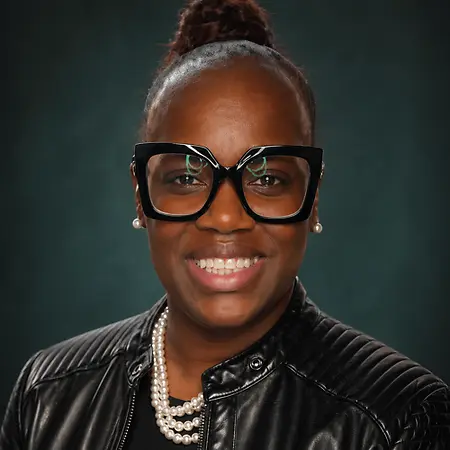
I trusted myself when I chose a path with no guarantees, only conviction, knowing my growth depended on taking that step.
Shalon Buskirk · In Her Own Words
Her Story
About Shalon
Shalon Buskirk is an experienced administrative and human resources professional based in Allentown, Pennsylvania, with a strong background in nonprofit organization management, customer service, and community outreach. She currently works in the human services field while also advancing her education in business administration and human resources management at Lehigh Carbon Community College. Throughout her career, she has developed strong skills in organization, communication, leadership, and supporting both staff and community needs in mission-driven environments.
Her professional experience spans a variety of roles, including administrative support, legal assistance, and human resources positions within nonprofit and service-based organizations. She also serves as the CEO and founder of Ascension HR Social and the Parris J. Lane Memorial Foundation, where she focuses on leadership, advocacy, and community impact. Her work is rooted in a commitment to helping others, building effective systems, and ensuring individuals are treated with dignity and respect in every setting.
In addition to her professional responsibilities, Shalon is actively involved in community service and board leadership with organizations such as Community Bike Works and the United Hearts of Autism. She is passionate about nonprofit work and advocacy efforts that strengthen families and support vulnerable populations. Known for her dependability, compassion, and attention to detail, she is dedicated to creating meaningful change through both her career and her ongoing community involvement.
Her Interview
Ten minutes with Shalon
01What do you attribute your success to?
I attribute my success to genuinely loving to help people and being a connector and a fighter who stands up for my staff and advocates for them to the fullest. That's just who I am as a person. I've been doing advocacy work for youth and gun violence prevention for over 20 years because these causes are very near and personal to me. When I lost my two sons to gun violence, the game changed - when it's a personal connection, it happens to you differently. I needed to turn my pain into purpose. I went back to school while navigating two tragedies and trauma, which was really hard. The degree I'm pursuing now is not for me - it's for my older son, Paris. I also started a nonprofit because I needed to get out of my head, and it's tailored to my son's name. I align myself with organizations that are a personal connection for me - I don't just do it to make it look pretty on a resume like some people do. I have to make sure I have a seat at the table and that my voice is heard, not just for me but for all other women who are fighting for a seat at the table. And first and foremost, God - along with my mentors Jean Raymond Hoffman and my mother Helen Easterling - they've been there for me through everything.
02What’s the best career advice you’ve ever received?
The best career advice I’ve ever received came from my mentor Jean Raymond Hoffman, my mother Helen Easterling, and my faith, all of whom taught me to stay grounded in integrity, lead with compassion, and trust that even in difficult moments, purpose and resilience will guide me forward.
03What advice would you give to young women entering your industry?
You have to align yourself with something that's really meaningful to you. Don't just do it because it looks good on a resume. If you have experienced a tragedy, turn that pain into purpose. It's hard - there's days where I don't want to get out of bed, but I have to. Give yourself grace. Don't let anybody put a timestamp on your grieving. Don't let all the naysayers tell you that you can't do it, because you can. You have to believe in yourself. As women, we have to empower women. We have to uplift them. We can't tear them down. There's so much jealousy and envy in this world, and with the way the world is working, that's what people want - they want to tear you down and not believe in you. I believe every woman can do it. You just have to align yourself with great women who support you, who believe in you, and who has your back. If you're not okay, you can't show up and be your best you. I needed to take my own advice. I'm too busy pouring into other people, I forget about me.
04What are the biggest challenges or opportunities in your field right now?
The biggest challenge right now is advocating for safer gun laws and trying to ban Glock switches in the state of Pennsylvania. 27 states have banned Glock switches already, but we're working on making stronger gun laws because the way people just buy guns off the street is alarming. It's personal to me because I lost two sons to gun violence. Another challenge has been navigating grief while continuing my advocacy work and education. I stepped away for a little bit because I needed to work on me - if I'm not okay, how can I serve the people that I advocate for every day? I needed to make sure I'm okay. I'm too busy pouring into other people, I forget about me. As a Black woman, I have two strikes against me already, so I have to make sure I have a seat at the table. I need to make sure my voice is heard, and my voice is heard for all other women who are fighting for a seat at the table.
05What values are most important to you in your work and personal life?
The values most important to me are being trustworthy, being a great listener, being ambitious, and being assertive. People take being assertive as a curse, especially as a woman, and for me, being a Black woman, I have two strikes against me already. So I have to make sure I have a seat at the table. I need to make sure my voice is heard, and my voice is heard for all other women who are fighting for a seat at the table. Communication is key - you have to be able to effectively communicate, both orally and in written form. Representation matters - I look just like you. I align myself with organizations that are a personal connection for me. I don't just do it to make it look pretty on a resume like some people do. If I could just help one mother, one grandmother, one aunt, one guardian, and let them know, hey, I see you, I've been there, I have walked that walk with you, but I'm willing to walk beside you to get you through these dark, tough days.
Join Influential Women and start making an impact. Register now.