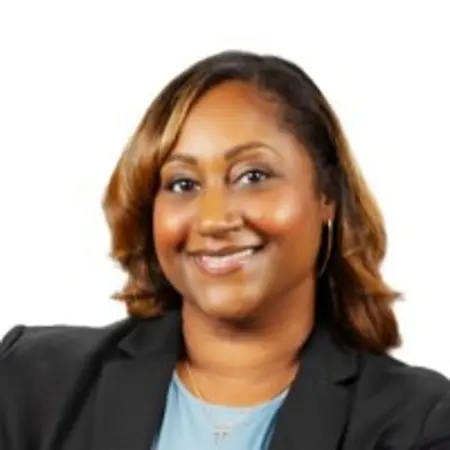
Her Story
About Shanda
Shanda Jones is an operations leader with extensive experience in healthcare staffing, organizational strategy, and team development. Currently serving as Operations Director for a confidential organization, she oversees key operational functions including licensing, process development, recruitment, onboarding, and human resources management. Known for her ability to bring structure and clarity to complex organizations, Shanda specializes in building efficient systems that improve performance, streamline operations, and support sustainable growth. Over the course of her career, Shanda has held several leadership roles within the healthcare staffing industry, including senior positions at NurseCore and Maxim Healthcare Services. During this time, she successfully led initiatives such as expanding operations across multiple markets, launching and scaling new divisions, and improving client and employee engagement. Her leadership has often involved guiding teams through periods of growth and transformation, while implementing processes and technologies that strengthen organizational performance and service delivery. Shanda began her professional journey in management roles at Enterprise Rent-A-Car before transitioning into healthcare program management and staffing operations. She holds a Bachelor of Science in Psychology from Albany State University and an MBA from Columbia Southern University, along with a certification in Niche Recruiting from LinkedIn. With more than nine years of experience in healthcare staffing and operations leadership, Shanda is recognized for her strategic mindset, operational expertise, and commitment to fostering high-performing teams.
Her Interview
Ten minutes with Shanda
01What do you attribute your success to?
I attribute my success to my hard work and my willingness to push myself outside my comfort zone. I've never let an obstacle get in my way. I've made myself very uncomfortable, and that's only benefited me. I was in a position where I was at a job for years, and it was cool, I was sailing along and making it. But it wasn't until I forced myself to leave that job and find something else that I really went out there and did what I was supposed to do. I had to make myself really uncomfortable before I could force myself to put myself out there and get what I wanted to get. Some people are afraid to take that step, and that's what holds them back. I was lucky that I came to that realization young enough, where I still had time to go back to school and dedicate two years to getting my master's.
02What’s the best career advice you’ve ever received?
The most valuable lesson I've learned is that no one has all the answers. As you grow and get to these executive board levels, a lot of it is just people asking each other, 'Hey, what do you think? Do you think this will work?' You would think they have all the answers, but no, they don't. They're trying to figure it out too. We're human, right? No one is the end-all, be-all. No one knows everything. It's about teamwork and being a collective. That's why you have to have strong leaders in place. We have a strong leadership team here, and I don't know everything about talent acquisition, so I poke my VP of Talent Acquisition because she's the expert in that field.
03What advice would you give to young women entering your industry?
I would say be yourself. You're more accepted, or you will be more accepted in larger spaces than you think. That's something that I struggled with when I was coming into corporate America as a Black woman. I realized the more authentic I was to myself, the more elevated my positions got, because there are companies out there that are looking for those perspectives. I am not afraid to speak up, and you can't be afraid when you get to these levels and when you're in these rooms with these executives. Don't be afraid to speak up, don't be afraid to add your input, because it matters. One thing that I know for a fact is that most people in these rooms don't know what they're doing, or a lot of them are trying to figure it out. It's a room of people with big titles that are coming together for one purpose, but that doesn't mean that they have all of the answers. So it's important to make sure you put your piece in and work as a team. Don't be intimidated by the titles.
04What are the biggest challenges or opportunities in your field right now?
The biggest challenge right now on the tech side is that everyone is not tech-savvy. A lot of people don't understand AI, or automation, or how systems work. As we go through tech stack evaluations, it's about bringing everybody up to speed and trying to educate everyone. For example, when you go to have a demo with a vendor, they can only show you so much of what their system can do within an hour. For someone like me, I can see something and say, 'Okay, they have this capability, so I know I can do X, Y, and Z,' compared to someone who may not have that vision or foresight. That slows down the process a lot. Some people are hesitant about incorporating AI into their everyday practices out of fear of being replaced, or just not understanding how it works. As the tech person, I have to make them comfortable with that and explain that it's not taking your job, but it's making your job a lot easier so you can focus on the things you want to focus on. On the opportunity side, I would say the opportunities right now are kind of endless. With the advancement of AI and investments into technology, there are a lot of companies creating amazing things. Within the next couple of years, I think a lot of the way we do business is going to change. I've been on so many demos these last couple of months, and I've seen AI do things that I never would have thought, especially not in a business sense. I really think the possibilities are endless, and the more people educate themselves and figure out how to use it to their benefit, the better. I always compare AI and ChatGPT to a calculator. It shouldn't replace you, but it should be a tool. You should be able to use it as a tool to put that sprinkle onto everything that you do, but it shouldn't be your all-in end-all.
05What values are most important to you in your work and personal life?
In my work, being able to do something that's bigger than myself is really important. Even though I'm in project management and a lot of what I do is behind the scenes, I know the company I work for has a bigger mission. Knowing that people may not see what I do behind the scenes, but that I'm part of the solution of making things move forward or making processes better, gives me purpose. Nobody wants to just go to work for a paycheck. I feel like it needs to be more than that. It needs to be mission-driven. I wanted to get into healthcare because I wanted to help people, and even though I couldn't go the route that I necessarily thought I wanted to go, I figured out a different way to be able to do that. I'm also kind of selective on the positions that I take and the companies that I want to associate myself with, based on past experiences. I want to make sure that the employer I'm working for is reputable, that they do business well, and that they create a culture that is healthy for everybody. I can honestly say that at Matrix, I see that here. That overall culture within the company is really important to me. Personally, I have a family, and having that work-life balance is crucial. I'm very family-oriented, so anything that's going to allow me to provide for them and put them first is going to be important.
Join Influential Women and start making an impact. Register now.