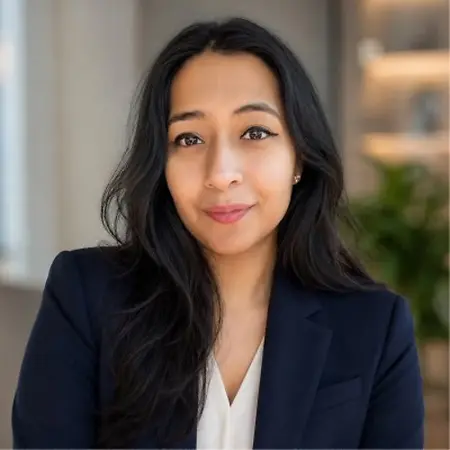
Confidence isn't something you're born with. It's built one courageous decision at a time. I've learned that courage creates confidence, not the other way around.
Shanila Rashid · In Her Own Words
Her Story
About Shanila
Shanila Rashid is a Senior Standardization Manager at a Target-owned Return Center in Maryland, where she leads enterprise-wide standardization, continuous improvement, inventory control quality assurance (ICQA), training operations, and change management initiatives. As the site’s Change Captain, she partners with senior leadership to drive operational transformation, strengthen workforce capability, and implement scalable processes that improve organizational performance. She oversees a team of approximately 70 members, including six direct leaders, while championing operational excellence through collaboration, innovation, and people development.
She holds a Bachelor of Science in Industrial Engineering from the University of Texas at Arlington and has further strengthened her leadership expertise through an Executive Leadership Certificate from Cornell University, a Six Sigma Green Belt certification from IISE, and a BasicMOST Certification from Accenture. With a professional foundation rooted in process engineering, Lean methodologies, and standardization, Shanila has built a career centered on creating structure within complex, fast-paced environments and transforming reactive operations into sustainable, high-performing organizations.
Shanila’s career spans multiple industries and nationally recognized organizations. She began as a Process Technician at McCormick & Company before joining the United States Postal Service as an Operations Industrial Engineer, where she led continuous improvement initiatives and developed the organization’s first fulfillment process supporting nationwide COVID-19 test kit distribution. Since joining Target in 2022, she has played an instrumental role in launching and stabilizing multiple supply chain facilities—including the company’s first manual food distribution center—and now leads strategic initiatives that shape operational consistency, leadership development, and organizational readiness across one of Target’s return center operations.
Beyond her professional achievements, Shanila is passionate about investing in people and giving back to the community. She volunteers with Martha’s Table, serves as a pro bono consultant helping entrepreneurs strengthen their products, services, and business strategies, and has contributed to community initiatives through The Awareness Project, a 501(c)(3) nonprofit organization. She also served as a Mathematics Tutor for ASME members at her alma mater and has maintained active membership with the IISE Manufacturing and Design Division since 2017.
Fluent in Bengali, English, Hindi, and Urdu, Shanila brings a culturally diverse perspective to leadership. She is known for remaining composed and level-headed in high-growth, rapidly changing environments, making thoughtful decisions amid ambiguity, and bringing an exceptionally organized, systems-oriented approach to solving complex business challenges. Her leadership philosophy is grounded in empowerment, accountability, and continuous improvement, always believing that developing people is the foundation of sustainable operational success. As she continues her leadership journey, Shanila’s aspiration is to advance into a Director-level role, where she can influence organizational strategy on a broader scale, cultivate future leaders, and drive transformational change that creates lasting business and people impact.
Her Interview
Ten minutes with Shanila
01What do you attribute your success to?
I attribute my success to three things: leading by example, embracing change, and never becoming complacent in my own growth. Every step of my career has challenged me to step outside my comfort zone—from starting on the manufacturing floor at McCormick, to designing critical operational processes at the U.S. Postal Service during the COVID-19 response, to now leading standardization, continuous improvement, training, and quality functions at Target. Rather than viewing uncertainty as a barrier, I’ve learned to see it as an opportunity to create structure, solve problems, and help others succeed.
I believe the strongest leaders listen first, remain humble enough to keep learning, and earn trust by being willing to do the work alongside their teams. That philosophy has allowed me to build meaningful relationships, develop future leaders, and navigate complex, fast-paced environments with confidence and composure. I’m also deeply committed to investing in myself—whether through earning my Executive Leadership Certificate from Cornell or continuously seeking feedback and new challenges—because I believe great leadership is a journey of lifelong learning. Ultimately, my success has been driven by a genuine passion for developing people, improving systems, and leaving every organization stronger than I found it.
02What’s the best career advice you’ve ever received?
The best career advice I’ve ever received was, “Don’t be afraid to fail—be afraid of never trying.” That mindset has stayed with me throughout my career and has given me the confidence to take on opportunities before I felt completely ready. Some of my greatest professional growth has come from stepping into ambiguity, thinking differently, and challenging the status quo. I’ve learned that innovation rarely comes from playing it safe, and sometimes the biggest breakthroughs begin with simply asking, “Why not?”
Another lesson that has shaped my leadership is that change isn’t something you push onto people—it’s something you help people believe in. Before introducing a new process or idea, I always try to understand what matters most to those it will impact and answer the question, “What’s in it for them?” When people understand how change makes their work easier, safer, or more meaningful, they’re far more likely to embrace it.
That philosophy has guided me from engineering and process improvement to leading organizational transformation and developing future leaders. I continue to approach every challenge with curiosity, resilience, and the belief that meaningful growth comes from taking thoughtful risks, learning from setbacks, and having the courage to keep moving forward.
03What advice would you give to young women entering your industry?
My advice is to never let inexperience or fear of failure stop you from pursuing opportunities that challenge you. Some of the biggest milestones in my career came from raising my hand before I felt completely ready and trusting that I could learn along the way. Don’t be afraid to think differently, ask questions, and challenge the status quo—innovation begins when someone is willing to look at a problem from a new perspective.
As you grow into leadership, remember that your role isn’t to have all the answers; it’s to bring out the best ideas in others. Lead by example, set clear expectations, and create an environment where people feel empowered to think creatively and take ownership. I’ve found that asking thoughtful questions is often far more powerful than giving instructions.
Most importantly, listen before you speak, stay curious, and invest in your own development. Technical skills may open the first door, but communication, emotional intelligence, resilience, and the ability to lead through change are what will sustain long-term success. Believe in your capabilities, even when you’re the only woman in the room, because confidence is built through action—not by waiting until you feel ready.
04What are the biggest challenges or opportunities in your field right now?
One of the biggest challenges—and opportunities—in operations today is leading organizations through constant change. Supply chains are evolving faster than ever, driven by automation, artificial intelligence, shifting customer expectations, and increasingly complex business demands. While technology continues to transform how we work, the greatest challenge isn’t implementing new systems—it’s helping people embrace them.
Successful change happens when leaders build trust, communicate the “why,” and help individuals understand what’s in it for them. I’ve found that the most sustainable transformations occur when employees feel heard, involved, and empowered rather than simply being told what to do.
At the same time, this creates an incredible opportunity for leaders who can balance operational excellence with people development. Organizations need leaders who are comfortable making decisions amid ambiguity, remain calm in fast-paced environments, and can create structure where uncertainty exists. Those who combine strategic thinking, empathy, and continuous improvement will be the ones who shape the future of our industry and build organizations that are both high-performing and people-centered.
05What values are most important to you in your work and personal life?
The values that guide me, both professionally and personally, are empathy, integrity, continuous growth, and leading by example. I believe some of the best decisions come from taking a step back and looking at a situation through someone else’s perspective before forming your own conclusion. Whether I’m leading a team, managing change, or navigating a difficult conversation, understanding what motivates others helps me build trust and create solutions that work for everyone involved.
I also believe that failure is not something to fear—it’s one of our greatest teachers. I’ve never been afraid to challenge the status quo, think outside the box, or take calculated risks because growth rarely happens inside our comfort zone. Finally, I believe leadership is earned through action. I strive to model the standards I expect from others, remain open to feedback, and create an environment where people feel empowered to learn, contribute, and become the best version of themselves.
Join Influential Women and start making an impact. Register now.