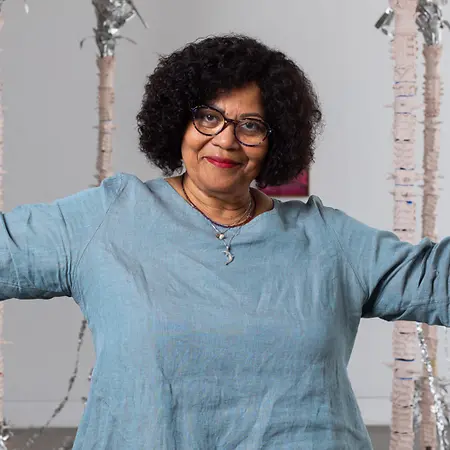
A powerful reflection on self-knowledge and conviction, exploring how women can honor their intellect and ambitions while navigating life's demands, without waiting for ideal conditions.
Her Story
About Sharon
I am a faculty member in the College of Creative Studies at the University of California, Santa Barbara, where I have also served as Director of the Center for Black Studies Research since 2018. My intellectual home in CCS is the perfect fit for my way of thinking and being in the world. Unlike traditional academic departments, CCS invites and expects boundary-crossing, and that is exactly where I thrive. It is a space that honors curiosity without borders, and for a scholar like me, that freedom is not a luxury but a necessity.
I have always described myself as a conceptual architect, someone who does not simply work within existing frameworks but designs new ones. I am a transdisciplinary thinker at heart, someone who finds the most exciting questions living in the spaces between disciplines, between communities, between what we know and what we have not yet imagined. I do not believe in building bigger boxes. I believe in building entirely new ones.
That spirit is at the heart of two initiatives I am particularly proud of. The Student Engagement and Enrichment in Data Science program, known as SEEDS, was born from my conviction that data science belongs to everyone, not just those who have traditionally been invited to the table. SEEDS creates pathways for students across all disciplines to engage with computational and data science through an anti-racist, intersectional, and design justice lens. Similarly, the Learning Institute for Visionary Epistemologies in STEM and Interdisciplinary Studies, LIVE and LIVES, reflects my belief that how we know things matters just as much as what we know. Both programs are about bringing all disciplines and all people to the forefront, because innovation without inclusion is simply not innovation at all.
For me, the work is personal. It is rooted in a lifelong commitment to equity, to the full humanity of every learner, and to imagining the kinds of institutions and technologies we have not yet had the courage to build.
Her Interview
Ten minutes with Sharon
01What do you attribute your success to?
I attribute my success to three core values that have anchored everything I have done: determination, drive, and commitment. These are not simply words I have adopted along the way. They are a profound legacy, handed down to me by my grandmother, whose life and character continue to shape who I am and how I show up in the world every single day.
My grandmother was a woman who understood, long before the world was ready to acknowledge it, that excellence was not optional and that giving up was simply not a choice. She did not have access to the institutions or opportunities that I have been fortunate enough to inhabit, yet she carried herself with a dignity, a purposefulness, and a quiet power that I have never forgotten. Watching her taught me that determination is not about the absence of obstacles but about the refusal to be defined by them. That drive is not something the world gives you but something you protect and cultivate from within. And that commitment, real commitment, means showing up fully even when it is hard, even when it is lonely, and even when no one is watching.
I carry her with me into every classroom, every research project, every initiative I build, and every student I mentor. When I think about why I do this work, why I push to create new programs, new frameworks, and new possibilities for students who have been told there is no place for them, I think of her. She is the reason I believe so deeply that every person deserves to be seen, supported, and given the chance to thrive. Her legacy is not just personal. It lives in every life this work touches.
02What’s the best career advice you’ve ever received?
The most transformative advice I ever received was deceptively simple, yet it has proven to be the most enduring truth I carry: believe in yourself. Not blindly, not arrogantly, but deeply and consistently, even when the evidence around you seems to suggest otherwise. In a world that too often asks women, and particularly women of color, to shrink, to qualify their brilliance, and to second-guess what they know to be true about themselves, that advice is nothing short of revolutionary.
I have learned over the course of my career that self-belief is not a destination you arrive at once and then possess forever. It is a practice. Some days it comes easily, carried forward by momentum and affirmation. Other days it requires a conscious, deliberate choice to stand in your own truth when the noise of doubt, from within or from without, grows loud. What has helped me most in those moments is returning to two anchors that have never failed me: integrity and gratitude.
Integrity, for me, means doing the work honestly, speaking the truth even when it is uncomfortable, and refusing to compromise my values for the sake of convenience or approval. It means that when I look back at the choices I have made, I can stand behind them. And gratitude, genuine and constant gratitude, is what keeps my feet on the ground when success could otherwise lift me away from what matters. Being thankful for where I came from, for the people who believed in me before I fully believed in myself, and for the opportunity to do work that matters keeps me connected to my purpose.
Together, these values, self-belief, integrity, and gratitude, form a compass. When the path forward feels uncertain or overwhelming, I return to them. And every time, they point me in the right direction.
03What advice would you give to young women entering your industry?
Here is an expanded version in her own voice:
First and foremost, I want every young woman entering this industry to hear this clearly: believe in your own vision. Not a version of it that has been edited down to make others comfortable, not a cautious, hedged approximation of what you truly see, but the full, bold, unapologetic vision that lives inside you. The world will offer you many opportunities to shrink it. Do not take them. Your vision is not a liability. It is your greatest asset.
Beyond that, I urge you to cultivate a spirit of gratitude as a daily practice, not as a performance of humility, but as a genuine acknowledgment of the people, the moments, and the struggles that have shaped you and continue to carry you forward. Gratitude has a way of keeping you honest. It reminds you that you did not get here alone, and that the success you build is most meaningful when it creates pathways for others to follow.
I also want to speak directly about the people you choose to surround yourself with, because this may be one of the most important decisions you ever make. Seek out people of positive energy and high integrity. Not people who simply agree with you or celebrate everything you do, but people who challenge you with love, who hold you accountable with kindness, and who show up for you with consistency. Guard that circle carefully, because the energy of the people closest to you will shape your thinking, your confidence, and your sense of what is possible in ways you may not even notice until you look back years later.
And please, do not underestimate the power of genuine human connection. Networking is a word that has been drained of its meaning in many professional circles, reduced to the exchange of business cards and LinkedIn requests. But what I am talking about goes so much deeper than that. I am talking about building real relationships, relationships grounded in mutual respect, shared purpose, and authentic care for one another's growth and wellbeing. These are the relationships that sustain you when a project fails, that celebrate you when you succeed, and that remind you of your worth on the days when you have forgotten it. In my experience, it is not the credentials on your resume or the accolades on your wall that carry you through the hardest seasons of a career. It is the people who know your name, believe in your work, and refuse to let you give up. Invest in those people. Be that person for others. That is the most enduring currency any of us will ever have.
04What are the biggest challenges or opportunities in your field right now?
We are standing at a critical crossroads, and I do not use that phrase lightly. The rapid evolution of artificial intelligence is not simply a technological shift. It is a civilizational one, and it is happening faster than our institutions, our ethics, and frankly our imaginations have been able to keep pace with. The opportunities for innovation are genuinely vast and, in many ways, thrilling. AI has the potential to democratize access to knowledge, to personalize learning in ways we have only dreamed of, and to help us solve problems that have resisted solution for generations. I am not someone who turns away from that potential. I lean into it, study it, and work to shape it.
But I also hold a profound concern that I believe we must name clearly and honestly: as we lean more heavily on technology to mediate our lives, our work, and our relationships, we are at risk of losing something irreplaceable. We are moving, sometimes without even noticing, away from authentic, human-to-human connection. The kind of connection that cannot be optimized, automated, or replicated by even the most sophisticated algorithm. The kind that happens when someone truly sees you, listens to you, and chooses to show up for you not because a system prompted them to, but because they genuinely care.
This tension is at the heart of my work in the College of Creative Studies and beyond. I study empathy not as a soft skill but as a fundamental human capacity that is being quietly eroded in a landscape that rewards efficiency over intimacy and speed over depth. My research on how empathy, engagement, and self-efficacy shape learning is, at its core, a argument for the enduring importance of the human element in education and in life. Technology should serve our humanity, not substitute for it.
The most important work we can do right now, as educators, as researchers, as leaders, and as human beings, is to ask ourselves with real seriousness: what do we refuse to outsource? What parts of connection, of care, of meaning-making, are so essentially human that we must protect them even as everything else transforms around us? I believe that how we answer those questions in this moment will define not just the future of education or technology, but the future of who we are to one another. And that is a question I intend to keep asking, loudly and for as long as I am able.
05What values are most important to you in your work and personal life?
Here is an expanded version in her own voice:
If I am being truly honest about what anchors everything I do, it begins and ends with gratitude. Not gratitude as a social nicety or a passing acknowledgment, but gratitude as a lived philosophy, a daily orientation toward the world that shapes how I receive people, how I approach my work, and how I move through both the triumphs and the trials that inevitably come with a life fully lived.
Gratitude is not something I practice when things go well. It is what I return to precisely when they do not, because it is in the difficult moments that thankfulness becomes most powerful and most necessary.
Alongside gratitude, I hold ethics at the very center of how I operate. I believe deeply that how we do our work matters just as much as what we accomplish. The shortcuts we refuse to take, the credit we give generously, the honesty we maintain even when it costs us something, these are not small things. They are the substance of a life and a career that you can look back on with genuine pride. I have always sought to collaborate with people who share this commitment, people who bring not just talent and intelligence to the table, but a positive morality, a genuine desire to do right by others and to leave the spaces they inhabit better than they found them. Those are the partnerships that sustain meaningful work over the long term, and those are the people I choose to build with.
But I also want to say something that I think gets lost in conversations about professional success and achievement, because our culture has a way of reducing a life's worth to its outputs, its publications, its awards, its titles. Life is so much more than what you accomplish. It is about the people you love and who love you back. It is about the student who comes to your office hours struggling and leaves feeling seen. It is about the colleague who takes a chance on a collaboration that changes both of your trajectories. It is about the unexpected moments of beauty and connection that no resume will ever capture but that you carry with you always.
Being deeply appreciative of the people in your life, and of the unique experiences that shape your journey, is not a passive state. It is an active choice, made again and again, to recognize that you are surrounded by gifts, even when they arrive disguised as challenges. Graciousness, in both the rewarding seasons and the hard ones, is what keeps you human, keeps you humble, and keeps you connected to what truly matters. That is the value I most want to model, and most want to pass on.
Her Content Hub
Articles by Sharon
Know who you are! Before the titles, I knew who I was
A life shaped by conviction, not circumstance—the power of knowing yourself early and refusing to betray that knowledge.

I do not tell my story as one of discovering that I was capable. I always believed that I was.
When I was seven years old, I went to the library and checked out a book on the biochemistry of microorganisms. Did I understand it? Not fully. But I tried. Even then, something in me was reaching. Something in me already knew that my mind was meant to stretch beyond what was immediately familiar.
That matters, because too many stories about women’s lives begin with doubt, as though our power only becomes visible after hardship has first convinced us that we have none. That was never my story. My life was not easy, but I was never confused about whether I had ability, intellect, or promise. I was told I was smart. I was told to believe in myself. And I did.
The challenge was never whether I could become someone. The challenge was building a life that could hold what I already knew about myself.
I became a teenage parent. Later, I found myself raising children while pursuing my doctorate, working as a research assistant and teaching assistant, and living in family student housing on campus. At one point, my children were 20, 10, 3, and 4 months old. My eldest daughter was in art school when I returned to the university. My youngest had been born prematurely at just 1 pound, 9 ounces. I was also moving through the collapse of my marriage and carrying the full responsibility of making a way forward for my family.
That period of my life was not the beginning of my belief in myself. It was the proving ground for it.
I did not wake up in those years and suddenly decide I had value. I already knew I had a mind. I already knew I could learn. I already knew I could build. What those years required of me was not self-discovery, but discipline. Not a lesson in worthiness, but a sustained commitment to honoring what I knew I was capable of becoming, even while life was demanding everything from me.
That distinction matters to me.
I am not interested in telling a “look how hard it was and look what I overcame” story. There is nothing wrong with survival narratives, and many women rightfully claim them. But I have always felt that my life was shaped less by hardship itself than by my refusal to let hardship define the outer edge of my future. I did not see myself as someone waiting to be rescued by confidence. I saw myself as someone with responsibility, ability, and work to do.
So, I did the work.
I left my job as a K–12 teacher and entered doctoral study. I supported my family through assistantships. I mothered, studied, worked, wrote, and persisted. I completed my dissertation in 1998 while accepting a position as an assistant professor. I formally filed the dissertation in 2000 as I prepared to pursue opportunities at a research university because, by then, I knew clearly that my deepest scholarly commitments would flourish most fully in a research-intensive environment. That was not a rejection of teaching. I valued teaching deeply and had already devoted myself to it. It was an affirmation of the kind of intellectual life I knew I was called to build.
What I have learned across that journey is that voice is not always born from pain. Sometimes it is born from conviction.
Sometimes a woman’s voice emerges not because she has finally been told she matters, but because she has known all along that she matters and refuses to live beneath that knowledge. Sometimes the struggle is not believing in yourself. Sometimes the struggle is protecting your sense of self from reduction, interruption, dismissal, and the thousand daily pressures that would make you smaller if you let them.
That was true for me.
Motherhood did not diminish my intellectual life. It sharpened it. Responsibility did not weaken my ambition. It clarified it. Early parenting, single parenting, graduate study, and professional aspiration were not separate chapters that took turns defining me. They were simultaneous realities, and I had to learn how to carry them without surrendering any essential part of myself.
I wanted something different for my children. I wanted them to see that intellect is not a luxury reserved for people with easy lives. I wanted them to understand that education is not merely credentialing. It is a way of widening what is possible. I wanted them to witness a woman who did not abandon her mind, even when life gave her every reason to postpone herself.
That is what I mean when I talk about voice.
Voice is not just an expression. It is authorship. It is the decision to live in alignment with what you know to be true about yourself. It is the refusal to shrink your aspirations because your circumstances are demanding. It is the discipline of continuing to think, build, and become while carrying real responsibilities.
Too often, women are encouraged to wait: wait until the children are older, wait until the money is steadier, wait until the divorce is behind you, wait until the grief lifts, wait until there is more time, quieter, more certainty.
But many women will never be handed ideal conditions.
I was not.
And yet, I never believed that difficult conditions meant I was meant for a smaller life.
That is the message I most want to share, especially with women who are carrying multiple realities at once. You do not need to wait for ease to honor your intellect. You do not need perfect conditions to begin building the life that corresponds to your gifts. You do not need a world that fully accommodates your ambition before you claim it.
There is a difference between having a hard life and having a diminished sense of yourself. The two are not the same.
My life included difficulty. It also included clarity. I knew early that I was curious. I knew early that I could learn. I knew early that my mind was alive. From that point forward, the task was not learning to believe in myself. It was learning how to keep faith with that belief while moving through the demands of real life.
Before the titles, I knew who I was.
Before the appointments, the publications, the leadership roles, and the public recognition, I knew I had a mind worth cultivating. I knew I was not meant to remain confined by circumstance. I knew that my children needed to see what it looks like when a woman trusts her capacity and builds accordingly.
That knowledge sustained me.
And that is what I hope other women hear in this story: not that life will become easy, not that obstacles are poetic, and not that hardship automatically transforms us, but rather that there is power in knowing yourself early and refusing to betray that knowledge later.
Sometimes the most important thing a woman can do is not to discover that she is capable.
It is to remember that she always was.
Join Influential Women and start making an impact. Register now.