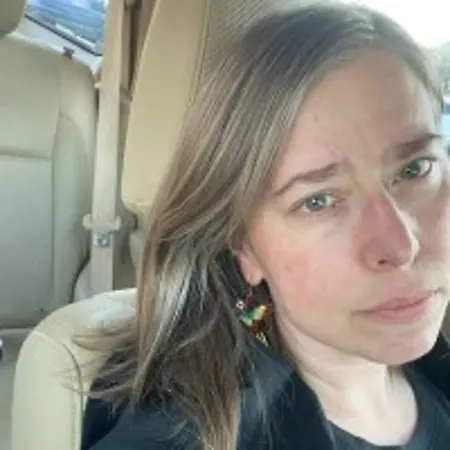
Her Story
About Sharrah
Sharrah Lane is a Spanish educator and Latin American researcher based in Chapel Hill, North Carolina, currently serving as an Assistant Teaching Professor at the University of North Carolina at Chapel Hill. With over five years of experience in higher education, she teaches a wide range of courses—from beginner and intermediate Spanish to specialized topics such as Spanish for medical professionals, Hispanic film, and youth in Latin America—while also co-advising the Spanish Minor in the Professions. Her teaching emphasizes creativity, community-building, and student engagement through innovative, experiential learning approaches. Her research centers on contemporary Latin American film, particularly the representation of children and the ways film production intersects with broader economic and cultural systems. She has explored how media reflects and reinforces societal structures, including capitalism and identity formation, and has contributed scholarship on both film studies and the use of artificial intelligence in language teaching. In addition to her academic work, she has engaged in translation projects supporting transgender Latino immigrant communities, demonstrating a commitment to socially impactful scholarship. Lane’s academic journey includes a PhD in Hispanic Studies from the University of Kentucky, where she also held leadership roles and received multiple honors for her research and service. Beyond the classroom, she co-leads study abroad programs in Costa Rica, providing students with immersive cultural experiences that complement their academic learning. Driven by a passion for language, culture, and education, she strives to create inclusive spaces where students feel empowered to take intellectual risks and build meaningful connections.
Her Interview
Ten minutes with Sharrah
01What do you attribute your success to?
I attribute my success to the support of colleagues, a creative and innovative approach to teaching and research, and a strong commitment to helping and positively impacting my students.
02What’s the best career advice you’ve ever received?
You are where you need to be.
03What advice would you give to young women entering your industry?
Embrace experimentation in your teaching practice and remain open to new approaches. For example, I’m currently teaching a culture course for which I designed a creative final project. While we have encountered a few challenges along the way, they have been manageable and instructive.
I have increasingly incorporated creative final projects into my courses, as effective teaching involves staying attuned to the needs and interests of students. By engaging directly with them, I aim to identify not only what they know, but also what will sustain their curiosity and engagement. As a result, my assignments often emphasize creativity alongside academic rigor, encouraging students to explore ideas beyond conventional boundaries and to take thoughtful risks. The project my students are currently working on involves researching a particular decade in a specific Latin American country and considering the child’s perspective during that time period. The final deliverable is a project that incorporates political, social, and cultural information that represents this child’s perspective.
I am transparent with students about this process, framing these projects as collaborative experiments. I emphasize that if outcomes differ from expectations, it is an opportunity for adjustment and growth rather than failure. Equally important is cultivating a network of supportive colleagues within one’s department, who can offer feedback and perspective on innovative teaching practices.
Maintaining balance is also essential. Taking time for personal interests outside of work helps sustain energy and perspective, particularly in a profession that often intersects closely with one’s identity. Ultimately, what I find most rewarding is witnessing how my courses can shift students’ perspectives and foster a strong sense of community within the classroom.
04What are the biggest challenges or opportunities in your field right now?
The biggest challenges in my field include balancing multiple responsibilities, managing time constraints, and navigating delays in academic publishing. At the same time, there are exciting opportunities to integrate creative and experiential learning into coursework, expand curricular offerings, and use AI in meaningful ways to enhance language teaching.
05What values are most important to you in your work and personal life?
The values most important to me in my work and personal life are community, creativity, helping others, and a strong commitment to making the world a better place.
Join Influential Women and start making an impact. Register now.