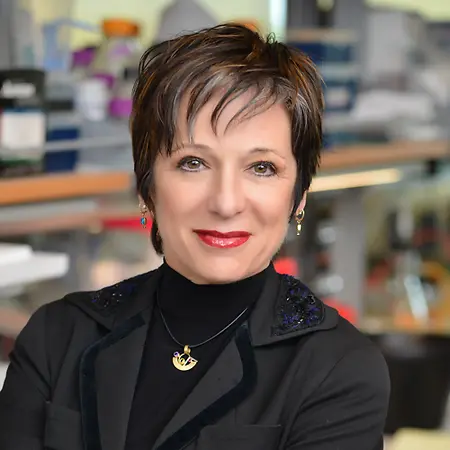
Strength is born from the will to succeed, bringing colleagues along as a team, maintaining control through rocky seas and calm waters alike.
Sheila Collins · In Her Own Words
Her Story
About Sheila
Sheila Collins is a Professor at Vanderbilt University Medical Center and a nationally recognized scientist in the field of cardiometabolic disease research. She runs an active research laboratory focused on obesity, diabetes, and heart disease, with particular expertise in adipocyte biology and receptor signaling. In addition to leading discovery science, Sheila mentors PhD students and postdoctoral fellows, reviews grant applications for major funding agencies, serves on editorial review panels for academic journals, and consults with pharmaceutical companies on early-stage discovery projects. Across all of her roles, she emphasizes rigorous, hypothesis-driven research that connects fundamental biochemical mechanisms to human disease.
Sheila’s career spans decades of academic and translational science. She began her training as a research technician at Massachusetts General Hospital (Harvard Medical School) and Caltech before earning her PhD from the Massachusetts Institute of Technology, which she began in 1980 and completed in 1985. She went on to complete a postdoctoral fellowship at Duke University, focusing on receptor biology, and joined the academic faculty ranks in 1992. Since then, she has maintained a sustained research career that bridges academia and industry, contributing both foundational discoveries and applied insights to the biomedical field.
A committed advocate for scientific rigor, mentorship, and public understanding of science, Sheila values making complex research accessible while training the next generation of scientists to pursue meaningful, long-term questions. Her contributions have been recognized through features in regional publications and public outreach campaigns highlighting local leaders, and she has been selected as an Influential Woman for 2026.
Her Interview
Ten minutes with Sheila
01What do you attribute your success to?
I attribute my success to a lifelong curiosity about how cells communicate and the discipline to pursue that question rigorously, even when the answers were complex or slow to emerge. That sustained curiosity—combined with deep mentorship, perseverance, and a commitment to supporting the people behind the science—has shaped both my discoveries and the impact of my work.
02What advice would you give to young women entering your industry?
My advice to young women entering research is to get hands-on lab experience early to understand the realities of graduate work, bring both passion and persistence to your studies, and choose a path—academia or industry—that excites you while fitting the life you want to lead. Success in science isn’t one-size-fits-all; knowing what drives and sustains you is just as important as your intellectual curiosity.
03What are the biggest challenges or opportunities in your field right now?
One of the biggest challenges in my field is securing funding, which is highly competitive and essential for supporting lab work, equipment, and personnel. At the same time, there’s a major opportunity in translating basic research into real-world treatments, bridging discoveries in the lab with early-stage drug development in collaboration with pharmaceutical companies.
04What values are most important to you in your work and personal life?
The values that guide me in both work and life are accessibility, generosity, and a genuine commitment to helping others succeed. I strive to combine persistence and enthusiasm for science with an easygoing openness, whether mentoring colleagues, teaching, or communicating research to the public. Clear, thoughtful communication and supporting those around me are just as important as the discoveries themselves.
Join Influential Women and start making an impact. Register now.