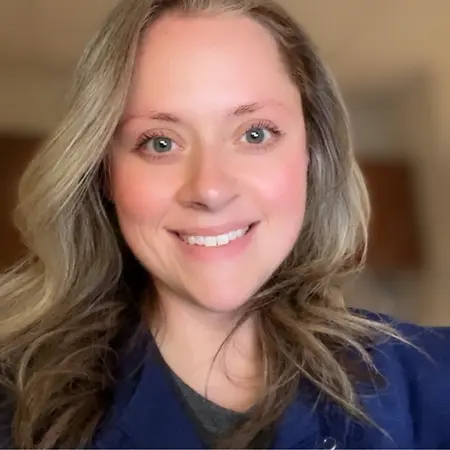
Her Story
About Shelby
Shelby Banks is an MRI technologist, educator, and safety advocate dedicated to advancing patient protection and professional excellence in medical imaging. Through years of experience in a wide range of MRI environments—from outpatient imaging centers to Level I trauma hospitals—she developed a deep understanding of the critical role safety plays in every scan. Recognizing significant gaps in MRI safety education and regulation, Shelby pursued her Magnetic Resonance Safety Officer (MRSO) credential to expand her expertise and better equip herself to advocate for patients and colleagues. Her mission is simple but powerful: ensure that MRI professionals have the knowledge, confidence, and resources needed to make safe decisions and speak up when safety is at risk.
In addition to her clinical work as an MRI technologist, Shelby serves as an adjunct instructor for an online MRI program, where she teaches patient care, MRI safety, and physics fundamentals. Her unique combination of teaching and hands-on clinical experience allows her to bring real-world scenarios into the classroom, helping students understand not only the theory behind MRI safety but also the practical challenges they may encounter in the field. She is passionate about preparing the next generation of technologists to think critically, challenge unsafe practices, and become strong advocates for patient care.
When her youngest son was born three months premature and required specialized care at home, Shelby faced the challenge of balancing a demanding healthcare career with her family’s needs. Rather than stepping away from the profession she loves, she found a new way to contribute by founding SafeSpin MRI Consulting, LLC. Through consulting, implant verification services, and MRI safety education, she helps healthcare organizations and imaging professionals strengthen safety practices and improve patient outcomes. Guided by tenacity, compassion, and a commitment to continuous learning, Shelby continues to champion a culture where safety is proactive, knowledge is shared, and every patient receives the highest standard of care.
Her Interview
Ten minutes with Shelby
01What do you attribute your success to?
I attribute my success to having a spirit that doesn't just do what I'm told without questioning. I've always had this quality where I don't just accept 'that's what they told us to do' as a reason, because that doesn't mean it's right. I've learned that this questioning attitude is actually a good quality if you use it for good and not evil. You have to be able to go against the grain and challenge what everyone else is doing in order to change things and protect people. Just because something hasn't been done doesn't mean it's impossible. I've had to keep that fighter spirit and not let anyone convince me that challenging the status quo won't serve me. If you just do what you're told, you're never going to go anywhere and things will never change. Even though I struggle with imposter syndrome like we all do, and you fake it until you make it, I've learned that you're not qualified for a job until six months in and you're not qualified to run a business until a year after running it. But I keep pushing forward because I know that questioning principles and refusing to take no for an answer is what allows me to protect patients and make real change in MRI safety.
02What advice would you give to young women entering your industry?
Don't let others make you feel like you're not worthy. I still feel that sometimes male counterparts in businesses are more sought after, more agreed with, and more valued than what similar female cohorts have to say. If I don't have a master's or PhD after my name and my male counterpart just has a bachelor's, I still think that being male versus female has influence over us in the field. Beyond that, especially for women, you're expected to take all of that on as a mom, but then when you need something to take care of your family, depending on what your profession is, it's like you're speaking to a wall. You're pushed to the wayside. If you can't make them money, then sorry. It's very eye-opening and kind of sad. You quickly realize how much you are valued once you can't sit in front of a scanner and scan patients, regardless of your safety education or your offer to research and help make things more streamlined. It's hard as a working mom who is the breadwinner, having to make sure you bring home what's needed but also find time to take care of the kids. You're expected to work like you don't have kids and raise kids like you don't have a job. Keep your fighter spirit and don't let anyone beat it out of you, because that quality will serve you in protecting people and challenging unsafe practices.
03What are the biggest challenges or opportunities in your field right now?
The biggest challenge in MRI is the severe lack of safety regulations. There are very, very little regulations for MRI safety and I don't even think there's any federal regulations for it. When you have a hospital or imaging department, they have to jump through hoops to get approved for a radiation license, but for MRI it's pretty much like 'well, you're on your own.' This is concerning because MRI is the only room in a hospital that can kill you just by walking in, yet there are no real safety standards. I see tremendous burnout in our field. You have to miss things because you're on call for holidays, or because of staffing and budget cuts that affect you personally. MRI is not an easy modality. It requires a lot of critical thinking and it's mentally demanding because you have to make sure patients are safe. Everybody nowadays has some implants that you have to research, and our scans are getting faster but the delays are longer because of all these safety verification requirements. All of that adds to the weight that techs carry, especially when you're expected to work like you don't have kids and raise kids like you don't have a job. The opportunity I see is in empowering and educating techs so they have the knowledge to speak up, make better decisions, and prevent safety events before they happen.
04What values are most important to you in your work and personal life?
The most important value to me is being able to protect people and empower others to do the same. I believe that if I can educate and empower another tech with knowledge about what we should be doing or guidelines that could protect them, then maybe I've prevented a couple safety events. I value being present for my family, especially after my youngest was born three months early and came home on oxygen and a monitor. I had to do CPR on him when he was young, and that made me realize I cannot leave him to go sit at a scanner for twelve hours. I value the flexibility to be a mom first while still contributing meaningfully to my field. I also deeply value challenging the status quo and not just doing what I'm told because 'that's what they told us to do.' That doesn't mean it's right. I believe you have to be willing to go against the grain and question principles in order to protect people and create change. Even though it's beautiful chaos juggling everything, I love the work, I love being home, and I love the flexibility that allows me to be both the breadwinner and present for my kids. I wish more workplaces valued that instead of expecting you to work like you don't have kids and raise kids like you don't have a job.
Join Influential Women and start making an impact. Register now.