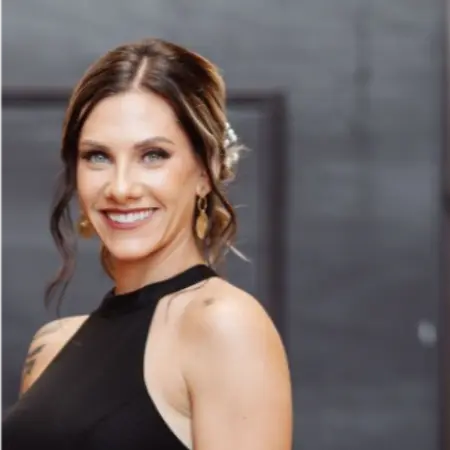
Her Story
About Shelby
I've been working as a Crime Scene Investigator for about 9 years now, and my official certification is as a Certified Senior Crime Scene Analyst. I originally wanted to start out with law, but it wasn't striking to me, so I kind of changed majors and ended up with a foot in the door as far as CSI goes. My degree is in criminalistics and criminology, so forensic psychology, and a lot of what I do was just learning out in the field and actual hands-on experience. I got into this career through connections with women I had known, particularly friends who worked for the county coroner's office who put me in touch with police departments. I work in a female-dominated field - my current unit has five of us and we're all women, and all the surrounding agencies I know of are female-dominated as well. Beyond my investigative work, I'm also an instructor for our police academy. I helped curate the crime scene investigation portion of our agency's post academy from the ground up, did all the lesson plans, and I've been teaching that for several years. I'm still very passionate about this career and the logistics behind it, so I still have that fire to go teach others about it.
Her Interview
Ten minutes with Shelby
01What do you attribute your success to?
I would probably say it's because I'm stubborn. I'm an oldest daughter, and I came from a rural background - I grew up on a farm - and so I have a very stubborn, thick-headed, not gonna take BS kind of mentality. We're civilians in law enforcement, we're not police officers, we're all science-based, so we all think very scientifically. So there is kind of a stigma - one, we're women in law enforcement, so we kind of have all of that working against us. When they throw their attitude at us and they're kind of demeaning, you know, their better-than-us kind of attitude, I take it and it just kind of rolls off my back. I think that you have to be very mentally, emotionally strong to be able to handle this career. The average CSI will spend 5 years in this career before they get burnt out - it's a very easy job to get burnt out on really quick, just because of the overall demands from the job, the mental-emotional toll that it takes on you, and then the agency toll that it takes on you.
02What advice would you give to young women entering your industry?
Truthfully, to find a good therapist and to take your mental health very seriously. When you first start out this career, it's exciting, and you want to see all the things and you want to do all of the things, and you will be 2 or 3 years in, having seen a lot of the things and done a lot of the things, and it will catch up to you. It can take a mental-emotional toll on you, the things that you're seeing, on repeat, every day. When I first started my career, I was at a really big metro agency, and there would be times where I would work a 12- to 15-hour shift and never once sit down at my desk, because it was just go, go, go, constantly. And that will catch up to you after a while. I think you're young and you're new and you're so gung-ho, and I can do it all, but recognizing that it will catch up to you and to prioritize your mental health, for sure, would be my biggest advice. Even in my current job now, we have a couple new gals, and that's always my recommendation to them - find, take care of your mental health first, whether talking to someone, or finding a safe place that you can vent if you need to vent, but just recognize those signs when it starts to creep up on you. For young women coming out of college, my recommendation is to not limit yourself to just your own state or your own local jurisdiction. You're gonna have to apply to other states, you're gonna have to apply on a nationwide basis if you want to get your start, just because it is so heavily saturated. You'd be going several states away from where you're from, just to get that first experience, those first few years of experience, and then move on.
03What are the biggest challenges or opportunities in your field right now?
The career itself is very heavily saturated. It is really hard to break through, just because everyone sees CSI on TV, so everyone wants to go get a degree in forensic science, and then it can make it difficult when you're looking for that first-time job to break through into this career. The only times that we're going out is on people's worst day of their life, whether it's a death or a sex assault. We see the worst of the worst all the time. There's not usually a positive aspect to it. We're constantly exposed to that stuff, and then say that case goes to trial - we've had that case sit on the back burner for a while, then we're reviewing our photographs to prepare to testify in trial, and we're reliving all of that again. And we deal with some of the back-to-blue type mentality, the law enforcement industry as a whole, and that takes a toll on you too. The average CSI will spend 5 years in this career before they get burnt out. It's a very easy job to get burnt out on really quick, just because of just the overall demands from the job, the mental-emotional toll that it takes on you, and then the agency toll that it takes on you.
04What values are most important to you in your work and personal life?
I try to keep the perspective that as with any job, we go in, we put in our 40-plus hours a week, and especially mothers, right? We have our full-time job, our career, and then we have our other full-time job, which is at home. The difference is, I'm not replaceable at home. My kids need me, my husband needs me, I hold down the fort there, I contribute, I do what I do there. I'm not replaceable there. I am absolutely completely replaceable at work - if something were to happen to me, if I were to quit, they would post my position within a week, within 2 weeks. So I try to leave everything here at work and try to make my real full-time job at home, so that I can be present there. That might be we go to the pool on the weekends, we take hikes, we go fishing, we try to do as much together as a family as we can, and that's how I'm able to kind of separate my career from my real job at home. I'm big on word of mouth, and I'm big on connections. It's not necessarily always what you know, but it's who you know, and once you have those really solid connections and word of mouth, I think that it goes a lot of places. I'm also of the mindset where, you know, if you get somewhere, you turn around and you help the next person in line. I'm very big on that mindset as well. Once you get to a point where you stop having empathy, then it's probably time to get out of the career.
Join Influential Women and start making an impact. Register now.