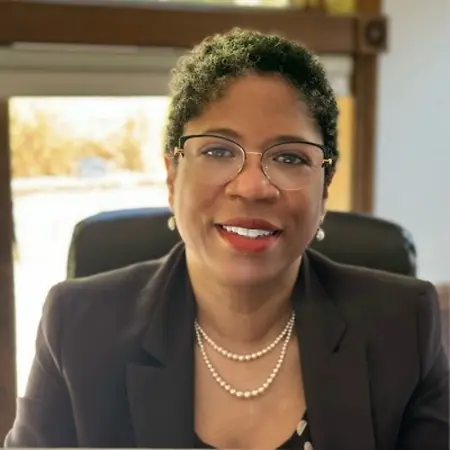
Her Story
About Shelley
As provost, I'm responsible for all of academics - that means all faculty, all students, and particularly the curriculum. Nursing curriculum isn't just nursing, it's all of the general education, whether it's your English, your math, your anatomy and physiology. So it is really constantly looking at the educational outcomes data and looking at our students, who comes in, how we can support them. As you know, generation after generation, based on what is happening in the world, it does impact the students that come to us. So you'll find that we, as educational leaders, have to continuously look at our students and look at the trends in the population, even to look at what are the deficits these students are coming in with. For example, COVID led to lots of our students being unprepared for higher education, and they're coming in with a lot more mental health needs. So the student that we're seeing today is not like the student I was seeing 10 years ago. I guess it's always looking at what is going on in policy, health policy, educational policy, just general situations in our world, looking at what is happening with our communities to say, well, what do our communities need? And then how do we actually take the students coming to us that say they want to be a healthcare professional, and helping them to meet those goals, their personal goals, while meeting the goals of society? So I feel as if we're always having our feet planted in two worlds. We want to stay close to what's happening, boots on the ground in the communities and in our clinical agencies, but then also looking at what is happening in education from high school to students coming to our doors. That requires us looking at data that's being produced by CDC and all of our government, but then also looking at the educational trends that we're seeing inside, so that we can see how to intervene.
Her Interview
Ten minutes with Shelley
01What’s the best career advice you’ve ever received?
One of the nurse practitioners I worked with at the nurse-run healthcare center came to me and said, you know, you see what we're doing here, you're learning a lot, it's time for you to decide to move forward with your graduate degree, you know, please think about it. That advice came at a pivotal moment when I was enjoying the work I was doing in the community, helping communities in Pennsylvania and the city of Philadelphia. As I was thinking about it, the opportunity came up to apply for a scholarship to Penn State, and I actually received that scholarship with a full tuition award focused on community health, which allowed me to continue to grow as a nurse educator and community health and psych nurse.
02What are the biggest challenges or opportunities in your field right now?
The nursing shortage continues - it's been a problem for a long time. I do think that sometimes nursing is glamorized, so people only see the television image, but then when they get into the field, they realize how hard it really can be. So we also have a problem of producing nurses, and then they're not staying very long in the field. COVID led to lots of our students being unprepared for higher education, and they're coming in with a lot more mental health needs. So the student that we're seeing today is not like the student I was seeing 10 years ago. Generation after generation, based on what is happening in the world, it does impact the students that come to us. We, as educational leaders, have to continuously look at our students and look at the trends in the population, even to look at what are the deficits these students are coming in with. We're always looking at what is going on in policy, health policy, educational policy, just general situations in our world, looking at what is happening with our communities to say, well, what do our communities need? And then how do we actually take the students coming to us that say they want to be a healthcare professional, and help them to meet those goals, their personal goals, while meeting the goals of society?
03What values are most important to you in your work and personal life?
I always remembered thinking, if I could make this better, it would be great for students, it would be great for patients, and it could potentially even change how nurses work together. When I'm a nurse and I'm dealing with a patient or a group of people, I'm helping one person at a time, maybe one family at a time. I do feel that what I do is amazing, because I am helping to produce many nurses to help many, many more people. Some people go, oh, well, you're moving farther and farther away from the patient. I'm going, yes, that's true. But what they're getting back is so much more than what I could do by myself. I don't see a lot of Black women in the role of provost in higher education, and I don't see a lot of nurses in this role, and I would like to be motivation for others.
Join Influential Women and start making an impact. Register now.