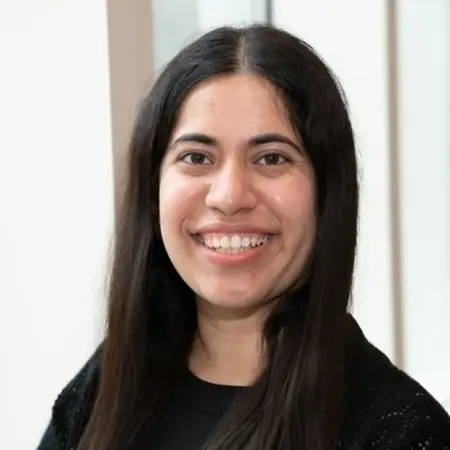
Her Story
About Shikha
My typical day as an analytical scientist revolves around working with different analytical methods and instruments to ensure the quality, integrity, and stability of products - specifically treatments that focus on neuromuscular and CNS diseases. My key responsibilities involve developing and characterizing assays and experiments that ensure product stability, integrity, and quality over time, so that these treatments can be useful for patients, the end users. I've been in the biotechnology industry for a little over 3 years now, and it's been a journey of continuous learning and growth. I'm still on that linear growth phase, and I'm loving it - it's been fun. The transition from academia to industry brought some challenges, particularly in shifting from dealing with fundamental scientific problems to doing translational work that bridges the gap between fundamental research and the patients who receive these treatments. But the experience I've gained has been invaluable. What I've learned is that whatever we do is not just us - the team contributes a lot, and it's the team that takes and carries forward those challenges. Unity in the team and relationships at work are incredibly important for finding the right solutions.
Her Interview
Ten minutes with Shikha
01What do you attribute your success to?
I think I attribute my success basically to persistence, and to probably my family as well, because my mom was the one who kind of pushed me towards a scientific direction, and I wasn't really sure at that time if I had the capability to do this, to do research and be more involved in development. But then she was the one who pushed me towards it, and then gradually I started to enjoy it to a level that I enjoy each and every single day. So maybe I would say my family would be the biggest supporter. And now my husband, who makes sure that if I get bogged down during my day in terms of work and culture, he would remind me that the biggest thing I need to focus on is being a great scientist. So yeah, my family, I would say, is the biggest contributor to my success.
02What’s the best career advice you’ve ever received?
The best career advice I have received is from one of my mentors. He said if I ever want a promotion, don't think about the promotion as just another step. Be that person. So, for example, at the moment, I'm a scientist, and if I ever want to be a senior scientist, that's my next promotion cycle. My role should already fit into that job description, that title. So I think that's the best advice - from now, or currently, I feel I am living that role, right? So be that person before you get that title.
03What advice would you give to young women entering your industry?
I would like to say that there is so much advancement that's going on in technology, in analytical development of these drug substances, drug products. So, just for women, I mean, believe it or not, I feel like we still are in a patriarchal society, and navigating in this environment can be challenging. But if you're consistent and we believe in ourselves, I think that's the way to go. Just self-esteem, that's the most important.
04What are the biggest challenges or opportunities in your field right now?
I feel the biggest one could be the transition from an academic path to an industry path, which brings a few challenges. When I was doing my PhD, I was dealing with more fundamental issues, fundamental problems in the scientific realm. But here in industry, it's more like translational work that we do, bridging the gap between the fundamentals research and the end users, the patients who are getting to the solutions through different treatments. So bridging that gap is a big challenge - it's not the easiest. And then also, whatever we do is not just us. The team contributes a lot. It's the team that takes and carries forward those challenges. So the unity in the team and relationships at work, that could be the most important thing or challenge that needs to be overcome before finding the right sorts of solutions.
05What values are most important to you in your work and personal life?
The biggest value is accountability, reliability, and persistence in my work, because there's a lot of challenges we encounter in order to go through the drug development process. I would say accountability for that, and more analytical thinking, and that goes even in my relationships. So most of my personal life involves consistency, all of these aspects.
Join Influential Women and start making an impact. Register now.