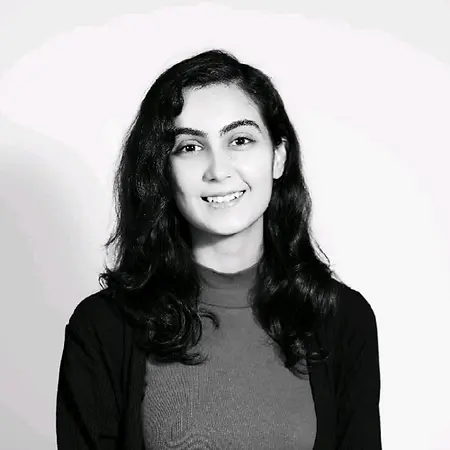
Her Story
About Shreya
Shreya Paliwal is an award-winning designer specializing in brand systems, packaging design, and strategic design innovation. Currently serving as Chief Designer for Brand Systems at Think Design in New York, she brings more than five years of experience working at the intersection of brand strategy, product design, and user experience. Shreya has built a reputation as a founding designer who helps organizations scale their design maturity and accelerate innovation, translating complex ideas into cohesive systems that drive meaningful business value. Shreya’s interest in design grew from a lifelong love of both art and science. As a child, she aspired to be an artist while also enjoying mathematics and scientific thinking, eventually realizing that design offered the perfect intersection of these interests. For her, design is a discipline where the analytical principles of science meet the creative inspiration of art—particularly when designing products that require both technical functionality and thoughtful form. Growing up in a small town in India where “design” was often associated primarily with fashion, she discovered the broader possibilities of the field and pursued a Bachelor’s degree in Industrial and Product Design from Avantika University. After graduating, she joined a startup as its first designer, where she helped grow the organization into a recognized brand. Through that experience, she developed expertise in building comprehensive design systems that spanned industrial design, logo creation, brand experience, product experience, and design strategy. She later earned a Master of Science in Packaging, Systems, and Identities from Pratt Institute in New York, where her studies expanded her perspective on design as an interconnected system that shapes how brands and products are experienced. Prior to her current role, Shreya served as a Founding Designer and Design Strategist at HRS Navigation, contributing to more than 30 projects across healthcare technology, digital systems, and branding, and helping the organization earn international recognition including the prestigious iF Design Award and A’ Design Award. In her current role, she leads projects ranging from digital product experiences to brand systems, collaborating with cross-functional teams to understand user needs, gather feedback, and ensure consistent, high-quality design outcomes. Passionate about continuous learning, Shreya thrives on solving complex problems and quickly adapting to new domains, bringing her design expertise together with technical insight to create thoughtful, impactful solutions.
Her Interview
Ten minutes with Shreya
01What do you attribute your success to?
I attribute my success to a deep commitment to personal growth and resilience. Over the years, I have developed a systemic way of thinking that allows me to look 9–10 steps ahead, anticipating what a product will go through before it actually happens. Alongside this, I’ve focused on improving my communication and embracing a true team spirit. There are many contributing factors, but my internal evolution, both in how I think and how I collaborate, is at the core of my work.
02What’s the best career advice you’ve ever received?
The best advice I’ve received is that a career is never linear. My own path hasn’t been a straight line; often, I was pushed into unexpected challenges and had to work my way through them. While my long-term career 'plans' didn't always unfold as expected, the projects themselves always succeeded. For instance, I initially planned to focus on HMI, but that path shifted and led me to Pratt and New York, a move that ultimately positioned me for better opportunities. I’ve learned that success is a balance of planning and staying open to where the path actually takes you.
03What advice would you give to young women entering your industry?
I would advise young women to cultivate resilience. Design is deeply subjective, and you will often face personal biases that conflict with user needs. True resilience is the ability to stand your ground and use data to prove what the user actually requires, rather than settling for a design that simply everyone 'agrees' on to avoid friction. It can be intimidating to face pushback, but the success of a product depends on your willingness to advocate for the user. In my experience, choosing accountability over comfort is what leads to better achievements
04What are the biggest challenges or opportunities in your field right now?
The best thing about design is how inclusive it is. It isn’t tied to just one technical area, so it’s very accepting of people from different domains. For example, I have a friend who transitioned from teaching to UI/UX after developing the necessary skills. It values transferable problem-solving skills. However, certain technical sectors like healthcare, mechanical design, or manufacturing still require deep experiential knowledge, often 10 to 20 years' worth. While the AI revolution may eventually make these fields more accessible or reduce the learning curve, that "hands-on" experience remains essential. For women in general, a major challenge is that our career paths aren't always linear. Every woman’s timeline is different—some plan to pivot earlier and some later—so you’re constantly re-navigating, which is very difficult. I think the biggest thing is being able to determine exactly when you want to change your path to stay aligned with your goals.
05What values are most important to you in your work and personal life?
Transparency is definitely the most important value to me. It’s about looking straight at a problem as soon as it arises, rather than avoiding it until it becomes much larger and harder to solve. I believe in being direct and honest when something isn't working, because it saves so much effort and builds real trust. Along with transparency and directness, I value honesty and a strong sense of service in everything I do.
Join Influential Women and start making an impact. Register now.