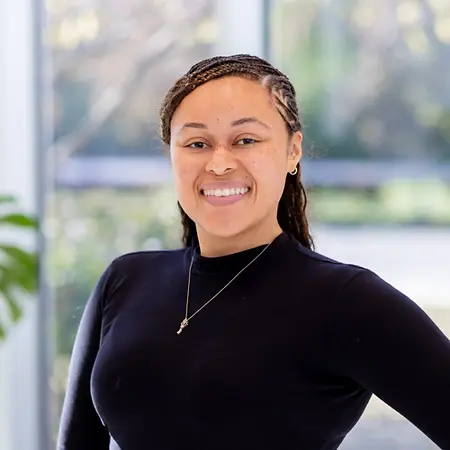
Her Story
About Sierra
Sierra Lee is a Medical Technologist II and Team Lead at Labcorp, where she specializes in genomic testing, molecular diagnostics, and laboratory quality improvement. In her leadership role, she supports high-throughput clinical testing operations while ensuring accuracy, compliance, and efficiency across complex genomic workflows. She plays an active role in coordinating daily lab priorities, supporting audit readiness, and advancing initiatives that strengthen both patient care outcomes and operational performance.
Sierra earned her Bachelor of Arts in Biology from IUPUI in 2017, building a strong foundation in science while gaining extensive hands-on experience in hospital and clinical environments throughout her academic journey. Early in her career, she worked as a medical scribe in the emergency room and completed phlebotomy and laboratory assistant roles during academic breaks, experiences that shaped her commitment to healthcare and reinforced the importance of real-world clinical exposure. Initially pursuing a pre-med path, she ultimately discovered her passion for laboratory medicine, where she found a balance between scientific impact, operational problem-solving, and long-term career flexibility.
Over the course of her professional career, Sierra advanced from support roles into molecular technologist and leadership positions, working across high-pressure laboratory environments where rapid turnaround times and precision are critical. She has contributed to process optimization, error reduction programs, and workflow improvements, including initiatives focused on identifying root causes of laboratory errors such as workload balance, system efficiency, and process design. In her current role, she also leads daily workload coordination, team check-ins, and sample prioritization to ensure both employee well-being and timely diagnostic delivery. Alongside her scientific career, she is pursuing graduate studies at Northwestern University Pritzker School of Law, reflecting her commitment to expanding her expertise across disciplines and continuing professional growth in healthcare, science, and compliance-driven fields.
Her Interview
Ten minutes with Sierra
01What do you attribute your success to?
My biggest drive—and I know a lot of people say this—is my family, especially my grandparents and my mom. I wasn’t the first person in my family to go to college, but in a way I was, because my mom hadn’t finished her degree at the time. My grandparents were in the Salvation Army, so they didn’t attend an accredited school. So it was really just my mom and me trying to figure everything out.
I did Upward Bound, and it was very helpful for college preparation, but you still don’t truly know what you’re doing until you experience it. My mom and I were learning as we went. She helped get me into school, and I felt like my biggest responsibility was to finish. She and my grandparents were my biggest motivation to start something and see it through, because I wanted to show them that I listened to everything they instilled in me throughout high school.
Finishing what I start is my biggest motivator. I want them to physically see the manifestation of all their hard work and sacrifices.
02What’s the best career advice you’ve ever received?
My mom is my best friend. I go to her for everything. I know I’m not fully grown, but I’m at an age where many people start to drift away from their mothers—yet I find myself drawing even closer to her. Even now, I’ll say, “Hey Mom, I don’t know what this word means. Can you tell me?” She’s someone I’m incredibly close with.
She was a single mom in the beginning. She’s married now—very happily—and I’m so excited for how far she’s come. There were times when she would feed me before she ate. She worked hard to make sure I had what I needed. So my biggest goal has always been to make sure that everything she sowed, she now gets to reap.
I made sure I graduated from college. I made sure I didn’t have kids before I was ready. I didn’t want to become a statistic, because I want everything she did to be worth it. I bought my house two years ago so I could keep my debt and responsibilities under control. There are so many things I do intentionally because I’m thinking about legacy—my own, and the one she passed down to me—even though I don’t have kids yet.
My mom always instilled scripture in me to build my confidence. Throughout college, I was often told I couldn’t do certain things because of my grades or because science didn’t come naturally to me. I was discouraged by professors and advisors, but my mom would remind me, “This is what the Bible says about you—remember that.” So I started speaking affirmations to myself every morning to stay grounded and encouraged.
03What advice would you give to young women entering your industry?
I would say the biggest thing is: don’t put yourself in a box. There is no straight path to success. Even now, I don’t feel like I’ve reached my peak—and that’s okay. It’s okay to feel like you haven’t arrived yet, as long as you also remember how far you’ve come. Always appreciate your progress.
One of the best ways to remember where you’ve come from is to journal your journey or blog about it. When you look back, you can say, “Wow, I really have come far.” Sometimes when you’re in the moment, you don’t realize what you’ve accomplished because you’re focused on what still needs to be done.
People told me these things when I was younger, but you don’t fully understand it until you start living through it. The biggest lesson is still the same: don’t put yourself in a box.
For example, I’m in a master’s program now, studying law. That alone reminds me that you don’t have to stay in one field. You can expand into others—that’s what makes you marketable. And if you don’t like what you’re doing, you can explore other interests while still handling your responsibilities. It’s okay to explore. It’s okay not to be 100% sure.
What matters most is having some kind of plan so you have direction. But stay open—open to how far you’ve come, open to how far you still have to go, and open to any detours that might lead you somewhere even better than what you originally planned.
04What are the biggest challenges or opportunities in your field right now?
Some of the challenges, honestly, come from a lack of representation. You walk into a room and, yes, you may see a lot of women—but as a Black woman, you don’t see many women who look like you. You feel alone. You feel unheard in certain situations. You feel like you have to work three times harder because you may not be as “likable” as your counterparts. I’ve faced those challenges, and I’ve had to deal with them on an ethical level within my company.
The biggest lesson I’ve taken from those experiences is not to run from them, even when they’re scary, but to face them and see them through—no matter the outcome. You learn a lot about yourself, about others, and even about the corporate system when you follow the proper process to speak up about things you see, feel, and experience that you believe are not moral. Being willing to face any challenge, as intimidating as it may be, and seeing it through is essential.
You also can’t rush the process. I went through some ethical issues at work that took forever to resolve. Sometimes you don’t get the outcome you hoped for, but you still have to follow it through because you want the people who come after you to have opportunities that feel fair, effortless, and unbiased. You do it for the people coming behind you. You stick with it.
And one of the biggest sources of inspiration is seeing people who look like you doing well—seeing women who are thriving, being the boss babes they are, and refusing to conform to societal expectations. At my job, there are women in managerial positions who aren’t married, who have lifelong partners, and who have decided, “This is who I am, and I’m okay with it.” I respect that fully, because it takes a lot of courage.
05What values are most important to you in your work and personal life?
I grew up in church, so my faith is a really big part of who I am. My mom would always instill different scriptures in me to build my confidence, especially because throughout college I was often told I couldn’t do certain things—either because of my grades or because science didn’t come naturally to me the way it did for others. I was discouraged by professors and advisors, but my mom would remind me, “This is what the Bible says about you—remember that.”
So I started speaking affirmations to myself every morning to stay grounded and encouraged.
Now I’m in a program at Northwestern University, earning my master’s in law, and I’ve learned how important it is not to let people define you. You have to hold on to your core values and let those guide you.
My faith is a big one, and my integrity is just as important—what I do when no one is looking. Everything matters to me because I want to have a clear conscience. I’ve noticed that people often accuse others of the very things they do themselves, so if I don’t want to project certain behaviors or judgments onto others, I have to make sure I’m not doing those things either.
Integrity is especially important at work, where I deal with many different patients I don’t know. I think about my grandfather, who has dementia and whom we all help care for. I remind myself: If this were my grandfather, how would I want him to be treated? How would I handle his sample? That perspective keeps me grounded.
And then there’s work ethic. People say your attitude determines your altitude—and so does your work ethic. I like to do things with passion. I want to be memorable. I want people to feel my impact if I ever leave a company. I tend to overwork, but the truth is, I also genuinely love working.
Join Influential Women and start making an impact. Register now.