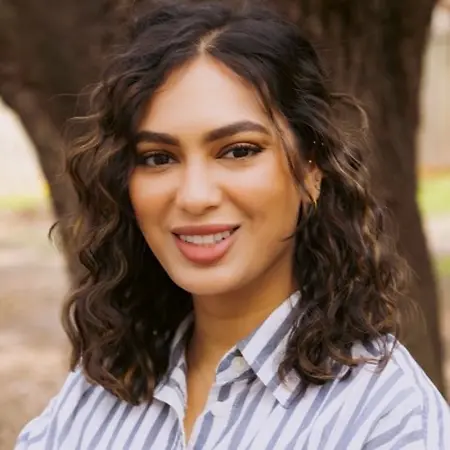
Her Story
About Sofia
I started my career studying biology at the University of Texas in Dallas for my undergrad, then moved to Washington where I earned my Master's in public health from George Washington University. Initially, I was on a policy track, which made sense living in Washington with its policy-heavy, lobbyist environment. But when my husband got a job in Boston, I changed tracks and looked for jobs there so we wouldn't be long distance. I ended up getting a job working in data analytics, and from there moved into health economics research and just fell in love with it. I had studied it a little bit at school, but it hadn't really been my focus until I started working in the industry. Being in Washington opened up my eyes to all the things you could do that weren't necessarily in a lab. I love science, but I realized I wanted to think about what actual people's needs are, thinking about people as actual people, as opposed to cells that you're studying. When you're in a lab, you get so focused on the minuscule details, looking at things through your microscope on a cellular level. But thinking about people as actual people, what their needs are, what conditions they're dealing with, how can we best alleviate that, how can we reduce their healthcare costs - being able to shift my focus onto that and do something tangible to actually help people and make a difference was the biggest thing for me.
Her Interview
Ten minutes with Sofia
01What do you attribute your success to?
I would say to my family and my friends, for always pushing me to do more than I was ever thinking that I would do. My family and my friends are genuinely so encouraging, but also they know how to get me to want to do things. I'm a very competitive person, and if you're not competing with me, I'm not interested in whatever it is. And so, even if it wasn't their thing, knowing that it was something I was interested in, they would get competitive with me just to get me to push through and do it, just to prove that I could do things that I wasn't even thinking about. Their ability to push me into doing all the things that I have done, making these moves across the country, all these things that I didn't know I could do - it would be them, my close friends and my parents.
02What advice would you give to young women entering your industry?
Trust your gut more than anything else. Even if you don't feel like you know yourself, you do, even if you don't realize it. And if you have ideas, or if you have aspirations, you just have to take that leap of faith and jump, and just try to do it in whichever way it comes to you. Sometimes, I find that when you're not looking for something, things will come and find you when you're not expecting it, and you just have to be open to those changes and those signs.
03What are the biggest challenges or opportunities in your field right now?
The biggest challenges are policy. There are so many changes that are happening on the government level that it's hard for us to sometimes keep up and predict what's going to happen, just because as administrations change, as ideas within administrations change on the healthcare side, things are always changing. If you think about Medicare or Medicaid access, it's not just on a national level, but also state access - things are always changing, and the political landscape makes a huge effect on that. So that is something that we can't really predict, and that can be a bit challenging. But on the flip side, it makes for really interesting research, so we are constantly tracking the effects of those changes. Everyone in the industry is always interested to see, because especially with Medicare patients, we don't want to lose their access to care. A lot of these people are retired, they no longer are working, they have their Social Security and their retirement funds. The less they're having to pay for healthcare as they get older, the better. But with policy changes, we're constantly having to follow those trends and see what the effects are, and so that can also be a lot of fun.
04What values are most important to you in your work and personal life?
Honesty and integrity are really important to me. There are no hidden agendas - I just want things to be out in the open, truthful. I don't like things to be messy, you know? I guess we can just get along and be happy.
Join Influential Women and start making an impact. Register now.