Her Story
About Soukaina
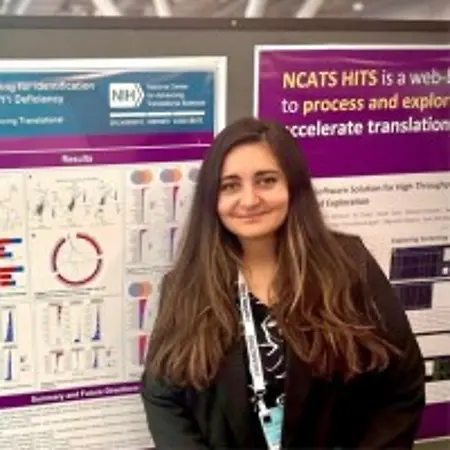
Soukaina Amniouel, PhD, is a postdoctoral fellow specializing in computational biology at the National Center for Advancing Translational Sciences (NCATS), where she applies bioinformatics and AI/ML-driven approaches to cancer, neurological, and rare disease research. Originally from Morocco, she began her scientific career in molecular biology before transitioning into bioinformatics, integrating computational methods with biological research to predict treatment outcomes and advance translational science.
She earned her PhD in Bioinformatics and Computational Biology from George Mason University, where her research focused on developing machine learning models to analyze gene expression data and predict chemotherapy efficacy, contributing to personalized medicine. Her expertise spans predictive modeling, algorithm development, and large-scale computational data analysis.
Soukaina has presented her work at national and international conferences, secured NIH/NCATS funding, and contributed to peer-reviewed publications investigating innovative therapeutic strategies, including neuroinflammatory approaches for Alzheimer’s disease and rare genetic conditions. Her research bridges computational discovery with real-world clinical application, emphasizing the translation of laboratory findings into potential patient-centered therapies.
In addition to her research, she is dedicated to mentorship and advocacy for women in STEM. She serves as an adjunct faculty instructor at George Mason University as a part time job, teaching cell biology, biostatistics, and medical microbiology, while actively supporting initiatives that empower the next generation of scientists.
Her Interview
Ten minutes with Soukaina
01What do you attribute your success to?
I attribute much of my success to the unwavering support of my parents and brother, who encouraged me to pursue my aspirations in the United States and instilled in me the confidence to take bold risks. I am equally grateful to my mentors, especially my PhD advisor, whose guidance helped me navigate pivotal transitions, including expanding my work into multi-omics and machine learning, a direction that ultimately defined my career path. Trusting my instincts, embracing new opportunities, and leaning on strong personal and professional support systems have been central to my journey.
02What’s the best career advice you’ve ever received?
The best career advice I’ve ever received came from my parents and my brother, who always told me to do my best and never fear failure. I also credit my PhD advisor, whose encouragement allowed me to dream big and pursue ambitious projects without hesitation, shaping the path of my career.
03What advice would you give to young women entering your industry?
My advice to young women entering this field is to work hard, but also to build and prioritize networks early. Hard work will get you started, but connections help you learn from others, open doors, and expand your opportunities in ways you can’t achieve alone.
04What are the biggest challenges or opportunities in your field right now?
The biggest opportunity in my field is leveraging AI and computational tools to advance cancer and rare diseases research, improve drug discovery, and predict treatment responses. The challenge lies in standing out in a crowded field and translating these findings into real clinical impact across diverse cancers and other diseases such as rare diseases.
05What values are most important to you in your work and personal life?
The values most important to me are perseverance, ambition, and hard work, combined with building strong networks and collaborating with others. I also prioritize making my research clinically meaningful, while in my personal life I cherish spending quality time with friends and family and exploring new places across the country.
Join Influential Women and start making an impact. Register now.