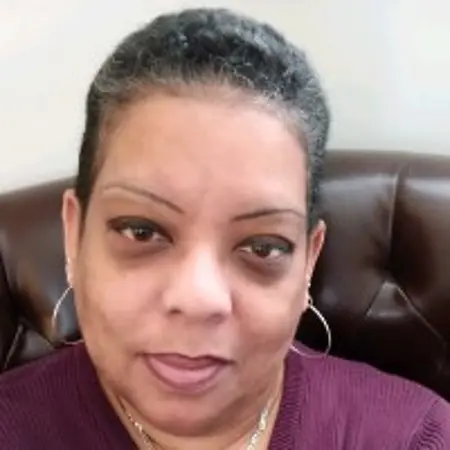
Her Story
About Stacey
Stacey Ricketts, BSW, MA, LMSW, CBT, is a seasoned mental health provider and counselor based in Dover, Delaware, with an accomplished career spanning over 38 years in social work and behavioral health. Since beginning her career in 1988, Stacey has worked across a wide range of settings, demonstrating exceptional leadership, adaptability, and dedication to client care. Early in her journey, she was among the first social workers hired in Texas following legislation requiring social services in nursing homes, where she built and led an entire social services department as Director. Her strong foundation in systems-building and patient advocacy set the tone for a career centered on meaningful impact.
Stacey went on to serve 12 years with Child Protective Services in Houston, Texas, working in multiple units with a particular focus on adolescents navigating complex and often traumatic life circumstances. She empowered youth to take accountability for their futures while supporting them in achieving personal goals. Her experience also includes working as a sex offender treatment therapist facilitating group therapy, where she developed a deep understanding of behavioral patterns and the cyclical nature of trauma. Additionally, she contributed her expertise to the Dover Adolescent Program for Pregnant Teenage Mothers (DAPI) and spent four years as a drug and alcohol counselor and therapist, strengthening her work in substance use treatment and recovery.
Currently, Stacey serves as a Mental Health Provider/Counselor at A Center for Mental Wellness in Dover, Delaware, where she provides both telehealth and in-office sessions to clients of all ages. Known for her collaborative style, Stacey approaches therapy as a partnership—acting as a coach rather than a directive authority—while emphasizing advocacy and ensuring every client has a voice. She credits her clients’ resilience as a continuous source of learning and inspiration. Outside of her professional life, Stacey is a dedicated fan of the Philadelphia Eagles, enjoys crafting, and attends tribal pow wows to stay connected to her culture, reflecting a well-rounded and grounded personal identity that enriches her work with clients.
Her Interview
Ten minutes with Stacey
01What do you attribute your success to?
I attribute my success in this profession to being devotedly passionate about people and having a heart's desire to uplift others.. The foundation of my practice is based on demonstrating empathy, supporting empowerment and advocating for hope. My inspiration as a child was a reflection of what I observed in the members of my community, immediate and tribal family. There was an importance placed on working together to resolve issues, confront problems and transition through the different stages of life. No one was allowed to face difficulties alone or without the support of others. Thus, these cliches were brought to life "It takes a village to raise a child" and "Never judge another until you have walked a mile in his moccasins". As I developed my own style of practice throughout the years, I was able to create my own personal framework that keeps me grounded as a practitioner. These include exhibiting professionalism at all times, trusting the process and creating a balance between job & family obligations. The most impactful aspect of my success is driven by my personal relationship with God and faith in his word. .It has been his presence in my life long development and unique experiences that have brought me thus far and fuels my ability to foster hope not only in others but also myself.
02What’s the best career advice you’ve ever received?
The best advice that I ever received was from my Program Director while employed at CPS in Houston, TX. Her advice to me - "Stacey, just do what you do and be the person I have always known you to be". I often reflect on these words and continue to be inspired by their meaning especially when facing challenges and the numerous changes that occur in this field constantly. Let me share with you what being me means, it's not stopping until a breakthrough happens, until a family gets relief , holding on until understanding replaces fear or when a prayer is answered. What I took from this advice was to stay true to yourself, bring the best version of you to the table daily, develop your own individualistic therapeutic style and build strong therapeutic alliances with your cliental.
03What advice would you give to young women entering your industry?
Be prepared to sacrifice for others because this job field requires you to be selfless at times .Often, one has to place their clients needs before your own resulting in working past designated hours, being available for emergency court hearings or receiving calls to handle crisis situations, depending on the job field selected. I found out as a new caseworker in my early days that preparation for these types of scenarios only play out in field practicum situations and are not emphasized as much in course curriculums. As a Social Worker, the biggest objective is gaining your client’s trust and cooperation which is essential. Without having such an alliance, providing services becomes impossible if the desire is to make progress or provide assistance. There will be times that your cliental will challenge you which often results in self-reflection as you listen to their life stories and personal challenges. Always be aware of your own limitations and boundaries when it comes to this profession. If you do not practice self-care and mindfulness, it is easy to fall victim to “burnout” due to constantly being the vessel pouring out into others when there is no one or thing sustaining you. This is a field that can easily cause one to become overwhelmed and fatigued while building character, enhancing resilience, and demands flexibility regardless of where your interest lies. It is always important to focus on taking one day at a time, developing a routine and being as organized as possible.
04What are the biggest challenges or opportunities in your field right now?
The largest and most influential challenge in this industry has always been the lack of adequate resources and services. As a practitioner, I have often witnessed cliental falling through the cracks and failing to ever get the assistance they require. This is a very difficult reality to accept while in this helping profession when all you want to see everyone win. Other challenges include: the growing number of cliental and worker safety issues whether in an office setting or in the community. The challenges of today are rooted in societal norms which embrace being concerned only about self, ignoring other’s suffrage and the belief that inequality does not exist. Because of this mindset, the demand for assistance, the lack of public concern and work safety issues will continue to rise. Even though there are challenges in the profession, the expansion of new opportunities has exploded while embracing specialization. This provides those who are new to the profession a diverse selection of careers to explore. The introduction of digital record keeping has streamlined case management services reducing paperwork piles and storage methods. . This allows one the ability to create non-traditional workspaces and conduct video conferencing services anywhere. So not only is the field expanding career wise, but it is also keeping up with modern technology. It is these factors which makes it appealing to those interested in careers rooted in social work or counseling. .
05What values are most important to you in your work and personal life?
Number one, is to put God first in both my work and professional life. Secondly, each person has a right to be treated with dignity and respect, free of judgement or persecution by others. Lastly, honesty and truth are essential to both aspects of my life, often being the catalyst of personal development and the motivation to be the best version of me possible. All these characteristics are the result of continuous spiritual growth, growing up in the Native American culture and embracing principles learned through others on this journey called life. My value system is and continues to be the primary reason I have succeeded in this profession thus far and if I had the chance to do it all over, I would not change a thing.
Join Influential Women and start making an impact. Register now.