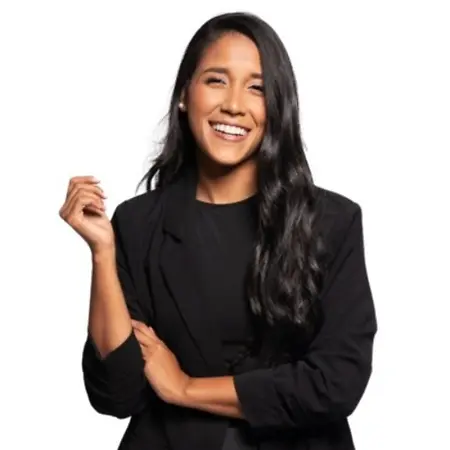
Her Story
About Stephanie
My sisters and I started very early in entrepreneurship. We began selling chocolates door to door in Colombia when I was 6, 7, 8 years old. We didn't just buy chocolates and sell them, we made them and did the whole process. My mom is an educator and my dad is an entrepreneur, and they said if we were going to do chocolate, we should start a business. They taught us all the business concepts - we had names, responsibilities, uniforms, rules. When I was 6, I would say I have to buy the raw material instead of ingredients, and I had to meet my sales quota. At the beginning it was just a game, but it was a profitable game. We were making almost $1,000 a month when we were 6 years old, but more importantly, we were developing skills like public speaking, responsibility, and financial education without even knowing it. After a year, we got invited to speak about our family business. In the last 20 years, we've been speaking in 25 countries at the United Nations and World Economic Forum. At the beginning we were just telling our story, but as we learned more about neuroscience, neuro-linguistic programming, and learning styles, we realized almost nobody had the blessing we had of our parents providing a different type of education. That's where our passion comes from - figuring out how we can share what we have with other people in a more structured way. We were the guinea pigs and my parents experimented with us, but we structured it and created a pedagogical model that could be replicated with other youth. My sister studied psychology and statistics, another studied finance, and I studied professional sales. We've always been working together with very clear understanding of our strengths and how we complement each other.
Her Interview
Ten minutes with Stephanie
01What’s the best career advice you’ve ever received?
The best career advice I received was about taking calculated risks based on information. A lot of people say that entrepreneurs are very risk-takers and risk-oriented, but I think that as entrepreneurs, we take a lot of risks based on a lot of information as well. There's always a little gap for, you know, you don't know if it will work or if it wouldn't work, but we look for a lot of information to be able to take that calculated risk. At the end of the day, it's still a risk because you don't know, there's still a space of it could work or it could not work, but it's based on information, not like, oh yeah, let me just start a business selling ice cream in the middle of the North Pole.
02What advice would you give to young women entering your industry?
My recommendation would be to look for information online. We're living in a different era today, there's a lot of information online. If you truly learn how to use AI, it could be an enabler to potentiate your strengths. In my own experience, if you ask AI to please build me a sales plan, it's gonna be super bad. But if you put all the context, you already ask it questions, and it makes you kind of like a Socratic way, asking questions and driving you through the answers, then I think that that's a huge tool that back in the day was not possible, and that provides a lot of information that back in the day we weren't able to have. There's a lot of information out there today, thank God. That's what we do with our social media - we post information so that people could have access to this. Most of our programs are for free.
03What values are most important to you in your work and personal life?
For me, it's your word, being very coherent. What you say and how you act need to align. You cannot be saying something and then acting in a different way. Integrity and accountability are at the top for me. It's important to be coherent between what you say and how you act.
Join Influential Women and start making an impact. Register now.