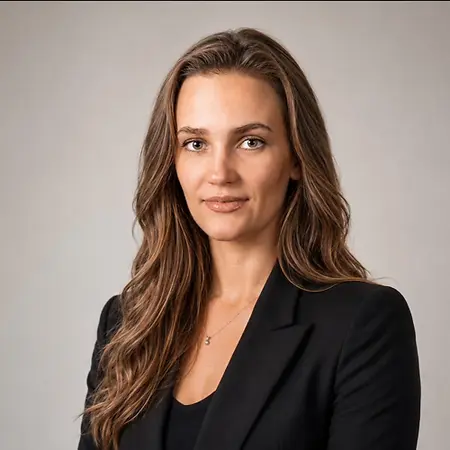
Her Story
About Stephanie
Stephanie Dobersch works on pancreatic cancer, a disease where five-year survival is still in the low teens and where most patients receive broadly the same treatment regardless of what their tumor is actually doing. That last point is the problem she has built her research program around.
Pancreatic tumors are not fixed. They shift between cell identities, basal and classical, that respond very differently to chemotherapy, and those shifts happen under treatment pressure. This is visible in the biology. It has not yet reached the point of care, where a pathologist looks at a biopsy and a treatment decision follows. Her work is aimed at closing that gap: identifying the markers that report tumor identity, proving they predict outcome in patient cohorts, and building them into an assay a clinical laboratory can actually run.
That last step is where most of her current work sits. She is developing a dual-marker assay on an automated staining platform, currently in optimization and designed from the outset to a standard other laboratories can adopt. The work is supported by commercialization funding from the Washington Research Foundation and a Fred Hutch Evergreen Pilot Award, reviewed on commercial and clinical viability rather than scientific novelty, and she is a named inventor on the resulting filings.
She takes on high-risk questions, on the view that this is where genuinely new approaches tend to come from. What keeps her pointed in one direction is a clear sense of what she is working toward, which is getting the right treatment to the right patient. It decides what she takes on and what she lets go. She has trained early-career scientists who each appear as co-authors on the resulting publications, serves as an editor at Frontiers, and thinks that people do their best work when they actually enjoy it.
Her Interview
Ten minutes with Stephanie
01What do you attribute your success to?
Persistence, mostly, about finishing things. Discovery is the fun part and I would not have stayed in this field without it, but a lot of good science stops at the publication, because that is where the reward is. The question I keep asking is what would have to be true for this to reach a patient, and then doing the work that answer implies.
And I let myself have ideas that sound unreasonable, and then test them. Most do not survive contact with an experiment, which is fine, that is what an experiment is for. But the ones that do are the only place real innovation has ever come from, and you cannot get to them by only asking questions you already suspect the answer to.
02What’s the best career advice you’ve ever received?
Choose the people, not the project. It came in pieces rather than as one line, from several people over years, and I did not appreciate it until I had seen both versions: a brilliant project in an environment that taught me nothing, and an ordinary starting question with people who changed how I think.
Projects fail or shift or get scooped. What you take with you is how you were taught to reason, what standard you saw held, and who is still willing to pick up the phone a decade later. That compounds and the project does not. Later, once you know what you are actually working toward, the question inverts and you choose the people who can help you get there. But early on you cannot know that yet, and the environment is what teaches you.
03What advice would you give to young women entering your industry?
Learn to do the thing yourself before you learn to delegate it. Early on there is pressure to specialize narrowly and hand off everything else, and it feels efficient. But the people who can generate data and analyze it, or who understand both the biology and what a clinical laboratory needs, are the ones who end up leading, because they can see the whole problem. Breadth is not indecision. It is leverage later.
And find the rooms where decisions actually get made, then get into them. Committees, editorial work, grant panels, technology transfer, whatever the version is in your setting. The science alone does not put you there and nobody hands you an invitation. The first time you walk into one of those rooms you will feel underqualified, and that feeling is not information. Go anyway, and stay long enough to be useful.
04What are the biggest challenges or opportunities in your field right now?
The biggest challenge in pancreatic cancer is that treatment has barely changed in two decades while our understanding of the biology has changed enormously. We know these tumors are heterogeneous, that they switch identity under therapy, and that basal and classical tumors respond very differently to the same drug. Almost none of that reaches the clinic. There is no assay in routine use that tells an oncologist which subtype they are treating, and there are no drugs designed against a specific subtype. Those two gaps are the same gap, because a test only changes care if there is a different decision to make, and a subtype-specific drug only works if you can identify the patients who should receive it.
That is also where the opportunity sits. Single-cell and spatial methods have shown us what the tumor actually looks like, but they are research tools, too expensive and too slow for routine pathology. Their value is in telling us what to measure. The work I find most interesting is what comes after, distilling those findings down to a handful of markers that can be read on a stained slide in any hospital laboratory, and then designing the trials that test whether a subtype-directed therapy beats the standard of care.
05What values are most important to you in your work and personal life?
Knowing what you are actually for, and then protecting it. There are endless things you could work on and most of them are interesting. Being clear about your purpose is what lets you say no to the rest, and that clarity matters more than working harder. Mine is getting the right treatment to the right patient, and it decides what I take on and what I let go.
Underneath that is caring about the work itself. I do not think you sustain twelve years of experiments that mostly fail on discipline alone. It has to be something you would still want to know the answer to on a bad week.
And kindness, which sounds soft next to the rest and is not. Science is small and careers are long. I want the work to serve something larger than my own record, and how you treat the people around you is part of that rather than separate from it.
Join Influential Women and start making an impact. Register now.