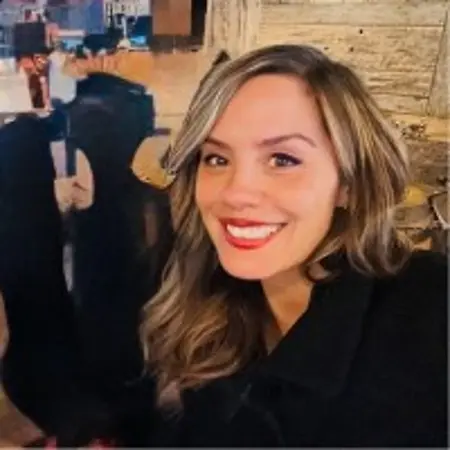
Her Story
About Stephanie
Stephanie Quattrocki, LCPC, is the Director of Ketamine-Assisted Psychotherapy (KAP) at Hopemark Health and serves as Lead Therapist and Lead Session Monitor for clinical research trials with Compass Pathways and Cybin. Based in the Greater Chicago Area, she is a psychodynamic, mindfulness-based (MBCT), and CBT-oriented psychotherapist with over a decade of clinical experience. Her work focuses on operationalizing safe, ethical, and effective psychedelic-assisted psychotherapy protocols within both private practice and research settings, helping shape the emerging infrastructure of innovative psychiatry.
Stephanie began her career in traditional psychotherapy, working extensively with individuals, families, couples, and groups. As interest in psychedelic medicine re-emerged, she pursued advanced training through the Integrative Psychiatry Institute and state-regulated programs in Oregon and Colorado, developing expertise in psilocybin-assisted therapy and other breakthrough treatments. At Hopemark Health, she played a pivotal role in creating therapeutic frameworks around ketamine treatments, strengthening clinical outcomes by centering preparation, integration, and the protection of the therapeutic container.
Driven by a vision of global mental health access and community healing, Stephanie is committed to advancing ethical research, expanding access to breakthrough therapies, and reducing violence through transformative mental health care. Her leadership in ongoing clinical trials studying psilocybin compounds for treatment-resistant depression reflects her dedication to bridging science, spirituality, and evidence-based care. Through her work, she continues to help define a new standard for compassionate, innovative psychiatry.
Her Interview
Ten minutes with Stephanie
01What do you attribute your success to?
It's a calling. Before psychedelics, it was always wanting to bring about peace to a person's life or an environment. I've always been called to help. With psychedelics, that calling deepened, because the words from Michael Pollan's book, How to Change Your Mind, and the whole MAPS movement was about global mental health, mental health for all. I understand that this medicine is an accelerant to traditional therapy. My mission in life is to reduce violence in my community as far as I can reach, and I intend my reach to be as far as I can. I just want to push that out because we need this. I believe that this is one of the ways, if not the primary way, that we're going to be able to reduce some of this violence and bring some unity back to humanity and help us evolve in this very critical moment in human history. Meeting people who are willing to throw the amount of energy and focus and time and money into this, we want it to be a thing. We're all working towards it really hard, but there's no guarantees. To be shoulder to shoulder with these people who are just committing so much to the possibility of this really lines up people who believe, the passion and the resolute mentality of this is the thing that must happen. That's been so much fun to be a part of.
02What advice would you give to young women entering your industry?
We do come programmed for empathy, we do come programmed for compassion and generosity, and those are superpowers. But they've been leveraged and extracted from us without our consent for so many years. We've been programmed to sort of offer those first as a way to get into the world, and I would say to young women getting into any profession that those are like access, you know. You don't have to lead with that. It's okay to be discerning about your own superpower of empathy and kindness and compassion, and it's okay to sort of take a beat first and say, you know, is this something that's important to me. Do I want to be this giving? Do I want to be helping this much? Do I want to be, is this good for me and what I'm trying to do? So, I think, you know, what I tell my young daughter is please check in with how you feel first. Always talk about what you need first. Be able to understand yourself before you're offering anything to anyone else. At my generation, at least, was really like, you know, you have to be nice, be polite, don't make a fuss, be helpful, be pretty, be all the things that we need you to be in order for you to be out there. We were just so grateful to be out there at all, being considered, and that's just not how it has to be anymore. I just encourage young women to always be checking in first with themselves and what they need.
Join Influential Women and start making an impact. Register now.