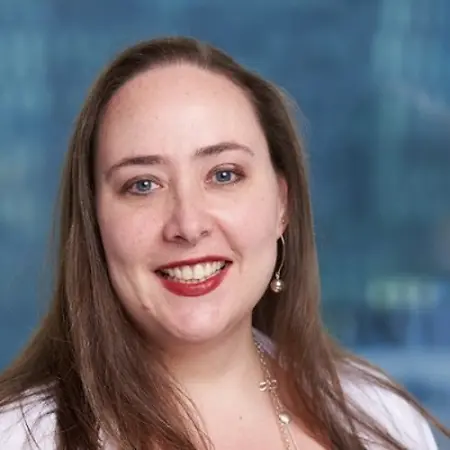
Her Story
About Stephanie
I've been in the legal field since 2002, after graduating from law school in 2001. My bachelor's degree is actually in math, and I went kind of a different way into the legal field. Even though I don't use my degree per se in what I do, how it taught me to think and be able to use the language of law is actually kind of rooted in my degree in math. So though not a direct line, and maybe not typical, it's actually served me well. As a business immigration attorney, I represent companies who are attempting to hire foreign nationals into their workforce. I work with basically one very large IT client, and I'm responsible for overseeing the work for their L non-immigrant visas and their EB1 green cards. So really what that means is that I'm overseeing the transfer of their population from their foreign entity into the U.S., dealing with their non-immigrant visas, which are the short-term working visas, and their green card applications. A typical day involves a lot of client contact where I'm advising them on the various issues that come along, plus I'm leading my team and making sure that any issues that they come across are being responded to, docket management, looking at kind of the big picture, because it's not just the individuals that we're looking at, but also making sure that the company is compliant with the immigration laws and looking at the long-term effects of decisions that they're making regarding their foreign national population. So it's really a mixed bag of what I deal with - sort of day-to-day management and then the outreach to the client. I really do build a relationship with not only the employees of my client, but also the client themselves.
Her Interview
Ten minutes with Stephanie
01What do you attribute your success to?
I think it is not seeing anything else but success. And it's not that I am always confident in myself, because I certainly have moments, but it's always saying, no matter what you do, you're going to be successful at it. But that success may look different than what you planned. For example, when we get these surges, right, where the law changes, and we are suddenly faced with having to file 500 cases and do it in a month, that's something that we can't fail at because our client relies on us to get that done. And so, I have to go into projects like that knowing that, one, we're not going to fail. I know I don't necessarily know how we're going to do it, but I know we're going to be successful. It doesn't mean that I don't have moments of, oh my god, throughout the process, but I know that we're going to be successful, and keeping that attitude throughout the process so that the people supporting you and working through it with you can also maintain their confidence, that's incredibly important. When you look at the mountain, of course it seems insurmountable, but you take one step at a time, case by case, and you just keep at it. And you have to be able to pivot if something doesn't exactly go the way that you thought it was going to go.
02What’s the best career advice you’ve ever received?
I think the best career advice, or the best advice that I've heard, is to never say no. And what I mean is, look at things as an opportunity to learn, and even if it's scary, even if it challenges you, open your mind to it, and don't say no, because you never know where it's gonna lead you. And sometimes that's hard. It's hard to do, because you get sort of locked in to the day-to-day, to what's easy. But don't say no to those opportunities, because they really are what allow you to progress and get further.
03What advice would you give to young women entering your industry?
Don't say no. Certainly, because that has served me well. And when you're working on a project, don't get overwhelmed by the mountain. It's one step at a time. You know what the goal is, so you gotta break it down. How are you going to take each one of those steps to get there? And a lot of times, I think women, we have to put so much pressure on ourselves to be successful, because there just seems to be so many outside factors that sometimes feel like the world doesn't want us to succeed, so we have to put so much pressure on ourselves to be successful that sometimes it's hard to give ourselves a break, too. It's okay if today I leave work 10 minutes early because I want to go do something fun when I started working at 6 o'clock in the morning. Those 10 minutes are not going to kill anyone. So it's okay to give yourself a break every once in a while to really clear your head, so that you know that you can go at it again the next day. So just try to relax a little bit.
04What are the biggest challenges or opportunities in your field right now?
Our biggest challenges in general are the just the changing political landscape. Immigration is so very tied to what's going on in DC and the president's agenda, that we are getting bombarded with policy changes, form changes, adjudication trends, like, everything is... it keeps hitting us on a weekly, daily basis. And we are having to be agile and figure out how to not only respond ourselves, but how to properly advise our clients on what they need to do. That's a huge challenge. And I would say immigration has never been an area that kind of has remained status quo, because that's just not how it works. But right now, it's just so fraught that it really is difficult to navigate. But I would say that that also gives a lot of opportunity as well, because if you can figure out how best to advise your clients on how to stay agile and how to be able to deal with those challenges, then it helps build that relationship with them and become a stronger partner. And that's really important in what we're doing, because you want companies to come to you, come to us, and seek out our advice to make sure that what they're doing is going to set themselves up for success when they're trying to hire foreign nationals.
05What values are most important to you in your work and personal life?
I think what I value so much and what's helped make me so successful is that I know that my colleagues can always depend on me, and I can always depend on them. And finding the people who you... finding those particular people where you work and who your colleagues are is so important to help you be successful, and that can be very challenging, right? Because you have all kinds of personalities anytime you go into a different place, but seeking out those people who are going to lift you up personally, and who you can also help lift up, is really important. And because we work hard, we work so, so hard, and I know for my team, we would not be nearly as successful if we didn't support each other and look out for each other. So I think that, to me, is really the most important thing.
Join Influential Women and start making an impact. Register now.