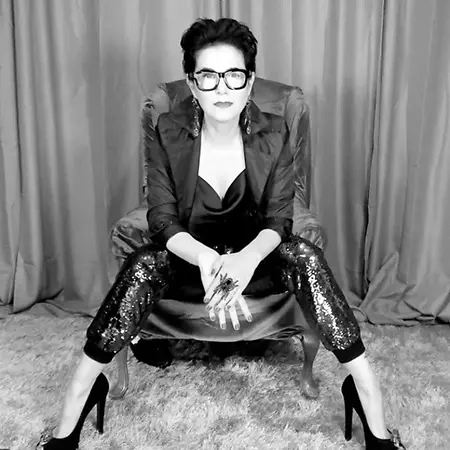
Her Story
About Susan
I've been working in behavioral and neuroscience consulting since I was 17 years old, which spans approximately 36-37 years of my career. My journey has been unconventional. I started as a political influence consultant for 18 years, working across Europe, Latin America, and the United States. I was brought to the United States in 2000, just before 9/11, and was offered to stay. When I was 40, I burned out and stopped being a consultant in that field. I then became the only civilian hostage negotiator in the world. After that experience, I had the opportunity to go to Israel to study elicitation and interrogation, which I found fascinating, but I realized there wasn't a market for that where I could get the lifestyle I wanted. So I ended up going to corporate America, mixing behavior, interrogation, and negotiation. Since my 40s, I've been driving women to my consulting practice, helping them not to be interrupted and to be the boss in the room in companies. I work extensively with manufacturing, construction, finance, pharma, and medical device industries, basically with women who want to move forward in their careers. This work led me to get my first master's in behavioral economics, and I'm currently finishing my thesis on my second master's in neuroscience and neuromarketing. All of this knowledge is applied to help people conquer what they need. I'm a minority, born and raised in Latin America because my parents were diplomats. I have an extremely strong accent because of dyslexia, which people don't understand as a speech impediment. I'm a Jewish divorcee, my passport says Latina even though the government brought me here and made me a citizen, and I have Asperger's, which makes networking and relationship-building difficult. But I got to the top of my field by owning what I bring to the table, not by crying or compromising my values, but by showing my strength and earning respect.
Her Interview
Ten minutes with Susan
01What do you attribute your success to?
I attribute my success to failing early and learning from it. When I was young, at 17, I finished high school early and ended up going to college at that age. They told me I have dyslexia, so a career in academia wasn't going to happen. It obliged me to say, okay, you either die or survive here. I had to make money, and I ended up in a better place than I was expecting to be because I wanted to be a profiler for the FBI, but I ended up training the FBI instead. I failed, and instead of pampering myself and crying in the corner, I said okay, I have two options. Some people are going to get to their destination flying in first class, and others are going to need to be swimming with sharks. If I'm going to be swimming with sharks, it's going to make me stronger. Mistakes are when you keep doing the same thing and you don't learn anything from them. If you look at something that's bad, that's a possibility to do it better. I learned that you're on your own, which means you're stronger when you're in a group, but you need to have a persona that people want to pair with you. You need to start with your own oxygen mask in order, and you're not going to gain respect in a room because you say so, you need to show it.
02What’s the best career advice you’ve ever received?
One of the things I learned in the military is that you are on your own. That means that you're stronger when you're in a group, but you need to have a persona that people want to pair with you. You can't be a drag on them all, and then people are going to follow. But you need to start with your own oxygen mask in order, and you're not going to gain respect in a room because you say so, you need to show it. I was told early on that I needed to be the toughest cookie in the room, but I realized that being a woman is an advantage, not a disadvantage, if you know how to use it and how to coach others to use it. From hostile negotiation to military to politics to manufacturing, I made a career being at the top of my game as a woman, because I was a woman. Nobody would see me coming.
03What advice would you give to young women entering your industry?
My goal is to help women understand that being a woman is an advantage, not a disadvantage, if you know how to use it. Women are 82% more accurate at reading the room and body language compared to men who are only 42% accurate, according to the latest studies from Harvard and Yale. Imagine if you give the right training to a woman what she can conquer, instead of being afraid to speak up and not being heard in the room. Stop the victimology mindset where someone else is responsible, because that's not going to take you anywhere. You need to learn that you are on your own, which means you're stronger when you're in a group, but you need to have a persona that people want to pair with. You're not going to gain respect in a room because you say so, you need to show it. Use your superpowers and your natural reading abilities. I got to the top of my field not by crying or sleeping with anyone, but by owning what I bring to the table. If I can do it as a minority, a Latina with an accent, dyslexia, Asperger's, and a Jewish divorcee, having gone through all the difficulties, then let me help you stop whining and start doing. Sometimes saying no is saying yes to a better option.
04What values are most important to you in your work and personal life?
The most important values to me are understanding priorities and boundaries. I do a deep dive on my priorities with the people I work with and my clients, and I train them on what is an emergency, urgency, and what can wait. Emergency is 911, like you lose an arm and you need me right away. Urgency is like 411, I need you in a short period of time. And if something can wait, like if I'm burned out by 2 p.m., you're going to need to wait until the next day. I need my clients to understand that sometimes saying no is saying yes to a better option. You really need to be conscious and ask, okay, is this really an emergency, or is it your emergency? I also value being grounded and in contact with nature. I wake up at 5 o'clock, feed my cats, get back in bed with my breakfast, and play with them because that gives me dopamine and oxytocin for the day. I take walks on the beach and in the forest because there are physiological and biological benefits to being in contact with the green and the natural processes. I value taking breaks and understanding that sometimes I cannot be an adult today, and that's okay. You need to start with your own oxygen mask in order before you can help others.
Join Influential Women and start making an impact. Register now.