Her Story
About Suzanne
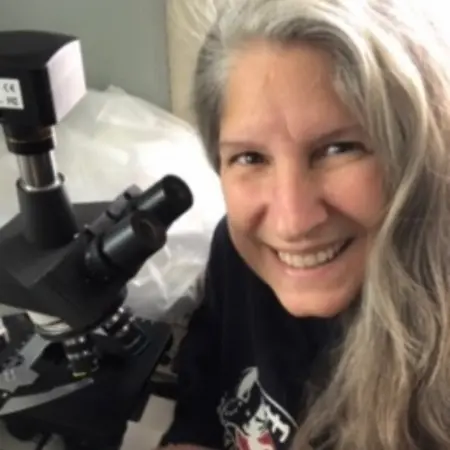
Suzanne Shea is the Founder and CEO of Regenerative Agriculture Solutions, where she helps farmers and gardeners improve soil health, productivity, and sustainability using native microbial methods and regenerative agriculture practices. She is also a farmer at Old Sword Farm, where she applies her decades of hands-on experience to transforming challenging soils into productive farmland. Growing up on a 366-acre dairy farm in Maryland, Suzanne immersed herself in agriculture, taking every ag-related course in high school with the expectation of inheriting the family farm. When her parents sold the farm at auction just three months before her graduation, it was a turning point that led her into a career in travel, where she met her husband, a military serviceman. Over the next 32 years, Suzanne dedicated herself to homeschooling their eight children while managing household finances and family life.
In 2020, during her youngest son’s senior year, Suzanne experienced a severe car accident that left her with serious brain injuries. She had to relearn basic skills, including walking, math, and speech, through intensive therapy. During her recovery, Suzanne discovered soil microbiology, using microscope work as a form of brain rehabilitation. This passion quickly became her vocation—she completed the Soil Food Web School certification program with distinction in just a few months, earning praise from Dr. Elaine Ingham as one of her star pupils. Today, Suzanne applies her expertise nationwide, examining living soil microbes under the microscope to help farmers reduce input costs, restore soil biology, and grow healthier, more flavorful food.
In addition to her consulting work, Suzanne remains deeply connected to her roots, contributing to the restoration of her childhood farm, now owned by an Amish family. Passionate about education, she brings her microscope into schools to teach students about soil regeneration, including donating equipment to a flood-damaged school in North Carolina for a three-year soil study. Her lifelong dedication to farming, education, and regenerative agriculture reflects her commitment to healthy soil, healthy food, and thriving communities.
Her Interview
Ten minutes with Suzanne
01What do you attribute your success to?
Growing up on a dairy farm in Maryland and having that connection with farming and all the success and nutrients it brings and wanting to share that with others. Having a loving family that pushes me to be my best.
02What’s the best career advice you’ve ever received?
Not to undervalue yourself. Listen for the problem in order to find the solution. I definitely feel that listening, making sure you're listening for the problem is the best professional advice across the board, at work and at home. Always listen. My whole job is observing. If I'm not good at being still and seeing what's happening around me, I can't do my work. I'm kind of a soil detective in a sense, testing for compaction and figuring out what kind of practices were used before by looking at the compaction layers at different depths.
03What advice would you give to young women entering your industry?
Set your goals and don't give up. People always talk about finding your why, and I've always hated that because it's such a big homework assignment. Sometimes you just don't know why you do it. For me, I didn't know why, I just did it because it was helping. I wanted to make my soil better. Set small goals and stick with it. My original goal was to fix my farm, and then the more I learned, I needed to tell people about this. Just like when you find a good sale, you want to tell all your friends. The neat thing is, there's not a single person that farming doesn't affect. We all eat. When I found out how much better the food tastes when you use microbiology to correct the soil, I had to share it. It's important to understand farmer culture. They're following what they were told to follow by experts who studied and trained. They're just doing what they learned, just like I am. I'm just recommending what I learned, which happens to be observing nature and constantly trying to mimic nature.
04What are the biggest challenges or opportunities in your field right now?
There are so many opportunities because right now there are only a hundred-some of us that do soil microbiology. I just sat in on the Pennsylvania State Technical Advisory Committee meeting, and every project they reported on, I kept asking if they assessed the soil microbiology before and after their studies. They hadn't thought about it because there wasn't someone who did that. I suggested doing a soil microbiology demonstration where they look at actual soil under the microscope and share it on screen so people can see what living microbes look like. The biggest challenge is that we need to develop a customer base where people know this exists. I'm working on a trademark certification that I can give to my growers so consumers can start saying this is what they want, and then more farmers will want to do it. We've lost the equivalent of 77 farms a day over the past 5 years, and about 41 farms a day this past year. We need to rescue farmers. There's no profit margin in farming right now because input costs are so expensive. Farmers can't risk losing any profit on something that may or may not work, even though the old thing is not working for them. In dairy farming, we were making $14 per 100 pounds in 1981, and right now farmers are only making $16, just $2 more after 40 years. When you consider that gasoline has more than quadrupled in price, it's ridiculous. We need to let farmers know that when food is more nutritious, you don't need as much because you're more satisfied.
05What values are most important to you in your work and personal life?
My faith is my most important thing. I like to try and follow what God's Word says as best I can. Other values include honesty, endurance, and compassion. I pour a lot into my job now because I feel for these farmers. I know what it feels like to not have the farm anymore, to drive away from it the final time, and I don't want people to have to have that feeling. You have to take into consideration that farmers are following what they were told to follow by experts. Consumers are condemning farmers and accusing them of polluting our foods and land, but farmers are just doing what they learned, what's been the way of life since the 1950s. They're just recommending what they learned, just like I am. I have respect for natural things and I'm constantly trying to mimic nature.
Join Influential Women and start making an impact. Register now.