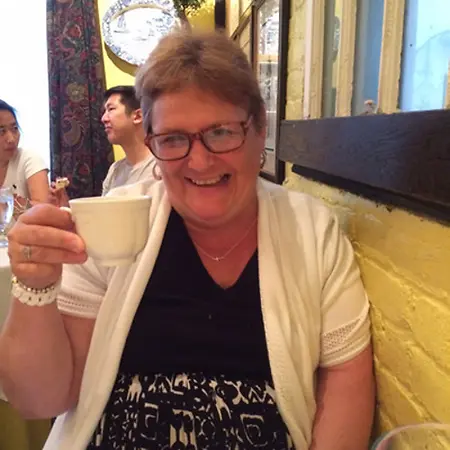
Her Story
About Suzi
Suzi Tomasulo is a retired social worker who spent four decades dedicated to serving developmentally disabled children and adults and the families who support them. Drawing personal inspiration from her own experience living with cerebral palsy, she built a career centered on helping parents navigate the emotional and practical challenges of raising a child with a disability, offering counseling, education, and steady reassurance during some of their most difficult moments. Her professional path spanned multiple settings, including eighteen years in a clinical role at Long Island College Hospital's Lamm Institute, thirty-two years as a part-time residential social worker with the Block Institute, two years in a rape crisis program, time spent at Lamm Preschool coordinating with interdisciplinary teams, and a final stint at iBrain before her retirement. Throughout her career, Tomasulo credits much of her professional growth to her supervisor at Long Island College Hospital, Iris Gerson, who mentored her in handling complex family situations and connecting clients to essential resources. She became known among the families she served for her trustworthiness and accessibility, at times fielding calls at home from parents seeking guidance during major transitions, such as a child's move to a new group home. Her responsibilities over the years included interviewing parents ahead of developmental evaluations, collaborating with teams of physical, occupational, and speech therapists, running parent support groups, and assisting families with concrete needs such as Medicaid, Medicaid recertification, and guardianship arrangements for their adult children. Tomasulo holds a Bachelor's degree from New York University and a Master of Social Work from Fordham University's School of Social Work at Lincoln Center. Since retiring, she has continued to informally mentor seniors at her local community center and has pursued her lifelong passion for art, particularly collage work, with a piece displayed at the Brooklyn Museum. Reflecting on her career, she remains a strong advocate for compassion and human connection in social work, encouraging the next generation to approach the field with emotional resilience and a genuine desire to help others.
Her Interview
Ten minutes with Suzi
01What do you attribute your success to?
I attribute my success to the mentorship and guidance of my supervisor, Iris Gerson, at Long Island College Hospital. She taught me how to work with parents, connect them to the right resources, and handle difficult situations with confidence. I truly loved my work there for eighteen years — it became my life.
02What advice would you give to young women entering your industry?
My advice is to take a deep breath, because this work is going to be emotionally demanding. You have to be able to step back, ground yourself, and accept that not every outcome will be a happy one — some situations, like working with individuals with Down syndrome, can involve real sadness, including loss. You need a special kind of heart to do this work, one that can hold both the joy and the grief that come with it, and you should only pursue it if you genuinely care about the people you're serving.
03What are the biggest challenges or opportunities in your field right now?
The biggest challenge social workers face today is the pressure of heavy caseloads combined with constant connectivity — cell phones, computerized systems, and a lack of administrative support — which has reduced the amount of genuine human contact in the work compared to the slower-paced methods I started with. At the same time, the greatest opportunity and reward is watching children and clients make real progress, whether that's learning to walk, learning to read, or achieving something their families once thought was impossible. Seeing the joy on a parent's face in those moments makes the work worthwhile.
04What values are most important to you in your work and personal life?
Compassion, active listening, and human connection are the values I hold most important. I've always believed in making families feel comfortable, informed, and supported, and in preserving genuine human contact in a field that increasingly relies on computers and paperwork instead of people.
Join Influential Women and start making an impact. Register now.