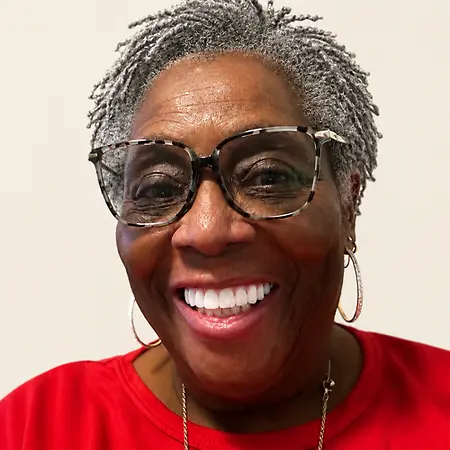
Influential Woman · Owner SMD Publishing Group
Sylvia Marie Dyson
Startup owner focusing on AI operational excellence consulting, SMD Publishing Group
Los Angeles, CA 90045
Her Story
About Sylvia
I worked for AT&T for 26 years doing a variety of tasks across 8 jobs. I retired in 2012 after surgeries and disability. After recovering I got interested in AI and started SMD Publishing Group LLC last year in 2025. I have a draft book called Conflict Without Damage and am working on an AI operating system for operational excellence consulting. My education is from A.B., Stanford, CSUN - Women in Engineering, Electrical Engineering Certificate , MBA USC and Masters in American Intercontinental University
WHEN SHE REALIZED HER JOURNEY COULD HELP SOMEONE ELSE
"I've never been a teacher. Or I've always been one."
I tutored my classmates starting in second grade. I did not know it as a calling then. I only knew a friend struggled with a problem and I understood it, so I explained it. That pattern repeated for years: tutoring my cousins' children in reading and math over summers, volunteering in high school Junior Economics, Algebra through Calculus, and American Literature classes, then spending three years at a neighbor's kitchen table on Saturdays teaching their child high school math. Each one teach one is not a phrase I picked up. It describes what I have done since I was young.
I sat in rooms with LAPD officers on the Community Police Advisory Board long before I called myself an advocate for anything. I was a woman who believed two sides of the same street could understand each other if someone built the table. I brought what I knew from managing people, listen first, name the real problem, let both sides keep their dignity, into conversations about trust between police and the community they served.
Leadership Development in Interethnic Relations, sponsored by the Asian Pacific American Legal Center of Southern California, the Central American Resource Center, and the Southern Christian Leadership Conference, trained leaders to work for change in their own communities and institutions. My cohort built a web page for a teacher and taught her to keep it updated. We also worked with a local Girls Club. The program reminded us that people share more than we admit, and that racial division is man made, built on misconceptions and false assumptions. Good and evil exist in every race.
Days of Dialogue taught me the same lesson from another angle. Strangers of different races sat across from each other and said the hard thing out loud. I watched people who arrived guarded leave changed, not because anyone won an argument, but because someone finally listened.
I saw it again running conflict resolution at a teen weekend camp. A camper who solved every disagreement with his fists learned, over one weekend, to solve disagreements with words instead. Different beliefs were allowed to exist in the same room.
The tools I used to help a Pacific Bell supervisor resolve a grievance were the same tools that helped a teenager walk away from a fight, and the same tools that helped a police commander sit across from a skeptical resident.
This work did not stay one on one. I brought my conflict resolution frameworks, problem solving methods, and emotional regulation training to a guest lecture at the Pat Brown Institute for Public Affairs at CSULA. My background in process improvement and problem solving techniques shaped how I approached community problem solving. The work of our LAPD 77th Street Community Police Advisory Board was presented at an LAPD officer conference and again at CSULA.
I carried this into my work as a Stanford alumna too. I served for years as Secretary of the Stanford Black Alumni Association of Los Angeles, attended college fairs to represent my school, and conducted applicant interviews for students from our community. When Stanford admissions needed readers for applicant essays, I read them. When the Southern Christian Leadership Conference asked for volunteers to score papers for their scholarship contest against a rubric, I said yes. If what I have learned shortens someone else's path, I will keep handing it over.
That work continues today. I am building an Educator Operating System to support CASEL tools in classrooms. Advances in agentic AI and vibe coding are accelerating my timeline to finish it.
Sylvia Dyson, Founder, Kind Kids Press
Her Interview
Ten minutes with Sylvia
01What do you attribute your success to?
A true desire to still contribute. After going through depression when disabled, AI has allowed me to contribute to society again and be a role model for my son and grandson by not letting obstacles stop you.
I grew up in South Central Los Angeles, the youngest of four children in a home where faith, family, and perseverance defined our days. My parents were married for nearly thirty years, and though their paths later diverged, the foundation they built — one of love, discipline, and hope — never left me.
I was raised in the Mennonite Church, where I learned that peace is not passive. It is practiced. It is lived. Those quiet teachings of humility, service, and grace shaped the way I see people and the way I listen to the world.
As a child, I wore full-length leg braces and couldn’t play outside like other kids. While others ran, I read — and in the stillness of those early years, books became my landscape. Stories gave me wings long before I could move freely on my own. I discovered math and logic and fell in love with the elegance of problem-solving — the kind of thinking that reveals order within chaos.
That love of structure and curiosity never faded. I graduated high school at sixteen and entered Stanford University, where the world suddenly widened. I later earned an M.B.A. from the University of Southern California, a Master’s in Information Technology, and certifications in Project Management, Six Sigma Black Belt Agile, Scrum, and Lean Systems. Yet no matter how technical or analytical my work became, the thread of communication — of connecting hearts and ideas — remained at the center.
Outside of boardrooms and data systems, I’ve been a Sunday School teacher, a choir director, a mentor, and a student of life itself. I’ve danced Afro-Haitian rhythms, studied acting and voice, and wandered behind a camera searching for the light that God has made. Every form of expression — dance, photography, writing — has been another way to understand grace.
02What’s the best career advice you’ve ever received?
Go back to school and get your M.B.A.
Don't wait till it's perfect. Act and then adjust. Do it now. It’s still not my nature and I fight against a perfectionist ideal even now.
03What advice would you give to young women entering your industry?
Try to get a mentor. If you don't have one, that's no reason not to go for it. Having a mentor would have helped avoid some mistakes like draining personal funds.
04What are the biggest challenges or opportunities in your field right now?
Personally I have run out of funds and ran my credit to the ground. I'm asking AI for ways to earn more money like putting together a course or webinar. I’d rather spend time on my major project. I also have new health challenges, different from the mobility issues and neuropathy I’ve faced most of my life. My severe eczema and immune system challenges impact my vision and hearing making it difficult to complete some of my “loop designing” tasks. I also experience facial distress that would hinder my confidence when interacting with others. However, that just means I may have to adjust timelines more than I would like and prefer to have more completed and autonomous services than maintenance services because my availability varies.
05What values are most important to you in your work and personal life?
Peace is very important to me. I grew up Mennonite and believe peace is a verb. Conflict resolution and emotional regulation are key, staying calm and taking interactions to a logical level while teaching tolerance and character values. Family, faith and education are all important to me. I believe education comes in many formats and a journeyman is just as knowledgeable as a P.H.D. Value has been assigned by those in power to do so. There is a higher power that made no mistakes in the creation of man/woman. Everyone is of value and has a story to tell. I believe in living the parable of the talents. I shouldn’t hide the talent but seek to use it and multiply it until my day of reckoning.
Join Influential Women and start making an impact. Register now.