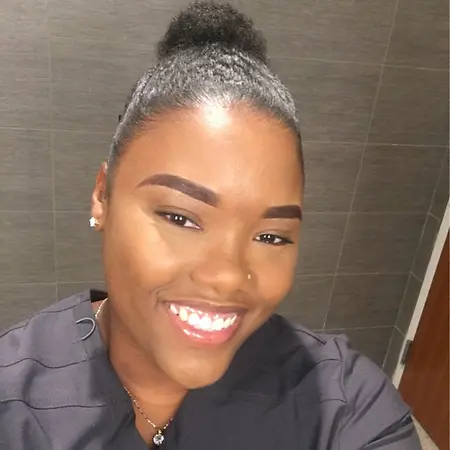
Her Story
About Ta' Kara
I've been working as a cardiac sonographer for about 6 to 7 years now, and it's been quite a learning experience. I came from a completely different background as a 911 operator, so transitioning from the non-health field into the health field was different, but in many ways still the same because I'm still serving people and helping them. The core of what I do hasn't changed - whether I was helping people by dispatching police officers and emergency responders, or now helping them while I'm scanning to see if we can find anything that they need to get taken care of. What made me decide to pivot into healthcare was my son. At the time he was young, and my job as a 911 operator was really taking my time away, so I needed to find something different. I'm not a stranger to healthcare - my mom was a CNA when I was growing up, and I had friends who transitioned into nursing school, so I'd been around it. Originally I wanted to do OB and work with babies, but I ended up getting into cardiac sonography and just kind of stayed doing that, and I've been doing it ever since. A typical day for me starts with setting up my room - making sure everything is clean, linens are put together, my machine is on, and I have all the supplies I need for the day. I check my schedule to make sure what I have matches what's on the screen because things can change overnight. At my current facility, we get an hour per patient and I can scan 8 patients. I look at their heart based on whatever indication is on their encounter form, following the same protocols but changing things up when they have arrhythmias, valve issues, fluid around the heart, things like that. Towards the end of the day, I make sure all my reports are done, charts are ready for the next day, and my room is stocked up so when I come back in, my day can run smooth. One of my most notable achievements is being able to train students as a preceptor. They come in for about 4 to 6 weeks, and I get to mold them, show them what it's like on the job, let them scan, give them tips, help them study, answer their questions, and critique the way they scan while explaining the why behind what they're doing.
Her Interview
Ten minutes with Ta' Kara
01What do you attribute your success to?
I definitely attribute my success to my support system, one, because without them, I wouldn't have been able to get through school and be here today. And then two, myself. I'm very determined - if there's a goal I need to meet, if there's something that I want, I'm gonna make sure I get it done, I'm gonna make it happen. I don't let anything get in my way when it comes to that.
02What’s the best career advice you’ve ever received?
The best career advice I've ever received was don't give up, be consistent, stay persistent, and it will click. One day you're gonna be scanning, and everything you learned, plus what you're doing, it's just gonna mesh together and make sense. Like, a light bulb will go off for you.
03What advice would you give to young women entering your industry?
I would definitely tell them, you know, it's not a super male-dominated field, but a lot of the doctors are males, so I would definitely say don't get discouraged. If they, or anybody, is pointing anything out as far as your scanning, or what you're looking at, or you're not getting the right information, I wouldn't let that get me down. I would say, okay, let me take some notes, see what they want, and then I would go back and critique my own work. It's all learning - it is definitely a learning process, and it definitely comes with time, and as long as you keep doing it, keep staying consistent, you're just gonna get better, you're gonna improve. And definitely don't be afraid to ask questions. Especially from older techs - when they give you information, hold it like gold, because some people are afraid to share their knowledge, but when you get a tech that's been doing it 20 years and they're telling you tips and tricks, I kind of keep those in the back of my pocket.
04What are the biggest challenges or opportunities in your field right now?
The opportunities in my field right now are that the job market has a real need - there's a lot of travel opportunities if you're willing to travel. As far as challenges, I would say maybe the hours if somebody didn't want to work 12- or 10-hour shifts. But other than that, there are a lot of 8-hour positions, 5 days a week. I don't like to work 5 days a week because I do like one day off, so I prefer 10-hour shifts. But you definitely can find something that accommodates your needs.
05What values are most important to you in your work and personal life?
For me, it's definitely treating the patients like family. I am big on making sure the patient's comfortable, making sure that they are okay. I check on the patient throughout my scan. I just would treat them how I would want somebody to treat my loved one if they were coming in to the office, or hospital, or anything of that nature.
Join Influential Women and start making an impact. Register now.