Her Story
About Tamara
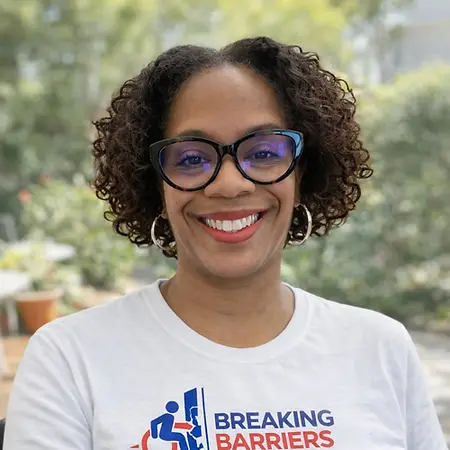
Tamara Maze Gallman is a strategic communications executive, nonprofit founder, and disability inclusion advocate whose work bridges public health, media strategy, and lived experience. She currently serves as an Associate Director of Communications at the CDC’s National Center on Birth Defects and Developmental Disabilities, where she leads cross-platform communication strategy, including earned media, campaigns, social media, and internal communications. With an academic background that includes a master’s degree in marketing from Johns Hopkins University and a bachelor’s degree in radio-television communications from the University of Houston, she combines data-driven strategy with human-centered storytelling. Her professional journey is deeply shaped by both her extensive career in public health communications and her personal experience as a spinal cord injury survivor following a life-changing natural gas explosion in 2011. That experience shifted her focus toward disability rights and health equity, ultimately inspiring her to found Disability Partnerships in 2016.
Through this organization, she works to improve quality of life for people with disabilities by expanding access to health and wellness programs, education, affordable accessible housing and economic opportunity—while intentionally keeping services free and accessible to those who need them most. Across her work, she is recognized for her commitment to inclusive systems change, strategic storytelling, and advocacy that centers dignity and access. She has built Disability Partnerships into a national initiative serving thousands of participants and continues to expand programming that addresses both physical and mental health needs within the disability community. Her leadership reflects a consistent focus on ensuring that people with disabilities are not only included in policy and conversation but meaningfully supported in everyday life.
Her Interview
Ten minutes with Tamara
01What do you attribute your success to?
I attribute my success to my faith, my commitment, my education, and a deep sense of purpose. My graduate degree is from Johns Hopkins University, where I studied marketing and public health, and my undergraduate degree is in speech communication from the University of Houston. So much of my professional career has been centered around communications — how we tell stories, build trust, educate communities, and connect people to information that can improve their lives.
I began my federal career through the Presidential Management Fellows Program, which was created to develop future leaders in government. That experience helped shape how I think about public service and leadership. Over the years, I worked in communications roles supporting national programs in tobacco education, health and wellness, infectious disease, disability, developmental disabilities, and blood disorders like sickle cell disease.
But my work became deeply personal after I sustained a spinal cord injury in 2011. After my injury, I started seeing the world differently. I saw how many barriers people with disabilities face every single day — barriers to health, transportation, wellness, independence, community, and opportunity. I also understood how easy it is for people to feel isolated or left out when programs are not designed with us in mind. That experience changed me. It helped me understand what access really means. And it became part of my healing journey.
That is why I started Disability Partnerships. What began with seven participants has grown into a national disability-led nonprofit serving more than 4,000 participants through accessible health, wellness, education, and community-based programs. And that growth did not happen because of me alone. It happened because of the trust, support, and participation of the community we serve.
I have never taken a salary from the organization. I have built much of this work in the evenings and on weekends while working full-time — sometimes from hospital rooms, rehab settings, and during difficult recovery periods. There have been late nights, sacrifices, and moments when I wondered how I was going to keep doing all of it. But then I get an email from a participant who says that because of our adaptive classes, she can now wash her own hair again. And when I read something like that, everything becomes clear. That is why the work matters.
For me, success is not just about titles, degrees, or professional accomplishments. Those things matter. But I believe real success is using what I have survived, what I have learned, and what I have built to make someone else’s life better.
02What’s the best career advice you’ve ever received?
I have had so many wonderful mentors. Who have helped guide me and showed me better ways of doing things. One piece of advice that sticks out came from a communications mentor I had at CDC, Katherine Lyon Daniels, who has since passed away. She helped train me on communications and public health and messaging, and she was just excellent at designing programs that would help resonate with people and help them understand their needs. As you probably know about public health, the science is important, but you have to also be able to communicate that science. That perspective has shaped everything I do in terms of how we share information, how we reach communities, and how we advocate effectively.
Beyond that, I've been guided by the communities that have poured into me through my involvement with Alpha Kappa Alpha Sorority and my church, where I've been surrounded by leaders who embody service, resilience, and excellence.
03What advice would you give to young women entering your industry?
To young women who want to launch a nonprofit, I would say do the research first, make sure you have a true commitment to your cause.
It can't be just your desire to do something because you think it's a good idea - you have to really be committed. A good idea, yes, is important, but the commitment is more important, because there are going to be many times where you don't get funding or support. There will be many more "no" answers to requests than "yes" responses. But you keep trying. And you keep trying because you believe in the work you are doing.
You always make decisions with the people you serve in mind. I have made intentional decisions to ensure our services were always free.
04What are the biggest challenges or opportunities in your field right now?
I think the biggest challenge right now is the reduction in funding. With this economic climate, the nonprofit community has been very concerned about the lack of funding and increase in expenses. There are a lot of really great programs out there that help many people. But unfortunately, with the funding squeeze and rising costs, it's made it very difficult. It's also more of a need for organizations like mine. People cannot afford basic healthcare services. That's one of the key challenges, trying to help people who already feel the strain of everything.
05What values are most important to you in your work and personal life?
The most important value to me is helping others and showing what's possible even after devastating life changes. Part of my healing journey was helping others, and that has been the case all of these years - trying to focus on other people's needs and not my own. I want people to understand that even with a devastating injury that is life-changing, you can still thrive.
Join Influential Women and start making an impact. Register now.