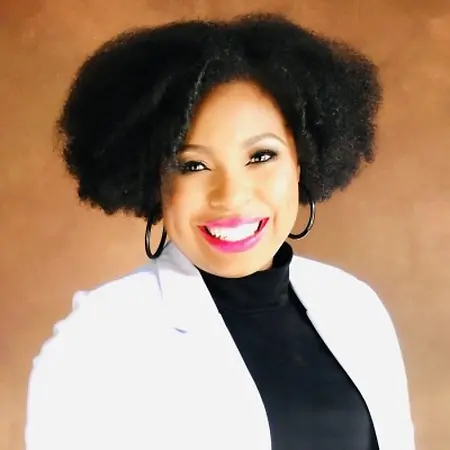
Her Story
About Tamira
My work in nonprofit and policy was inspired by my own lived experiences growing up in Tennessee. When I was in elementary school, my high-performing school was shut down due to asbestos, and I was zoned to a school with a longer commute, fewer resources, and poor infrastructure. Watching my mother and grandmother fight for my education lit my fire at an early age to become not only an educator but also an advocate in the public policy space. I bring the lens of what impacts our kids and families - including social services, mental health, and domestic violence - to the policy space, helping decision-makers understand that when you see a school of kids, you're seeing what impacts their home life, their family, their generation, and their lineage. Each pivot in my career has been an additional piece of the puzzle to create a whole picture of how we really create better equity and service of humanity. As co-executive director, I manage teams across 10 cities, support elected officials in their policy strategy, oversee culture and fundraising, facilitate leadership development programs, and am currently leading a massive transformation of the Urban Leaders Fellowship including a name change. My day-to-day involves everything from meeting with regional directors and elected officials to managing our 90+ regional partners, supporting our fellows, working with major donors like the George Kaiser Family Foundation, and serving on advisory committees like the one working with Tulsa Mayor Monroe Nichols on his Indigenous housing and affordable housing initiative.
Her Interview
Ten minutes with Tamira
01What do you attribute your success to?
I think my most notable professional achievement thus far has been the leaders that I have been able to cultivate that have grown other leaders. In my K-12 days, there have been at least up to 22 individuals that I've coached and worked with who have gone on to become principals, become founders, and then mentor and bring on a set of founders themselves. It's been incredible to see what has been poured into me through my mentors and through other leaders, and I've been able to pour that back into building a strong bench, particularly when I think about our women in public policy and in broader spaces. Right now I'm mentoring Dr. T. Michelle Colson, who is on the State Board of Education in Washington, D.C. Seeing her come through our program, run for office, and achieve it during a big federal election when she didn't think she could do it herself, and now seeing her bringing on a newer bench of leaders to not only fill her seat but also run for governor and other spaces - that, for me, is everything in terms of the biggest career achievements to date. I hope to be blessed even more to mentor and advise and support and keep cultivating bigger circles of influence and impact of more leaders to come.
02What’s the best career advice you’ve ever received?
I'm only here talking to you today because my predecessor, who's also one of my incredible mentors, looked at me and said in a meeting, I see so much more than a school leader who's putting out fires with kids. I see a national leader of an organization. I see someone who other women are gonna look to, they're gonna lead, they're gonna follow. We didn't sit down and nitpick my resume. She just said, give me what you have, and we'll let time and space and the interview process dictate the rest, and the rest is history. That moment taught me that sometimes the best advice comes from someone who sees your potential before you fully see it yourself, and who encourages you to just take the leap without overthinking every qualification.
03What advice would you give to young women entering your industry?
The advice I would give young women in my field today is just do it. Oftentimes, you will always find a way to talk yourself out of something and make excuse or delay of not being qualified enough when your own lived experiences and who you are in a space is enough. There's not a single person on this planet, even if they do check off every single box for their field, for their industry, for their job, it doesn't mean that there isn't experience or something they haven't been exposed to, or they haven't been met with a challenge. So there's always something new on the horizon, and we can always berate ourselves about having enough this, having enough that. There is a statistic that men, on average, around 72-75% of them may not meet no more than 40% of a job description bullet or criteria, and they'll still apply. They'll apply, they will go into the interview, they will go into the space, they will have coffee with great confidence that they are the right person and the right fit for the job, and they'll dominate. I highly encourage any young woman who is seeking to be the best version of herself and show up as an executive director or a CEO or a company, if you're thinking it, do it.
04What are the biggest challenges or opportunities in your field right now?
I think there are several major challenges and opportunities. Number one is commitment - how do we service other people in true authenticity and through true care through the market and through the workplace. The very first challenge in that is people understanding why their work exists, and what problems their work should be aiming to solve on behalf of others. The third challenge is that we've kind of become insulated since COVID, and the collective impact of people only comes together when it is a crisis or when there is a demand for change, rather than that being a way of life. When I think about my work in schools, public policy at the local, state and federal level, and in sustainability, the thread is a shared sense of life, a shared sense of duty and community. We all have to recognize that whether you're a doctor, whether you're a barista, whether you are working at 7-Eleven, we all have a purpose and value to serve each other, and that should be the basic commitment. Until we recognize that and break through silos and understand that it takes more than just the willingness but consistent, persistent action toward the future you want to see, it's going to be hard to achieve that. We're encountering weaponization of other groups, weaponization of policy, mistrust and credibility in our schools, in our public spaces, and in the average citizen. These are three root causes that have to deeply be tackled to solve the mindset and focus shift of where our society has ballooned to.
05What values are most important to you in your work and personal life?
The values most important to me center around equity, service to humanity, and creating a shared sense of duty and community. I believe we have to all recognize that whether you're a doctor, a barista, or working at 7-Eleven, we all have a purpose and value to serve each other, and that should be the basic commitment. My work is driven by the belief that we need to create better equity and service of humanity in the best way possible. I also deeply value character, integrity, and dignity in doing great work on behalf of others. Each pivot in my career has been an additional piece of the puzzle to create that whole picture of how we really create better equity. I want us to be a much better world for our young people, a much better place for us to thrive and grow and envision what the next century will look like. I believe that we not only need to say we're the change that we seek, but we need to be the change that we seek through our values, and that needs to be lived in how we work.
Join Influential Women and start making an impact. Register now.